
20.06.1839–17.09.1915
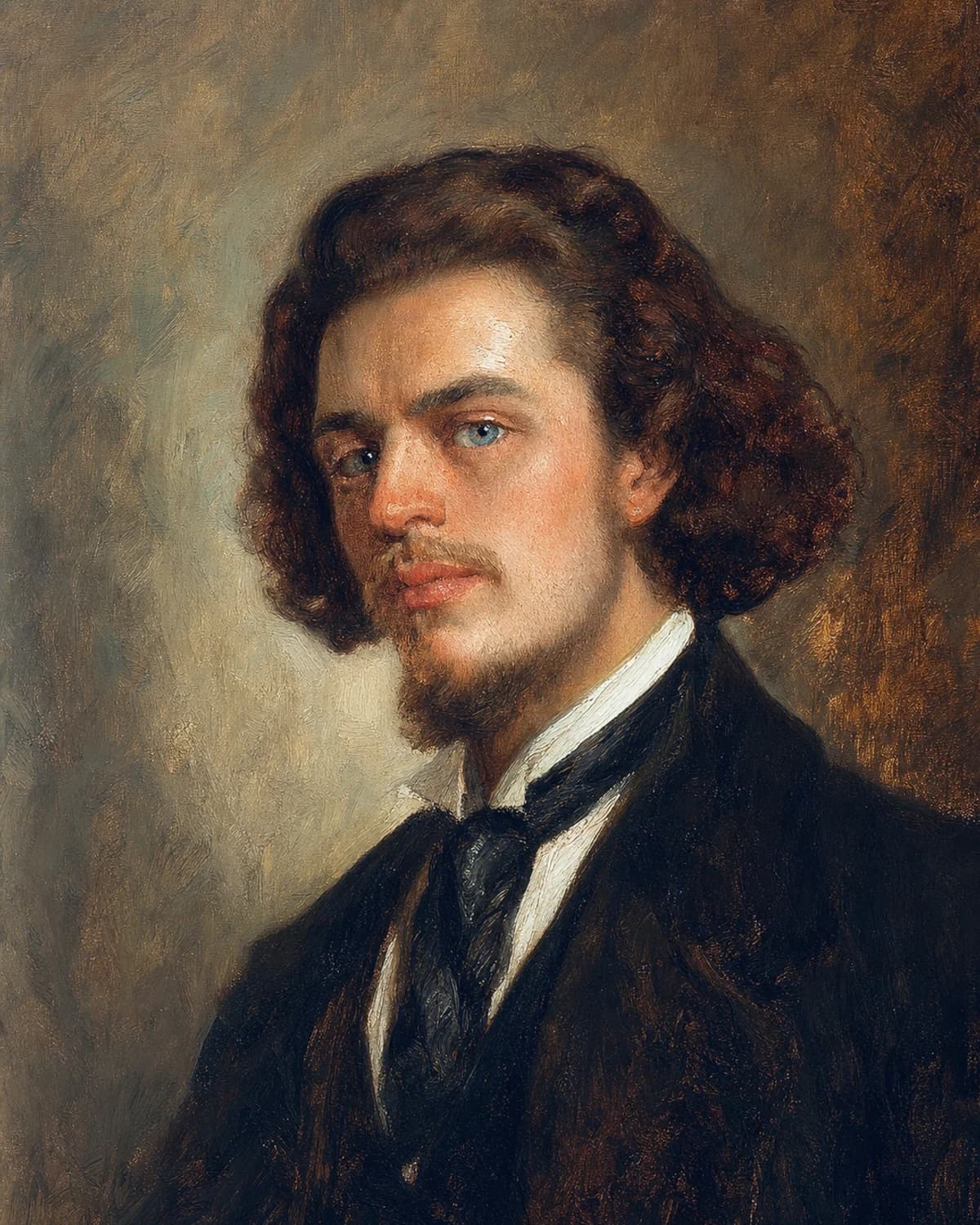
Konstantin Makovsky
Konstantin Makovsky (1839–1915) began as one of the “rebels” of 1863 and a founder of the Society of the Peredvizhniki, and became the most fashionable salon painter of post-reform Russia. He painted boyar feasts and weddings, mythological ceiling paintings and formal portraits of the imperial family and the aristocracy. “Minin’s Appeal” (1896) is considered the largest easel history painting in Russia.
Biography
In 1896, at the All-Russian Industrial and Art Exhibition in Nizhny Novgorod, Konstantin Makovsky showed “Minin’s Appeal”, a canvas measuring 698 by 594 centimetres. Russia had never before seen a larger easel history painting.
He had started out with pictures of quite another kind.
Makovsky was born on 20 June (2 July) 1839 in Moscow. His father, Yegor Ivanovich, a civil servant, amateur artist and collector, was one of the founders of the life class on Bolshaya Nikitskaya Street from which the School of Painting and Sculpture grew. His mother, Lyubov Kornilovna, née Mollengauer, sang soprano and later taught singing at the Moscow Conservatory. The house held literary and musical evenings, and the guests included Karl Bryullov, Glinka, Gogol, Tropinin and Shchepkin. Konstantin copied engravings, played the piano well and sang. His elder sister Aleksandra and his younger brothers Nikolai and Vladimir also became artists. In 1851, aged twelve, he entered the Moscow School of Painting and Sculpture, where he studied under Mikhail Scotti, Apollon Mokritsky and Sergei Zaryanko. He himself said that he owed everything “not to the Academy, not to the professors, but solely to my father”.
In 1858 Makovsky moved to St Petersburg, to the Imperial Academy of Arts, where his teachers were Aleksei Markov, Fyodor Bruni and Pyotr Shamshin. From 1860 he took part in the Academy’s exhibitions. In November 1863, together with other students led by Ivan Kramskoi, he refused to paint the set subject for the large gold medal and left the Academy. With Kramskoi he joined the St Petersburg Artel of Artists and began painting the street life of poor Petersburg, its poverty and grief, apparently under the influence of Vasily Perov. From this period come “The Widow” (1865) and “The Herring Woman”, for which he was made an academician in 1867. Two years later, for “Folk Festivities during Shrovetide on Admiralty Square”, he became a professor.
Success with the public came quickly. Makovsky left the artel, opened his own studio on Palace Square, and in 1870 joined the Society for Travelling Art Exhibitions and helped draw up its charter; he remained a member until 1883. He painted the harvest and peasant children. With the composer Sergei Taneyev he put out a handwritten humorous magazine, “Zakholustye” (The Backwoods), “free of charge, with no fixed run of issues and with no shame whatsoever”, and the artist drew caricatures for it under the pseudonym Nemvrod Plodovitoe.
Between 1872 and 1877 he travelled several times to Egypt and other countries of North Africa and brought back a great many ethnographic studies. From them he painted “The Transfer of the Holy Carpet in Cairo”, which the Tsesarevich Alexander Alexandrovich bought at the Paris Salon in 1876. In the summer of 1877, during the Russo-Turkish War, Makovsky followed the Russian army through Serbia and Bulgaria and sketched what eyewitnesses told him about the suppression of the April Uprising. This gave rise to the large painting “The Bulgarian Martyresses”.
At the end of the 1870s his interests shifted from social themes to colour and form. The influence of the French salon masters William Bouguereau and Alexandre Cabanel and of the Englishman Lawrence Alma-Tadema is noticeable. At the 7th Travelling Exhibition in 1879 he showed “Mermaids”, and Alexander II bought the picture for the Hermitage. In the 1880s international fame arrived: history and mythological paintings, boyar feasts and weddings, pre-Petrine Russia in an ideal, festive guise. All his life Makovsky collected Russian antiquities, from jewellery and kokoshniks to household utensils, and put them to work as studio props. The artist’s son Sergei recalled that his father bought “beautiful old things” with a connoisseur’s taste but without much discrimination. The paintings became part of the fashion for all things boyar: miniature copies of them decorated pieces made by Fyodor Rückert’s workshop for the firm of Fabergé, and “The Boyar Wedding Feast in the 17th Century” was printed in the United States on boxes of chocolates.
In 1886 Baron Sergei von Derviz commissioned from him ceiling paintings and panels on pastoral mythological subjects for the Great Concert Hall of his mansion on the English Embankment; Henryk Siemiradzki had also made sketches, but Makovsky was chosen. He worked on them for two years in Paris and in 1887 showed them there at the Galerie Georges Petit. At the 1889 Exposition Universelle in Paris he won the large gold medal for “The Death of Ivan the Terrible”, “The Judgement of Paris” and “Demon and Tamara”. Some critics judged him a traitor to the ideals of the Peredvizhniki, the author of showy but shallow works, on a par with Siemiradzki and Stepan Bakalovich. I think the reproach is only partly fair: these pictures never laid claim to anything but beauty.
At the same time he became one of the most fashionable authors of formal portraits. He painted Alexander II (three portraits from life and a posthumous one, 1881), the Dowager Empress Maria Feodorovna, the Stroganovs and the Yusupovs, Ivan Aivazovsky (1887), and the owner of Kachanovka, Vasily Tarnovsky, in the costume of a Zaporozhian Cossack (1884). During a trip to the United States at the turn of 1901 and 1902 he painted a portrait of Theodore Roosevelt; the picture is lost, and only black-and-white newspaper photographs of it survive.
In the 1890s Makovsky moved with his family to Paris and bought a studio there. From 1912 he worked in a large studio on Kamennoostrovsky Prospekt, and in 1915 he was among the founders of the Society for the Revival of Artistic Rus. His son Sergei became a poet and critic, his daughter Elena Luksh-Makovskaya a painter.
Konstantin Makovsky died on 17 (30) September 1915 in Petrograd. He was buried in the Nikolskoe Cemetery of the Alexander Nevsky Lavra; after the revolution the grave was lost. In 2013 a sculpture was put up on Rozhdestvenskaya Street in Nizhny Novgorod: Makovsky at work on studies for “Minin’s Appeal”.
Related context
Associations
Works connected through artistic movements, cultural context and period. Priced works available in this market appear first.








Profile notes
Profile and sources
Image
Artist image
На основе открытого изображения: Konstantin Makovsky; Wikimedia Commons; Public domain.
