
05.12.1861–11.09.1939
Konstantin Korovin
Konstantin Korovin (1861–1939) was among the first in Russia to paint pictures entirely in the open air, with a quick Impressionist brush: northern harbours, Paris boulevards, Crimean roses. For twelve years he was chief designer of the Moscow theatres and changed the very idea of stage decor. After 1922 he lived in France, where he wrote hundreds of stories.
Biography
Savva Mamontov jokingly called two young artists who worked for him at Abramtsevo “Korov and Serovin”. Konstantin Korovin and Valentin Serov had been friends since their student years, and in 1894 they set off together for the North: the Kola Peninsula, northern Norway, Swedish Lapland.
From there Korovin brought back “Norwegian Port”, “St Triphon’s Brook in Pechenga” and “The Coast at Murmansk”, built on delicate shades of grey. From the same impressions he designed the Far North pavilion for the All-Russia Exhibition of 1896 in Nizhny Novgorod and painted ten large canvases for it on the life of the northern peoples. After the exhibition they were hung in the Yaroslavsky railway station in Moscow; in the 1960s the canvases were restored and transferred to the Tretyakov Gallery.
He was born on 23 November (5 December) 1861 in Moscow, on Rogozhskaya Street, into a wealthy merchant family of Old Believers. His grandfather, Mikhail Emelyanovich, was a merchant of the first guild, while his father, Alexei Mikhailovich, had graduated from university and cared more for art and music than for the family business. When his father went bankrupt, the family moved to Bolshie Mytishchi, and there the boy began to draw. His elder brother Sergei also became a painter, and a relative, Illarion Pryanishnikov, taught at the Moscow School of Painting, Sculpture and Architecture.
Konstantin entered that school in 1875, at thirteen, first in the architecture department; a year later he moved to painting, studied under Savrasov and Perov, and became friends with Serov and Levitan. The St Petersburg Academy of Arts, where he went to complete his training, soon disappointed him, and he returned to Moscow, to Vasily Polenov’s class. It was Polenov who brought him into Mamontov’s Abramtsevo circle. From 1884 Korovin worked for Mamontov’s private opera: in 1885, under Polenov’s direction, he painted the sets for “Aida”, then designed “Carmen” and “Lakmé” on his own. He visited Paris more than once in the 1880s and later admitted that in the Impressionists he had found everything he was scolded for at home.
Paris remained one of his main subjects: “Paris. Boulevard des Capucines” (1902, 1906, 1911), “Paris in the Morning” (1906), “Café de la Paix” (1905), night boulevards ablaze with lights. The composer Boris Asafyev said of one such study that the artist “makes his own sensation into Paris”. In 1902 Alexandre Benois recalled how young artists stood before Korovin’s paintings and for the first time felt the intoxication of painting: “He was our first Impressionist.” At the 1900 World’s Fair in Paris Korovin designed the Russian display, drew up the building of the Handicrafts Department, painted 31 decorative panels (now in the Russian Museum) and received the Legion of Honour.
At the turn of the century the theatre became his main occupation. His name first appeared on the playbill of an imperial stage in 1900, for Dargomyzhsky’s “Rusalka”; then came “The Little Humpbacked Horse” (1901), “A Life for the Tsar” (1904, together with Apollinary Vasnetsov, Alexander Golovin and Fyodor Lavdovsky), “Sadko” (1906) and “The Golden Cockerel” (1909). From 1910 to 1922 he was chief designer and artist of the Moscow theatres. Together with Golovin he brought about the appearance at the Bolshoi of a principal designer for each production, working on an equal footing with the director or choreographer, and the choreographer Alexander Gorsky became Korovin’s regular partner. At the artist’s suggestion ballerinas exchanged their corsets for loose tunics, and after the costume the language of the dance changed too. The set turned from a backdrop into a full part of the performance, and in Puccini’s “La Bohème”, by some accounts, it even outshone the singers. In a letter to Polenov he called this work as much “pure art” as exhibition painting. He worked for the Bolshoi and the Mariinsky, for Stanislavsky and for La Scala in Milan.
From 1901 he and Serov taught at the School of Painting, Sculpture and Architecture; Korovin’s pupils included Nikolai Krymov, Ilya Mashkov, Martiros Saryan and Robert Falk. In 1905 he became an academician. In 1902 he bought land from Mamontov in the village of Okhotino near Pereslavl and built a house, and Fyodor Chaliapin bought the neighbouring plot from him and put up a house to Korovin’s design. In Gurzuf Korovin built a dacha to his own design and named it “Salammbô”, in memory of his sets for Arends’s ballet after Flaubert’s novel. In 1910–1917 he lived there for long spells, especially after 1913, when his son was hit by a tram, and painted roses against the sea visible from the windows.
During the First World War he served as a camouflage consultant at the headquarters of one of the armies. After the revolution he worked to protect artistic monuments, from 1918 lived on the Ostrovno estate in Vyshny Volochyok uyezd, taught at the free art workshops and went on working for the stage: “Die Walküre”, “Siegfried”, “The Nutcracker”.
On Lunacharsky’s advice he left for France in 1922, or, by other accounts, in 1923.
The large exhibition planned there never took place: the paintings, by some accounts, were stolen, and Korovin was left penniless. For years he painted Russian winters and Paris boulevards for sale and made stage designs for theatres in Europe and America, the best known being “The Golden Cockerel” in Turin. When his eyesight weakened, he turned to prose: more than four hundred stories in the émigré publications Vozrozhdenie, Illyustrirovannaya Rossiya and Rossiya i slavyanstvo, and a book of memoirs about Chaliapin. Golovin joked that Sergei Korovin had something to say but lacked the painterly power, while Konstantin had talent enough for three. The joke, I think, is unfair to both, but it catches the difference between the brothers exactly.
Konstantin Korovin died in Paris on 11 September 1939 and was buried in the Billancourt cemetery. In March 1950, with money collected by Russian Parisians, his remains and those of his wife were moved to the cemetery of Sainte-Geneviève-des-Bois.
Related context
Associations
Works connected through artistic movements, cultural context and period. Priced works available in this market appear first.








Profile notes
Profile and sources
Image
Artist image
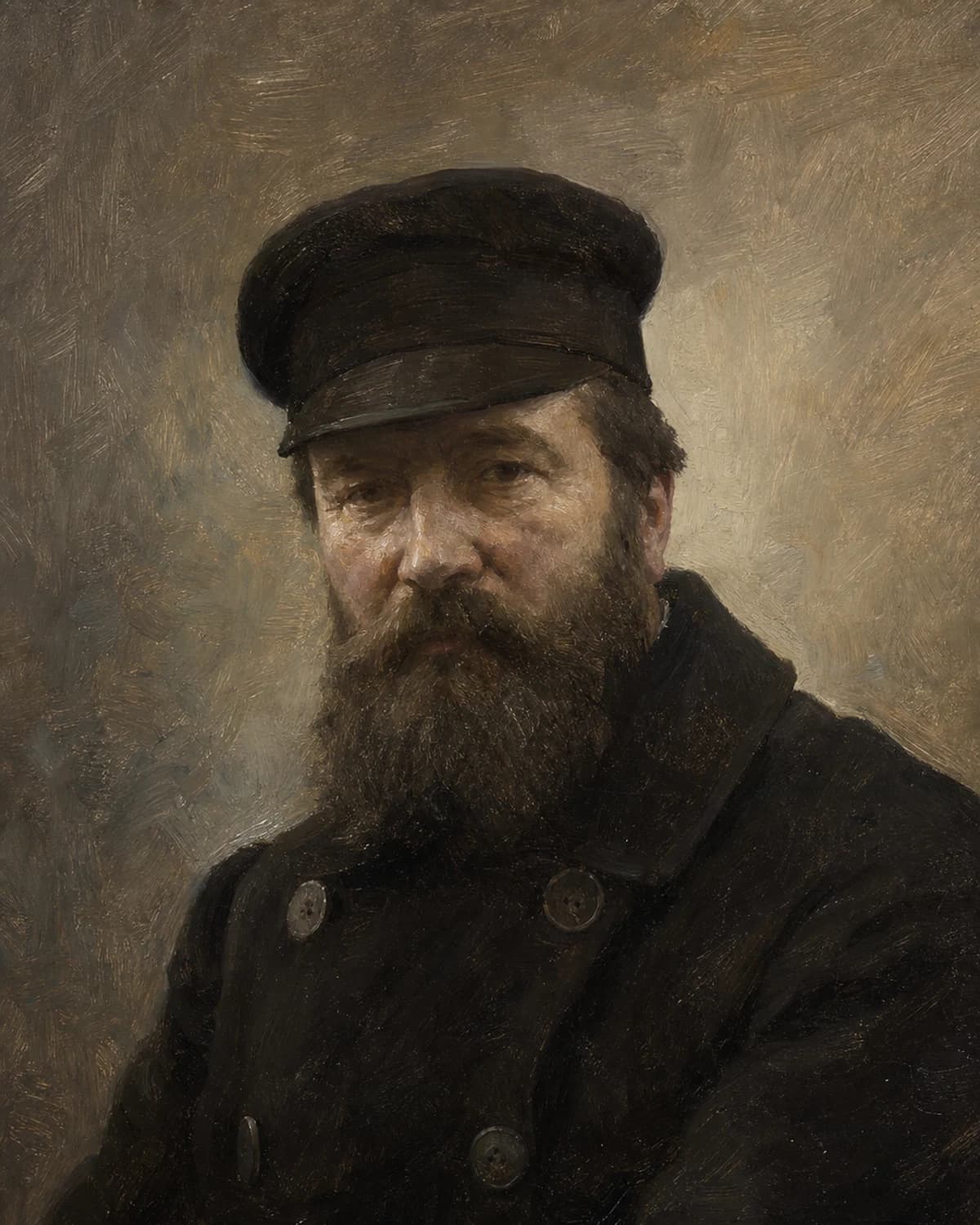
На основе открытого изображения: Константин Коровин; Wikimedia Commons; Public domain.
