
13.09.1830–03.09.1866
Konstantin Flavitsky
Konstantin Flavitsky (1830–1866) lived thirty-five years and left few works. His “Princess Tarakanova” (1864), a prisoner in a flooded cell of the Peter and Paul Fortress, earned him the title of professor and fixed in the public memory the legend that the pretender died in a flood. A pupil of Fyodor Bruni and for six years a pensioner of the Academy abroad, he painted in the manner of Bryullov, and was both praised and reproached for it.
Biography
Water is coming into a cell of the Peter and Paul Fortress through the bars of the window. A young prisoner has climbed onto the bed, and drenched rats are crawling out of the water towards her feet. This is how Konstantin Flavitsky painted the death of Princess Tarakanova, and at the Academy exhibition of 1864 the picture made him a professor.
It did not happen that way. The pretender, who passed herself off as a daughter of Empress Elizabeth Petrovna, died in the fortress on 4 December 1775, almost two years before the flood of 1777. But since Flavitsky she has been remembered as drowning, and in that form she found her way even into Pasternak’s poem “Soul”.
Flavitsky was born on 13 (25) September 1830 in Moscow. His father, an official of the Department of State Control, was transferred to St Petersburg and died there in 1839. Konstantin and his elder brother Ivan were placed in the Home for the Education of Poor Children at the St Nicholas Epiphany Cathedral, and it was there that the boy took to drawing. His maternal uncle, the architect Pyotr Tamansky, helped to have him taken on as a pensioner of the Society for the Encouragement of Artists: from 1847 he studied at the Society’s drawing school, and in 1848 he entered the Academy of Arts, in the studio of Fyodor Bruni.
He did well there. For drawings and studies from life he received the small and the large silver medals (1852 and 1853), and in 1854 the small gold medal for his competition picture “The Judgement of Solomon”. In 1855 he completed the course with the title of artist and the large gold medal for his programme piece “Jacob’s Sons Sell Their Brother Joseph”. The medal carried the right to travel at public expense, and in 1856 Flavitsky left: Berlin, Dresden, Paris, then Rome. He spent almost six years in Italy and became friends there with Nikolai Ge.
In Rome, on a commission from the president of the Academy, the Duchess of Leuchtenberg, he painted an enormous canvas, about four metres high and more than five wide. At first it was called “The Last Minutes of Christians Condemned to Be Devoured by Wild Beasts”; later the name “Christian Martyrs in the Colosseum” stuck. In a vault beside the arena, old men, women and children wait for death. A guard is opening a heavy door; beyond it lies the sunlit arena, with lions visible at its far edge. A man with a raised cross is leading a boy out, and the boy reaches back towards his mother, who has fallen to the ground with an infant. On the right a blind old man walks submissively towards the light. Everyone noticed the likeness to Bryullov’s “The Last Day of Pompeii”: the same contrasting patches of light, a similar plasticity of the figures. The art historian Alla Vereshchagina read the central figure in an unexpected way: in her view the man with the cross may be a brutal accomplice of the executioners, driving the doomed into the arena, and the sympathies of the painter, who lived in Italy in the years of Garibaldi, lay with those fighting for freedom of conviction.
In 1862 Flavitsky returned to St Petersburg, and at the exhibition of 1863 the public saw the picture. The Council of the Academy thanked the pensioner for a work “executed with particular love for art” and recognised him as an honorary free associate. He had hoped to become an academician and was hurt. Ge later recalled his complaints, and what he himself found out from the conference secretary: Flavitsky had been judged too much like Bryullov. “For the first time I learned that resembling Bryullov is a bad thing,” Ge wrote. Stasov, reviewing the exhibition, also mocked its “melodramatic fuss”, and Kramskoy, in a letter of 1877, called the canvas “bombastic and theatrical”, though he acknowledged the painter’s talent.
A year later Flavitsky showed “Princess Tarakanova”, and the tone changed. The Academy gave him the title of professor, which ranked above academician, and Stasov called the picture “the glory of our school”. To my mind, the main change can be seen in the canvas itself: instead of a crowd on a huge surface, a single figure in a cramped cell, and the drama rests on the water, the bars and the rats.
He had no time to make other large works. Konstantin Flavitsky died in St Petersburg on 3 (15) September 1866.
“Princess Tarakanova” was bought by Pavel Tretyakov after the artist’s death. Other versions exist: a presumably earlier one of 1862 in the Yekaterinburg Museum of Fine Arts, a smaller version of 1864 in the Penza picture gallery, and a study of the princess’s head of 1863, which came to the Russian Museum in 1903 from Pyotr Ge. The painter’s brothers, Nikolai and Ivan, sold the “Christian Martyrs” to the Academy in 1882 and used the proceeds to found a scholarship in his name. Since 1897 the picture has been in the Russian Museum; after the museum opened it was hung in the same room as “The Last Day of Pompeii”.
Flavitsky was buried in the Smolensky Orthodox Cemetery. The monument there was lost over time, and in 1936, in what was by then Leningrad, his remains were moved to the Tikhvin Cemetery of the Alexander Nevsky Lavra and a new one was put up.
Related context
Associations
Works connected through artistic movements, cultural context and period. Priced works available in this market appear first.








Profile notes
Profile and sources
Image
Artist image
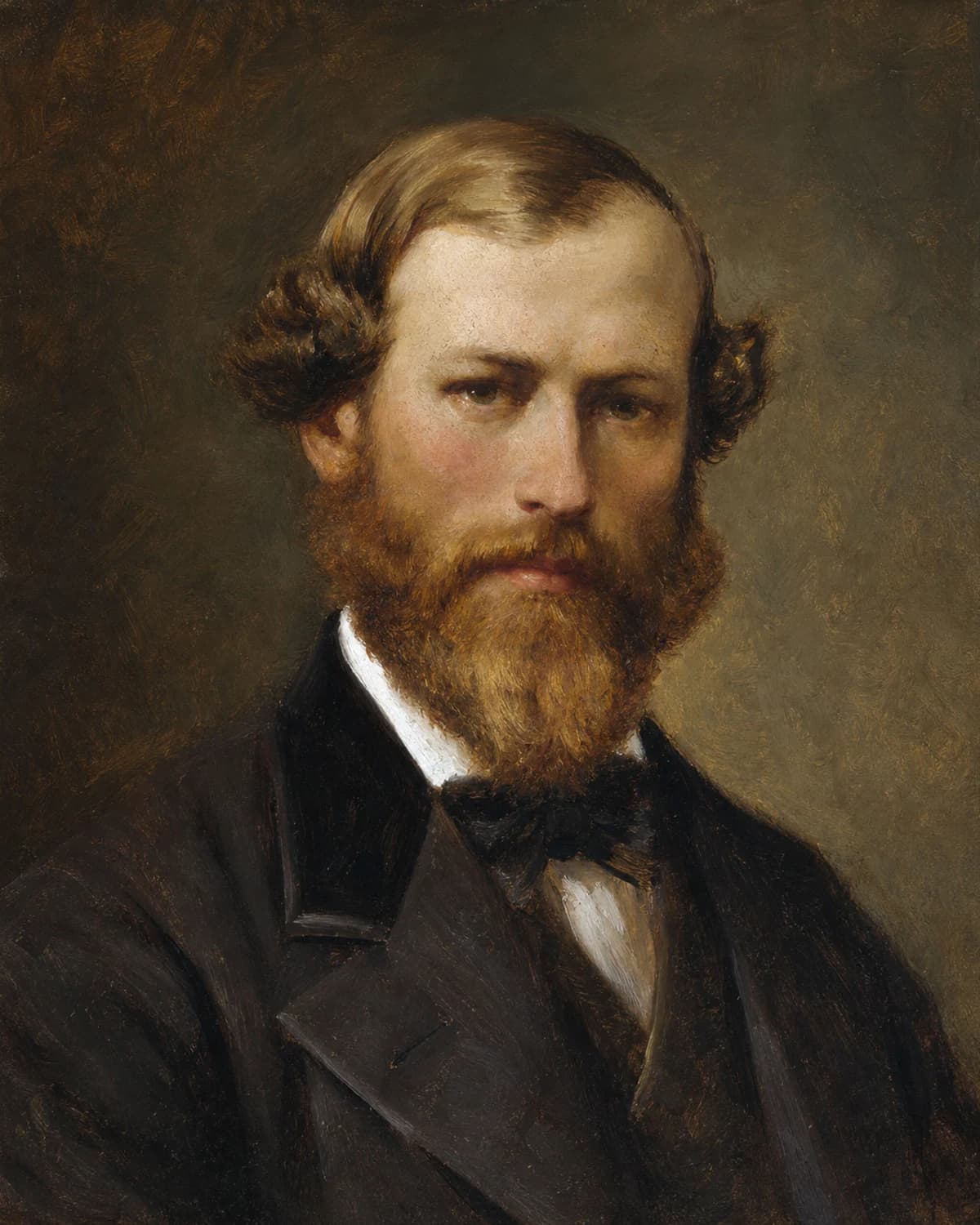
На основе открытого изображения: Fyodor Bronnikov; Wikimedia Commons; Public domain.
