
12.01.1872–17.02.1943
Konstantin Bogaevsky
Konstantin Bogaevsky (1872–1943) spent almost his whole life painting one land: eastern Crimea, ancient Cimmeria, with its chalk cliffs, folds of hills, Genoese walls and a sun of radiating beams. A pupil of Kuindzhi and a friend of Maximilian Voloshin, he worked in the studio he built in his native Feodosia in 1906. His panels of 1912 decorated Ryabushinsky’s Moscow mansion.
Biography
His friends jokingly called this country Bogaevia. On Konstantin Bogaevsky’s canvases it is recognisable at once: a sun with radiating beams, chalk cliffs, fortress walls, ships by an empty shore, and almost never a precise location. The artist himself said he was trying to convey the image of the land, “majestic and beautiful, solemn and sad”. His model was eastern Crimea, ancient Cimmeria, where he was born and where he worked for almost all his life.
At first his training went badly.
He was born on 12 (24) January 1872 in Feodosia, the son of a minor clerk in the town council. In 1880 he entered the classical gymnasium, and from 1881 he grew up in the family of a Feodosia manufacturer, Ivan Yegorovich Shmit. He tried to learn drawing from Adolf Fessler, in Aivazovsky’s studio, but without success. Then came St Petersburg: Bogaevsky became an auditing student at the Academy of Arts and worked in the studio of Arkhip Kuindzhi. According to some accounts, the Academy authorities disliked his work and at one point even dismissed him for “lack of talent”, but Kuindzhi valued his pupil and protected him. With his teacher and fellow students he went to paint studies in Crimea, at Nenel-Chukur near Simeiz (1895), and in 1897 to Germany, France and Austria. What struck him most at that time were the Vienna Secession and the pictures of Arnold Böcklin.
From 1900 Bogaevsky exhibited in St Petersburg, then in Venice, Munich, Paris and Moscow. In 1902–1903 he painted a series on familiar Crimean motifs, “The Old Crimea” and “The Ancient Fortress”. After that he turned for a long time to landscapes tied to no particular place, in which the influence of Böcklin and Klimt is noticeable. The light in them is gathered from several patches of colour, and the sky is tense and restless, as in “Last Rays”. In Western painting, apart from Klimt, his closest parallel is found in Giovanni Segantini.
In 1904 he joined the New Society of Artists, and almost at once he was called up for military service, at the Kerch Fortress. Demobilised in 1906, he married Josephine Gustavovna Durante and built a studio in Feodosia, where he worked for the rest of his life. The years of isolation at Kerch echoed in his pictures as themes of loneliness and the smallness of man: “The Star Wormwood”, “The Sun”, “The Genoese Fortress”. Voloshin dedicated his poem “Wormwood” to him. That same year, 1906, Sergei Diaghilev included his work in the exhibition of Russian art at the Salon d’Automne in Paris. By 1907–1908 calm had returned to his landscapes, as in “Southern Land. Cave City”.
The friendship with Voloshin counted for a lot. A series of Voloshin’s essays made Bogaevsky well known, and under the poet’s influence the so-called Cimmerian cycle came into being. In 1910 Voloshin’s book of poems “Years of Wandering” came out with drawings by Bogaevsky. He was compared with Nicholas Roerich. That same year he was elected to the Moscow Association of Artists, and in 1911–1914 he took part in the World of Art exhibitions. Journeys in 1908 and 1909 through Germany, Italy and Greece led him to the old masters, and from 1910 he painted classical landscapes with an eye to Dürer, Altdorfer and especially Mantegna. He took his idea of lighting from Claude Lorrain and called him his true teacher. Out of this came “Memory of Mantegna”, “Classical Landscape”, “The Cimmerian Region” and “Ships”. In 1912, commissioned by Ryabushinsky, he painted three panels for his Moscow mansion, his best-known work.
In 1914 he was called up again, served near Sevastopol and was demobilised only in 1918. After the revolution he stayed in Feodosia and went on exhibiting. In 1923 he painted panels for the agricultural exhibition in Moscow, in 1933 he received the title of Honoured Art Worker of the RSFSR, and in 1936–1939 he worked in Tarusa. In the 1920s and 1930s his motifs hardly changed, though he also tried the theme of industrial construction: “Dneprostroi”, “Port of an Imaginary City” (1932). It seems to me that the second title says more about him than the first: even the city of the future remained imaginary in his hands.
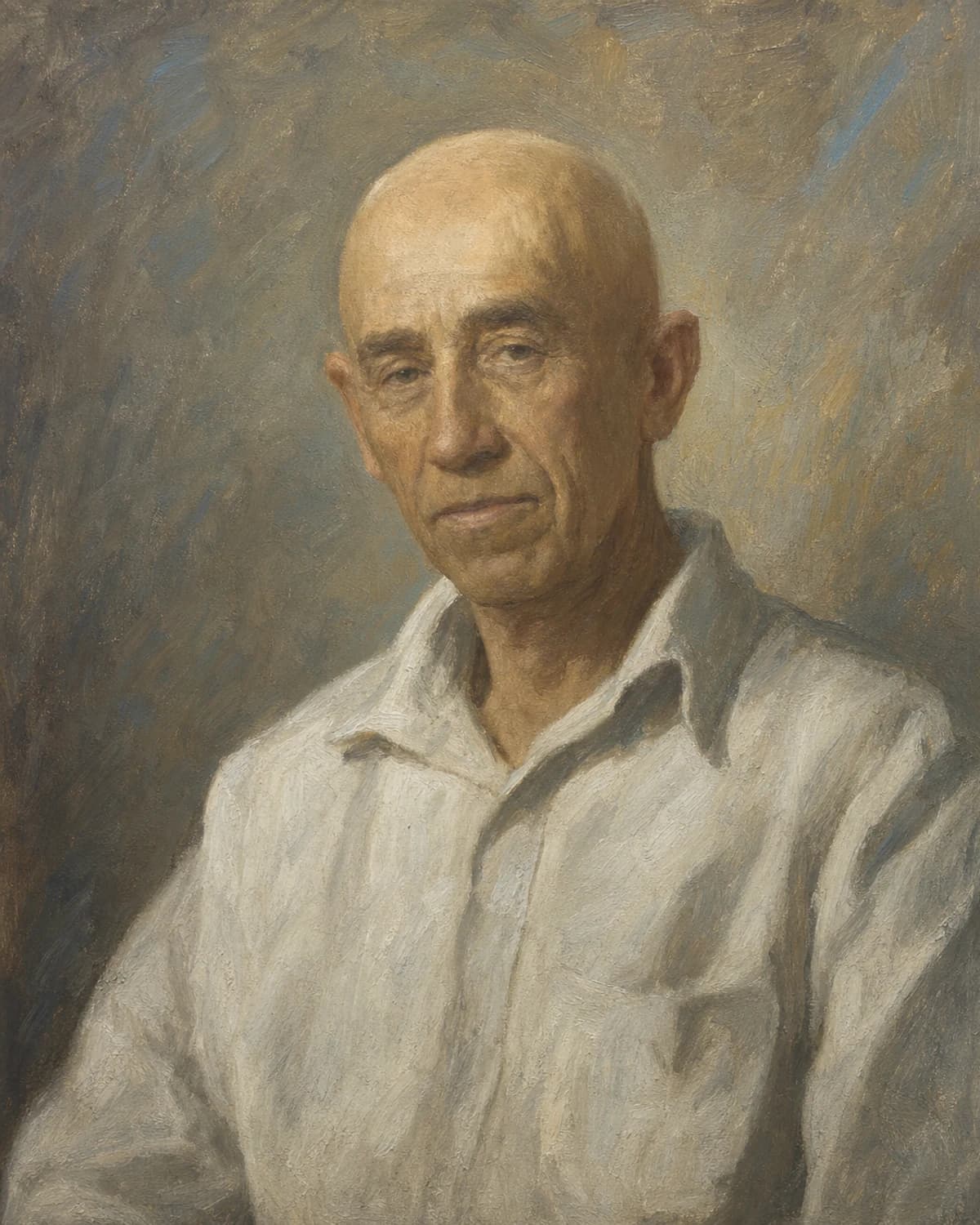
Contemporaries described him as reserved, conscientious, peaceable and unusually naive. His closest friends were the painter Konstantin Kandaurov and Voloshin; he also knew the Koktebel circle and another Feodosia inventor of non-existent countries, Alexander Grin. His portrait was painted by Voloshin, Nikolai Ulyanov and Anna Ostroumova-Lebedeva, and Paustovsky wrote about him in “The Black Sea”. Bogaevsky’s works are held by the Tretyakov Gallery, the Russian Museum, the Feodosia Picture Gallery and the art museums of Sevastopol, Simferopol and Sochi. Minor planet 3839, discovered in 1971 by Nikolai Chernykh, bears his name.
In November 1941 Feodosia was taken by German troops. Bogaevsky died in occupied Feodosia on 17 February 1943. He was buried from his home, and many people came: local artists, pupils of the art school. The coffin was lowered into the grave of Ivan Yegorovich and Sofia Antonovna Shmit, the people who had brought him up.
Related context
Associations
Works connected through artistic movements, cultural context and period. Priced works available in this market appear first.








Profile notes
Profile and sources
Image
Artist image
На основе открытого изображения: Unknown author Unknown author; Wikimedia Commons; Public domain.
