
около 1754–1806
Kitagawa Utamaro
Kitagawa Utamaro (c. 1753–1806) began with book illustrations and actor prints, and in the 1790s became famous for half-length portraits of beauties from the Yoshiwara pleasure quarter. He left more than two thousand prints, over a hundred series on women, and albums of insects. In 1804 he was arrested over prints of Toyotomi Hideyoshi, and he died two years later.
Biography
The only surviving official record of Utamaro is a gravestone at the temple Senkōji. It says that he died on the twentieth day of the ninth month of the third year of Bunka, that is, on 31 October 1806, at the age of 54 by East Asian reckoning. From this his birth year is deduced as about 1753. The year 1754 also turns up in reference databases.
The rest is poorly known. Sources give his birthplace as Kawagoe in Musashi Province, Edo, Kyoto or Osaka, and none of these has been confirmed. The names of his parents are unknown.
His childhood name was Ichitarō, and later he was called Yūsuke. He studied under Toriyama Sekien, an artist trained in the Kanō school, the academic tradition of Japanese painting, who in middle age turned to ukiyo-e, the woodblock print art of the pleasure quarters and theatres, made for the townspeople of Edo. Sekien recalled the boy playing in his garden and described his pupil as bright and devoted to drawing. Utamaro’s first work, apparently, was an illustration of eggplants in the haikai poetry anthology “Chiyo no Haru” (1770). In 1775, under the name Kitagawa Toyoaki, he designed the cover of a kabuki playbook, “Forty-eight Famous Love Scenes”, for the Nakamura-za theatre. For the rest of the decade he illustrated popular literature and occasionally produced prints of kabuki actors.
The decisive step was his acquaintance with the publisher Tsutaya Jūzaburō. In the autumn of 1782 Utamaro gave a lavish banquet for artists and writers; the guests included Torii Kiyonaga, Kitao Shigemasa and Katsukawa Shunshō. As custom required, a special print was made for the occasion, in which the artist bows before a screen bearing the guests’ names. It is believed that he first announced the name Utamaro then. His first work for Tsutaya appeared in 1783: the kibyōshi picture book “The Fantastic Travels of a Playboy in the Land of Giants”, made with the writer Shimizu Enjū. For about five years he probably lived in the publisher’s house. In those years he mostly drew for books of kyōka, “crazy verse”, a parody of classical poetry. Among them are the “Picture Book of Selected Insects” (c. 1788) and “Shiohi no tsuto” (c. 1789–1790), in which verses are combined with images of insects, shells and birds. Prints from 1790–1792 have not survived.
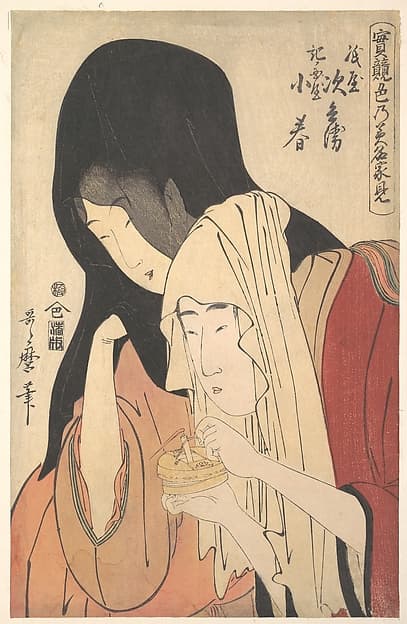
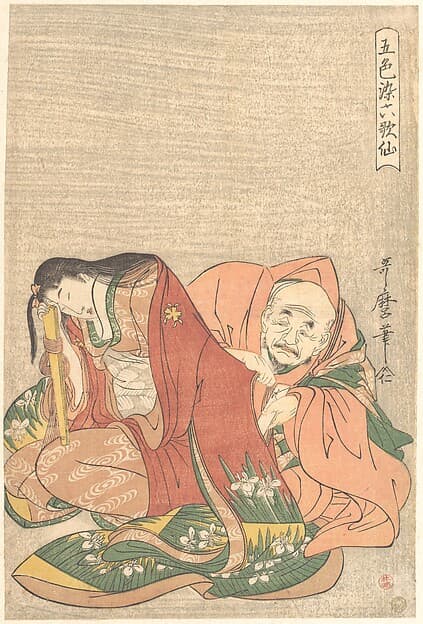
Around 1791 he gave up book illustration and turned to single half-length portraits of women, while other ukiyo-e artists preferred group scenes. There were many such series: “Ten Types of Women’s Physiognomies”, “A Collection of Reigning Beauties” and “Twelve Hours in the Pleasure Quarters”. He varied line, colour and printing methods to show differences in features, expression and background among women of different stations. For backgrounds he used mica dust, and he turned the white of the paper into a decorative element. Before him, women in ukiyo-e were more often shown as a single ideal type. Utamaro’s early prints are still close to Kiyonaga; later the figures grow slimmer and the faces longer. Scenes of domestic life also survive, in which the same woman and child recur.
His name spread beyond Edo, which was rare for a ukiyo-e artist. He worked with more than sixty publishers, the chief ones being Tsutaya Jūzaburō and Izumiya Ichibei. Tsutaya died in 1797. To my mind, it was not the loss alone: many scholars hold that Utamaro’s work grew weaker afterwards, and I am inclined to agree with them.
From 1790 prints had to carry a censor’s seal to be sold, and supervision gradually tightened. In 1804 Utamaro was arrested over prints of Toyotomi Hideyoshi, among them a triptych of the cherry-blossom party at Daigo-ji. Depicting military rulers, their names and crests was forbidden, and Hideyoshi was shown, besides, in the company of courtesans. He spent fifty days in manacles, and the publishers paid heavy fines. The court records have not survived, so the details are poorly known.
He died in Edo two years later.
He was given the Buddhist posthumous name Shōen Ryōkō Shinshi. He apparently had no heirs, and his grave at Senkōji was left untended. In 1917 admirers had the decayed gravestone repaired. The artist’s widow married his pupil Koikawa Shunchō, who took the name Utamaro II.
Artist works
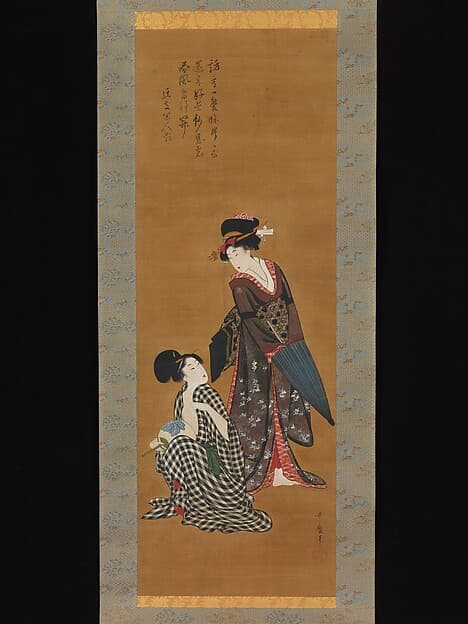
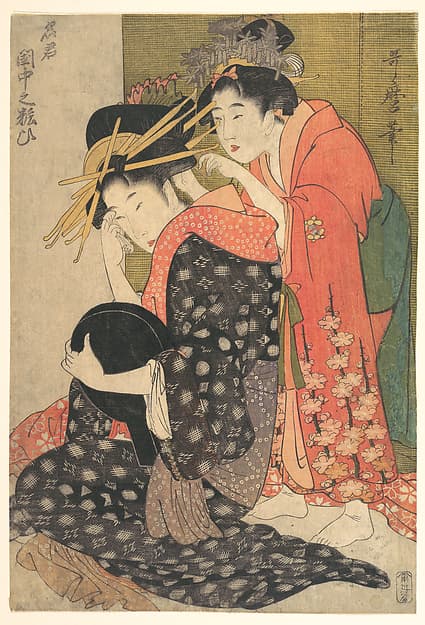
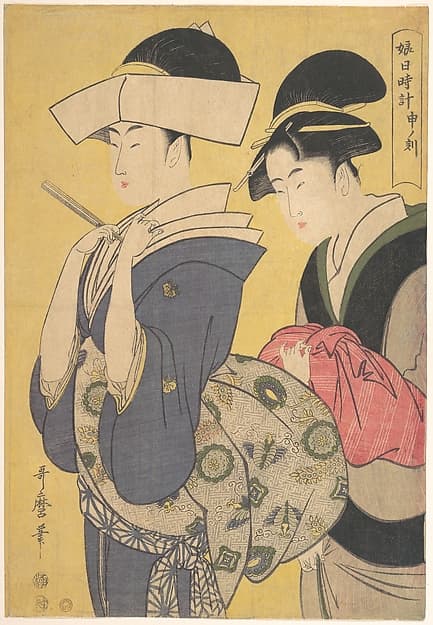
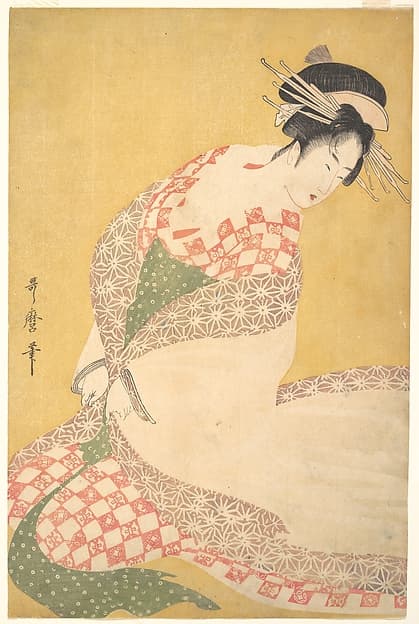
Works by the artist
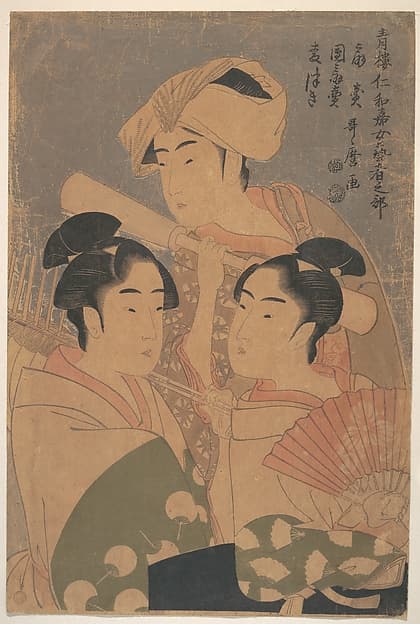
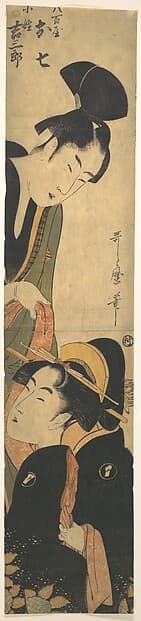
Works by Kitagawa Utamaro available in this edition of NEOARCA.
Related context
Associations
Works connected through artistic movements, cultural context and period. Priced works available in this market appear first.
Profile notes