
1745–1806
Kim Hongdo
Kim Hongdo (1745 – c. 1806), art name Danwon, court painter to kings Yeongjo and Jeongjo, took part three times in painting royal portraits and painted everything: Taoist immortals, Buddhist altarpieces, the Geumgang mountains. He is remembered for an album of 25 leaves in which Korean peasants of the eighteenth century wrestle, thresh rice, work the forge and sit in school; the album is in the National Museum of Korea.
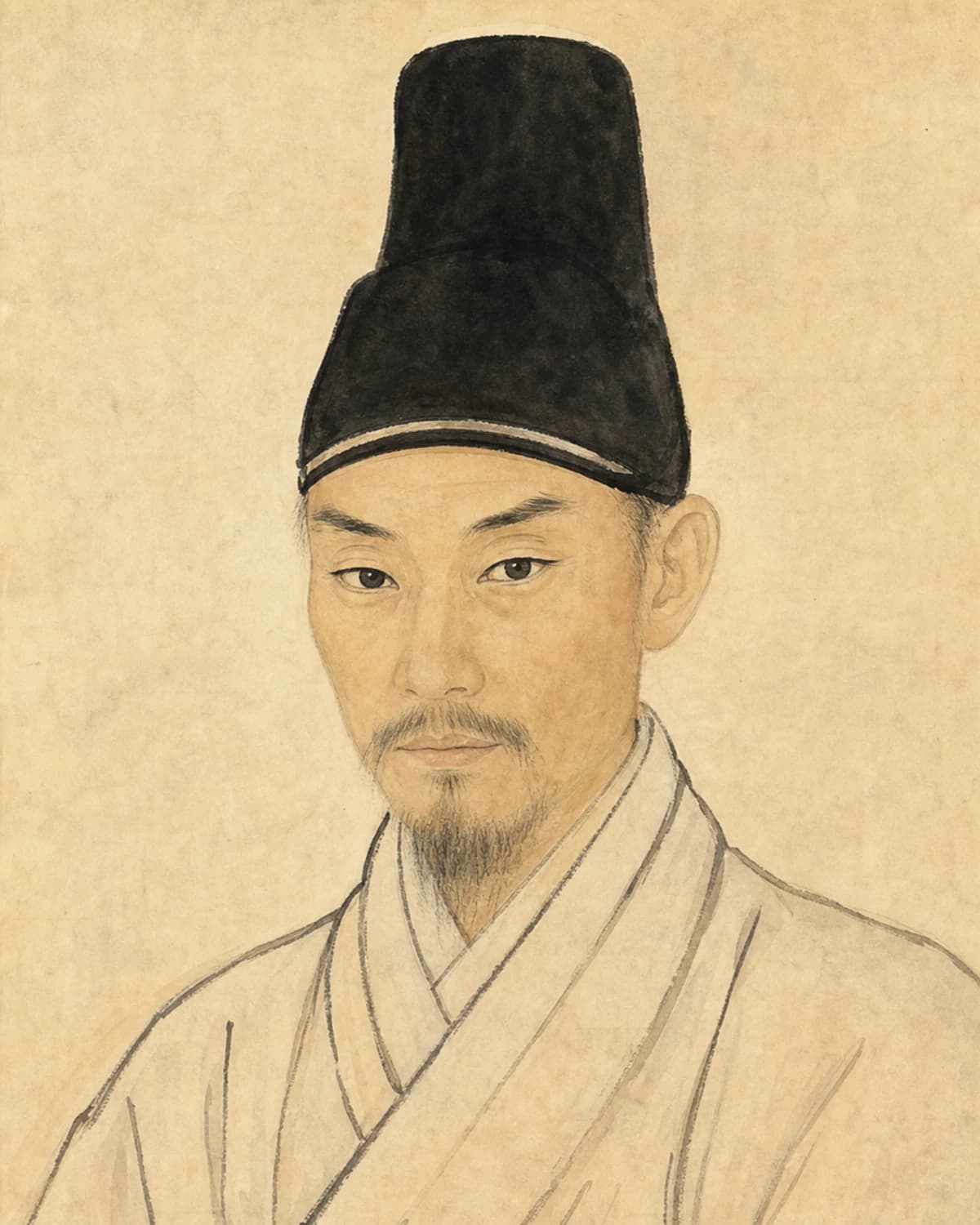
Biography
Twenty-five leaves, each 27 by 22.7 centimetres, paper, ink and a light wash of colour, no background. A schoolroom with teacher and pupils; a dancing boy; a forge; ploughing; shoeing a horse; ssireum wrestling; lunch; washerwomen, secretly watched by a man. This is the “Album of Genre Scenes by Danwon”, by which Korea remembers Kim Hongdo, though the album itself is, in essence, closer to a book of sketches than to finished pictures.
He was born in 1745 and grew up in Ansan, south of the capital, in a family of the Gimhae Kim clan that had served for generations as minor military officials; the court painters were on his mother’s side. From early childhood, from the time his milk teeth were falling out, he went to the house of Kang Sehwang, a scholar, poet and connoisseur of painting, who was then living in seclusion in Ansan. Kang taught him and later wrote of him that he was “the divine brush of our age”. In 1766, at twenty-one, on his teacher’s recommendation, Kim Hongdo entered the Dohwaseo, the court bureau of painting. In 1771 he painted the portrait of the heir, the future King Jeongjo, and in 1773 he assisted Byeon Sang-byeok on the portrait of King Yeongjo; for this he was given a post in the office of the palace gardens. In 1776, when the heir came to the throne, Kim Hongdo presented him with a picture of the Gyujanggak, the new royal library, and painted the “Group of Immortals”, a screen of Taoist saints which, it is thought, made his name; in 1971 it was listed as National Treasure No. 139 of Korea. In 1781 he again painted a royal portrait, now of Jeongjo.
Jeongjo singled him out. According to Jo Hui-ryong, his nineteenth-century biographer, the king ordered him to paint the Geumgang mountains and the four neighbouring counties and had the painter fed at public expense, which was counted an unheard-of honour. In 1784 Kim Hongdo painted “Danwondo” and from then on signed himself Danwon, a name taken from the Ming literati painter Li Liufang; in the same year he received the post of superintendent of the Angi post station in Andong and served there for two years and five months. In 1790 he painted for the Yongjusa temple, which Jeongjo had built in memory of his father, an altarpiece of the three Buddhas in which volume is rendered by light and shade in the Western manner; Western devices, which came by way of Qing China, he introduced boldly as a rule. In 1791, at forty-eight, he was appointed magistrate of Yeonpung county in Chungcheong province.
Exactly three years later, in 1795, on an inspector’s report, he was dismissed from the post and returned to Seoul as an ordinary court painter. Then came illustrations to the Buddhist “Sutra on Parental Kindness” for Yongjusa (1796) and to the government compendium “Oryun haengsildo” (1797).
The genre leaves by which he is known were almost all painted in his early thirties: the eight-panel screen of 1778, “Scenes from a Traveller’s Life”, with Kang Sehwang’s comments on each panel, and that same album of 25 leaves. He has been compared with the seventeenth-century Dutch for his attention to ordinary life, but to my mind something else is truer: he painted peasants without irony and without pity, as equals. Besides genre he painted mountains and waters, portraits, flowers and birds, Buddhist subjects; he also wrote poems, which his son, a painter too, published as a separate book.
After the death of Jeongjo in 1800 and the death of his patron Kim Han-tae he was left without clients, and life was hard. The last document that has come down from him is a letter of December 1805; after that no works and no traces. That is why it is usually written that he died in 1805 or 1806, though 1810 and “after 1814” are also met with. Together with Hyewon and Owon he is called one of the “Three Wons”, and together with Owon and An Gyeon (fifteenth century) one of the three principal painters of Joseon. In Ansan the district of Danwon-gu and an annual art festival are named after him.
Related context
Associations
Works connected through artistic movements, cultural context and period. Priced works available in this market appear first.








Profile notes
Profile and sources
Image
Artist image
На основе открытого изображения: Kim Hong-do; Wikimedia Commons; Public domain.
