
1786–1856
Kim Chŏnghŭi
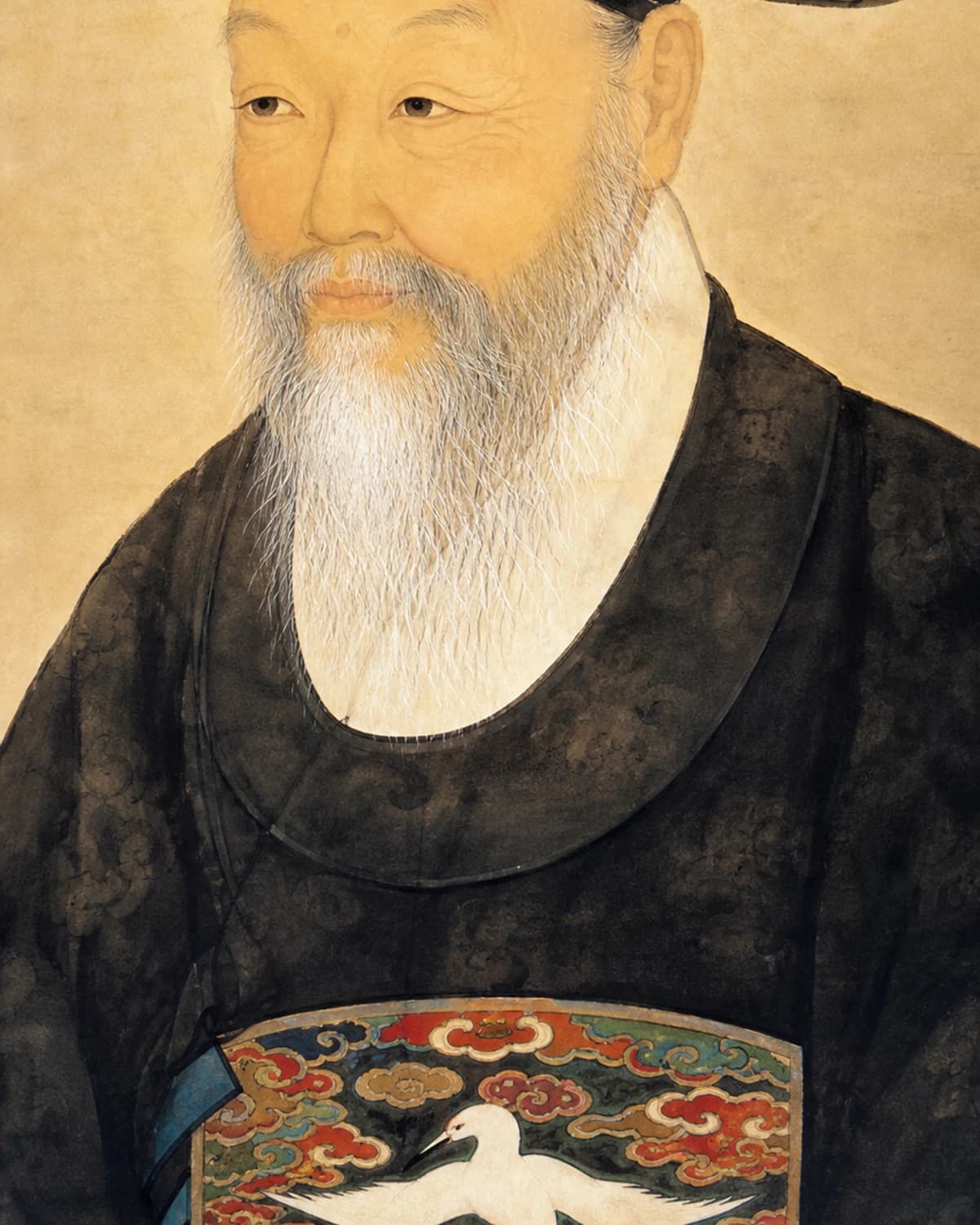
Kim Chŏnghŭi (1786–1856), better known by the art names Chusa and Wandang, was a scholar-official, an expert in ancient inscriptions and a calligrapher; the “Chusa” script, developed in exile on Jeju Island, bears his name. There, in 1844, he painted in ink the “Sehando”, a house between two pines, now a National Treasure of Korea. He painted orchids too, and wrote poems and letters to Chinese scholars.
Biography
In 1844, on Jeju Island, the exiled Kim Chŏnghŭi painted in ink a simple house, barely outlined, between two gnarled pine trees, and wrote beside it his thanks to his pupil Yi Sangjŏk. Yi, who travelled to China twelve times, had been bringing rare books to his disgraced teacher. The picture was called “Sehando”, “Painting of the Bitter Cold”: the phrase refers to the hard frosts at the turn of the lunar year. In 1845 Yi took the scroll to Beijing and showed it to the scholars there; sixteen of them added their tributes to it, then Koreans added theirs, and the painting grew a long tail of poems and calligraphy.
Since 1974 the “Sehando” has been a National Treasure of South Korea, and since August 2020 it has belonged to the National Museum of Korea.
Kim Chŏnghŭi was born in 1786 in Yesan, in Chungcheong Province, the eldest son of Kim Nogyŏng of the Gyeongju Kim clan. The family was noble and close to the court: his great-grandfather, Kim Hansin, had married King Yeongjo’s daughter, Princess Hwasun, and there were many calligraphers in the clan. It is said that at seven he wrote a spring good-luck charm on the gate of the family house, and the high official Chae Chegong, passing by, foretold the boy’s fame as a calligrapher. His teacher was Pak Je-ga, one of the leading men of the “Northern Learning”, which urged the adoption of practical knowledge from Qing China. His uncle, Kim Noyŏng, who had no sons, adopted his nephew as heir to the family, and the boy moved to the capital. Around 1805, when several people close to him and his teacher died one after another, he turned seriously to Buddhism; later he wrote name boards for temple halls and copied sutras. In 1809 he passed the lower examination for a scholarly degree in first place.
A year later he accompanied his father, who was travelling as vice-envoy, to Beijing and spent about six months there. The eminent scholars Weng Fanggang and Ruan Yuan recognised his abilities; Ruan gave him his own book on calligraphy, and the correspondence with them never broke off. After his return Kim held no office for a time, wrote essays against ossified Neo-Confucianism, and went out to ancient stelae to copy their inscriptions. He read and identified the stele on Mount Bukhan set up to commemorate a visit by King Jinheung of Silla. Since then he has been regarded as the founder of Korean epigraphy. In 1815 the Buddhist monk Cho-ui came to the capital, and a lifelong friendship began; the monk is called Korea’s “sage of tea”, and Kim, it seems, took to tea thanks to him as well, though there is no way to check this.
In 1819 he passed the great state examination and began to rise: tutor to Crown Prince Hyomyeong, secret royal inspector in Chungcheong Province, service in the Kyujanggak library. After the prince’s death power passed to the Andong Kim clan, Kim was demoted, and his father was exiled for several years. With the accession of Heonjong in 1835 he rose again, to head of the Seonggyungwan state academy and vice-minister. In 1840 factional struggle ended for him in exile to Jeju, under guard.
Almost nine years passed there. Studying models of the earliest Korean and Chinese inscriptions, he developed a script of his own, known as the “Chusa” style; the monk Cho-ui came to the island five or six times to see him, bringing tea.
He was released in 1848 or 1849, but in the early 1850s, after a dispute over moving the tomb of the late King Heonjong in which his friend, the chief state councillor Gwon Don-in, was involved, Kim was exiled again, to the north, to Bukcheong in Hamgyeong Province, for about two years. He was reputed to have had three thousand pupils; among them were Heungseon Daewongun, father of the future King Gojong, and Pak Gyu-su. He left more than a hundred art names, 503 by one count: whenever he gave someone a painting of orchids, he devised a new name for the occasion. That, it is said, is how he became the man with the most names in his generation.
He spent his last years in Gwacheon, south of the capital, where his birth father was buried, in a house he called the “Thatched Hut in the Melon Field”. In 1856 he went for a while to Bongeun-sa temple and, according to tradition, took monastic vows, then returned to Gwacheon and went on writing until the end. Kim Chŏnghŭi died there in 1856. His pupils published his letters and poems in 1867, a collection of his writings appeared in 1868, and a complete edition in 1934 through the efforts of his great-great-grandson.
Related context
Associations
Works connected through artistic movements, cultural context and period. Priced works available in this market appear first.








Profile notes
Profile and sources
Image
Artist image
На основе открытого изображения: Yi Han-cheol (circa 1812- circa 1893); Wikimedia Commons; Public domain.
