
28.11.1788–16.06.1878
Kikuchi Yōsai
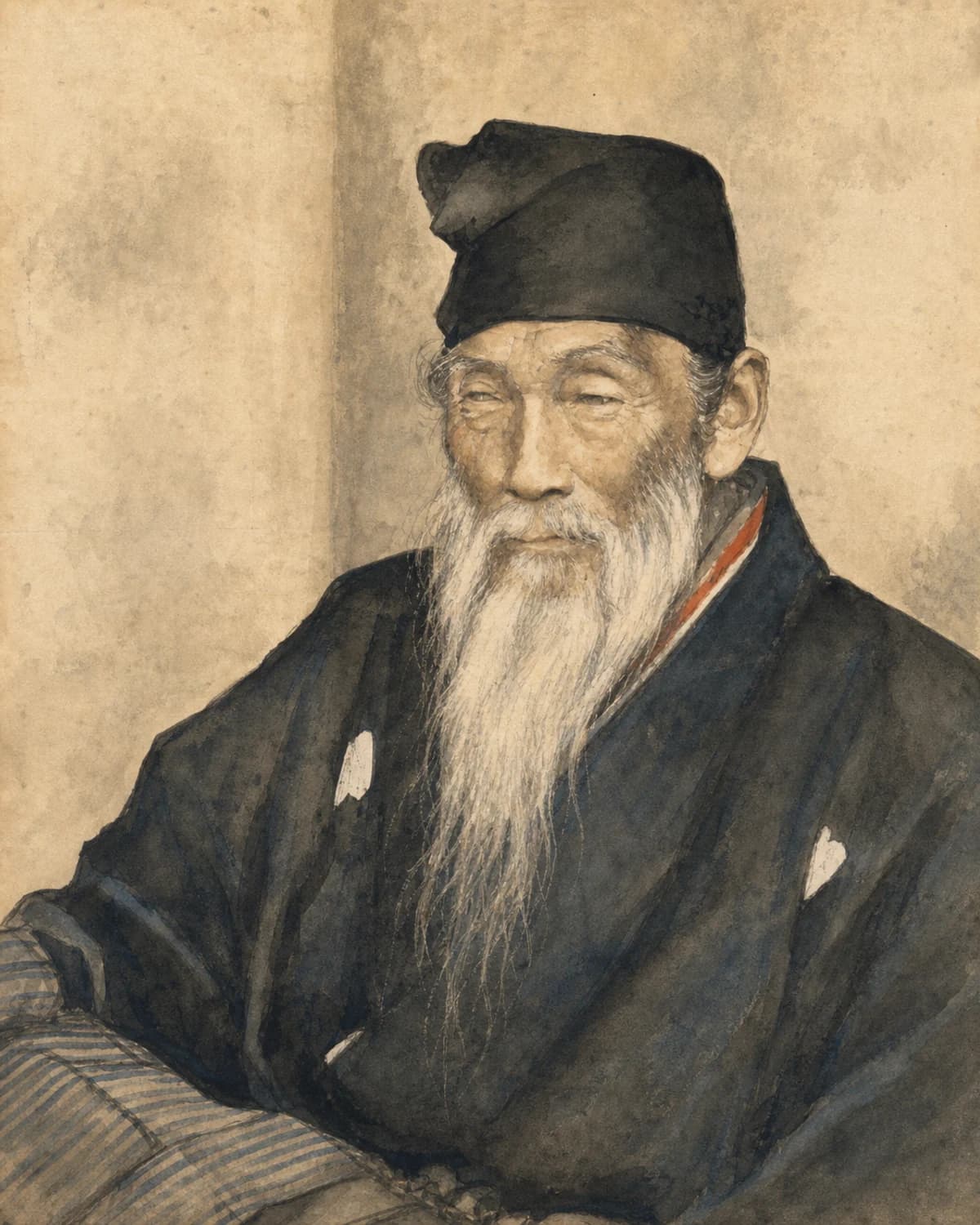
Kikuchi Yōsai (1788–1878), the son of a foot soldier in the shogun’s guard in Edo, gave up his post for painting and spent most of his life on a single book: the “Zenken Kojitsu”, ten volumes of portraits of 571 figures from Japanese history, dressed according to old custom and surviving objects. The book came off the press in 1868 and became a reference work for the history painters, printmakers and even photographers of the Meiji era.
Biography
The name Yōsai the artist chose for himself, and chose as a reprimand: the characters mean something like “studio of forbearance”, and he took them, so it was said, to rein in his own temper, so strict that he forgave nobody anything.
He was born on 28 November 1788 (the first day of the eleventh month of the eighth year of Tenmei) in Edo, in the Shitaya district, the second son of Kawahara Senzō Takeyoshi, a foot soldier in the guard of the Western Citadel of the shogun’s castle. His father had himself come into the Kawahara house as an adopted son from the Kikuchi family, and the Kikuchi genealogy traced itself back to Kikuchi Taketoki, a retainer of the Southern Court. At fifteen, after the early death of his elder brother, the boy became heir to the Kawahara house. At twenty-eight, when his father’s Kikuchi line died out, he took pity on the old name: he married his sister to an adopted son-in-law so that the Kawahara line would continue, and at thirty-eight he himself retired from service and revived the Kikuchi house under the name Kikuchi Takeyasu. His earlier name, Kawahara Ryōhei, also appears on his works.
He began studying painting in 1805 with Takata Enjō, who showed his pupils the manners of various schools. After his teacher’s death Yōsai sought no one else and kept to his rule: attach yourself to no school, take what is strong from each. So the Kanō, Maruyama and Shijō schools met in his hand (possibly by way of Ōzui, son of Maruyama Ōkyo), and the critic Nakane Kōtei added that Hokusai had affected him in his youth. Money came from the hatamoto Kugai Masanori, and with his support Yōsai painted large works on subjects from Chinese history: the burning of the Epang Palace, Empress Lü putting Lady Qi to death. Among his scholarly friends was Hagura Kandō. His independent manner was compared with that of Tani Bunchō. In 1825 he left his post in the guard of the Western Citadel, and from then on painting was his main occupation.
From 1827 he spent about five years in Kyoto and Yamato province: he studied with masters of the Maruyama and Shijō schools, looked at the Tosa school and ukiyo-e, studied yūsoku kojitsu, the science of court customs, dress and utensils of earlier centuries, and examined ancient objects. Out of these studies grew the main work of his life, the “Zenken Kojitsu”, which might be rendered as “Ancient Customs of the Former Worthies”: 571 people, from the Age of the Gods to the era of the Southern and Northern Courts, courtiers, aristocrats, monks, warriors and court ladies, each given a double-page spread with a short biography and a figure in ink wearing dress checked against written sources and surviving objects. For this he occupied himself with history and also with what today would be called archaeology. The printing of the ten volumes was completed in 1868, the first year of Meiji. The book was presented to Emperor Kōmei, then to Emperor Meiji, and in 1875 Yōsai received the honorary title of “Nihon gashi”, painter of Japan. In 1877, at the first National Industrial Exhibition, he was awarded the highest prize, the Ryūmon award. Nakane Kōtei observed that Yōsai had borrowed the very form of the book from a Chinese collection of portraits compiled by the Qing illustrator Shangguan Zhou. Among his individual paintings the best known is the “Night Attack at Horikawa”, in the collection of the Sensō-ji temple in Tokyo.
He did not make his pupils copy funpon model books, as was the custom in studios. Watanabe Seitei recalled that the master let them draw what they liked and then went through the result; calligraphy he valued as highly as drawing. His pupils included Matsumoto Fūko, Suzuki Kason and Mishima Shōsō; Kajita Hanko and Ogata Gekkō regarded him as their teacher from a distance.
His influence on the next generation passed not through the studio but through the book. When in the 1880s and 1890s the government began to encourage history painting, the “Zenken Kojitsu” lay on many desks: Kobori Tomoto’s, those of the printmakers Tsukioka Yoshitoshi and Kobayashi Kiyochika, those of the Western-style painters Honda Kinkichirō and Hara Bushō; even the maker of “living dolls” Matsumoto Kisaburō, the photographer Kitaniwa Tsukuba and the storyteller Shōrin Hakuen turned to it. Kajita Hanko made his pupils copy it in its entirety, and out of those exercises came Kobayashi Kokei and Maeda Seison. To my mind, no other picture book did as much for Japanese history painting.
Kikuchi Yōsai died on 16 June 1878 and was buried in the Yanaka cemetery in Tokyo; in the same year a stele with a text by Akizuki Tanetatsu was set up by the grave. In 1928 he was posthumously granted the senior fifth court rank.
Artist works
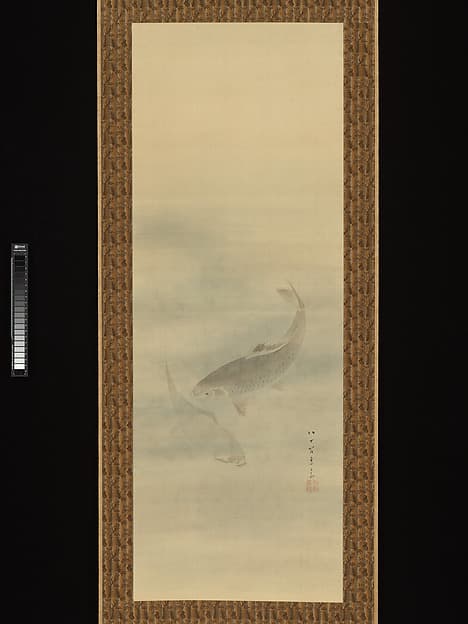
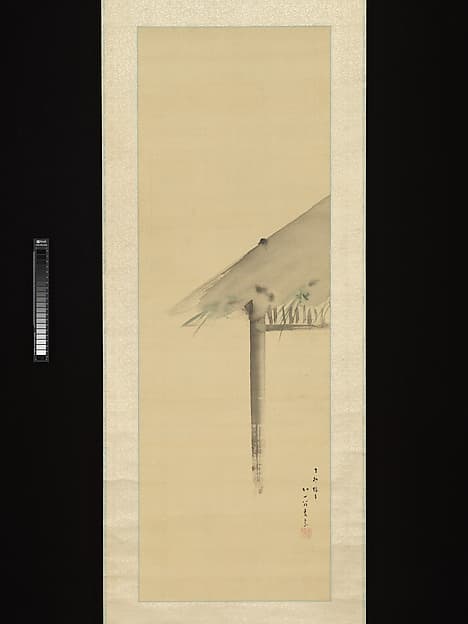
Works by the artist
Works by Kikuchi Yōsai available in this edition of NEOARCA.
Related context
Associations
Works connected through artistic movements, cultural context and period. Priced works available in this market appear first.








Profile notes
Profile and sources
Image
Artist image
На основе открытого изображения: Unknown author Unknown author; Wikimedia Commons; Public domain.
