
04.05.1958–16.02.1990
Keith Haring
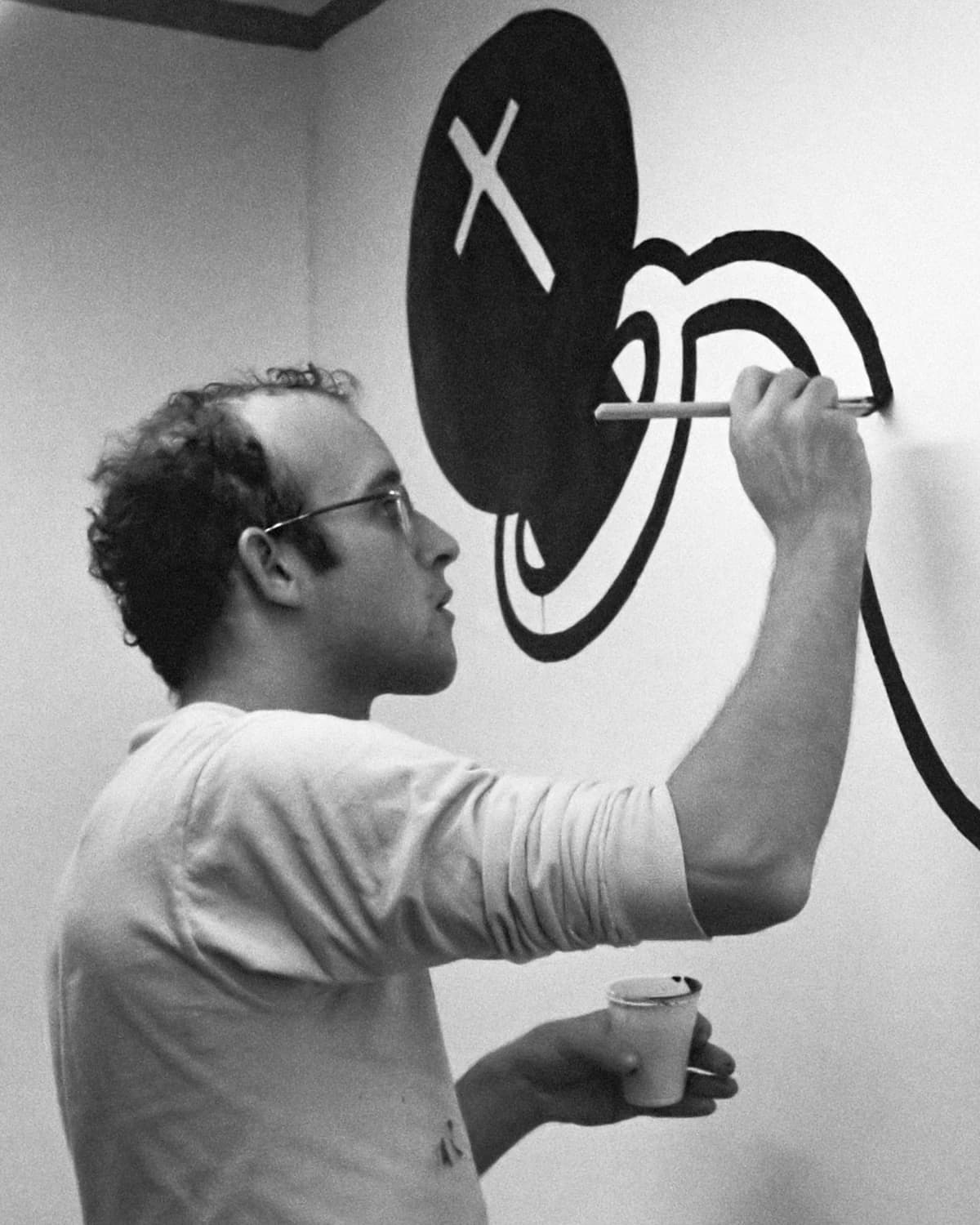
Keith Haring (1958–1990) began with chalk drawings on the black advertising panels of the New York subway, and in less than ten years he made more than fifty public murals, from Harlem to the Berlin Wall and Pisa. His crawling radiant baby and barking dogs became a recognisable language, and he used it to speak about crack, apartheid and AIDS.
Biography
In June 1986 Keith Haring painted the mural “Crack Is Wack” on a wall in East Harlem, clearly visible from the FDR Drive. The police treated it as vandalism and arrested him; after the newspapers took up the story, he was released on a lesser charge. While he was in custody, someone altered the words to “Crack Is It”, and the city's Parks Department painted over the whole thing. In October Haring painted the mural again on the same wall.
He was twenty-eight, and international fame had already come to him.
He was born on 4 May 1958 in Reading, Pennsylvania, and grew up in the nearby town of Kutztown. His father, an engineer and amateur cartoonist, drew with him; his first models were Disney cartoons, Dr. Seuss, Charles Schulz's comic strips and Bugs Bunny. As a teenager Haring hitchhiked across the country selling T-shirts of his own design. In 1976–1978 he studied commercial art in Pittsburgh, but gave it up after reading Robert Henri's book “The Art Spirit”. Working as a maintenance man at the Pittsburgh Arts and Crafts Center, he studied Dubuffet, Pollock and Mark Tobey; in 1977 he saw a retrospective of Pierre Alechinsky, which suggested to him large images combining writing and characters, and in 1978 he heard a lecture by Christo on how to draw the public into art. His first significant exhibition was held at the same centre.
In 1978 he moved to New York, to the Lower East Side, studied painting at the School of Visual Arts, took classes in semiotics, tried video and performance and read William Burroughs. In his journal that year he wrote that the act of painting itself was becoming as important to him as the finished picture. From December 1980 Haring drew in white chalk on the black paper used to cover vacant advertising spaces in subway stations. He called the subway his laboratory. It was there that his vocabulary took shape: a crawling baby with rays streaming from it (he used this sign as his signature), barking dogs, flying saucers, dancing figures.
After that everything moved fast. In February 1981 he had his first solo exhibition; that summer he met the graffiti artist Angel Ortiz, and they began working together; in November a commercial gallery showed him for the first time. In 1982 Haring made work for the electronic billboard in Times Square, painted a large mural on the Houston Bowery Wall and was included in documenta 7 in Kassel, where he hung alongside Beuys, Kiefer, Richter, Twombly, Basquiat and Warhol; in the autumn Tony Shafrazi's gallery in SoHo held an exhibition of his work that the critics received well. In 1983 he took part in the São Paulo Biennial and the Whitney Biennial, painted the Fiorucci store in Milan and covered the body of the choreographer Bill T. Jones in drawings from head to toe. In 1984 Vivienne Westwood turned his drawings into textiles, he exhibited at the Venice Biennale and painted murals in Melbourne and Sydney; in 1985 he designed watches for Swatch, a United Nations stamp for International Youth Year and “Free South Africa” posters, and had his first museum exhibition, in Bordeaux.
The prices of his canvases kept rising, while he went on drawing in the subway for free and handing out badges and posters. In April 1986 the Pop Shop opened in SoHo, selling T-shirts and posters with his drawings at affordable prices. Haring explained that the shop carried on what he had been doing in the subway and broke down the boundary between high and low art. After that he stopped drawing underground, all the more so because people had started tearing down his drawings and selling them. I think he should be taken at his word: from the subway to the Pop Shop it was one and the same conversation with the public.
On 23 October 1986, for the museum at Checkpoint Charlie, Haring painted three hundred metres of the Berlin Wall: interlocking red and black figures on a yellow ground, the colours of the German flag, as a sign of hope for the unity of East and West. In 1987 he painted “Tower” on a twenty-seven-metre stairwell at the Necker children's hospital in Paris, made a carousel for an artists' amusement park in Hamburg and painted the mural “We the Youth” in Philadelphia, which still stands in its original place. In 1988 one of his drawings appeared on the label of Château Mouton Rothschild.
Haring spoke openly about being gay and campaigned for safe sex. In 1988 he was himself diagnosed with AIDS, and in his last years he worked to spread awareness of the disease. In February 1989 the mural “Together We Can Stop AIDS” appeared in the Barrio Chino district of Barcelona, and in the same year he set up the Keith Haring Foundation to support AIDS organisations and children's programmes. In June 1989, on the rear wall of the convent of the church of Sant'Antonio Abate in Pisa, he painted “Tuttomondo”, one of his last large murals. Two weeks before his death he completed “The Life of Christ”, a triptych modelled in clay and cast in bronze in nine copies; one stands in the church of Saint-Eustache in Paris, another in the Cathedral of St. John the Divine in New York.
Keith Haring died on 16 February 1990 in his apartment in Greenwich Village. His ashes were scattered in a field near Bowers, south of his home town of Kutztown. On 4 May, the day he would have turned thirty-two, a memorial service was held in the Cathedral of St. John the Divine.
Profile notes
Profile and sources
Image
Artist image
Rob Bogaerts (Anefo); Wikimedia Commons; CC0.
