
11.02.1879–15.05.1935
Kazimir Malevich
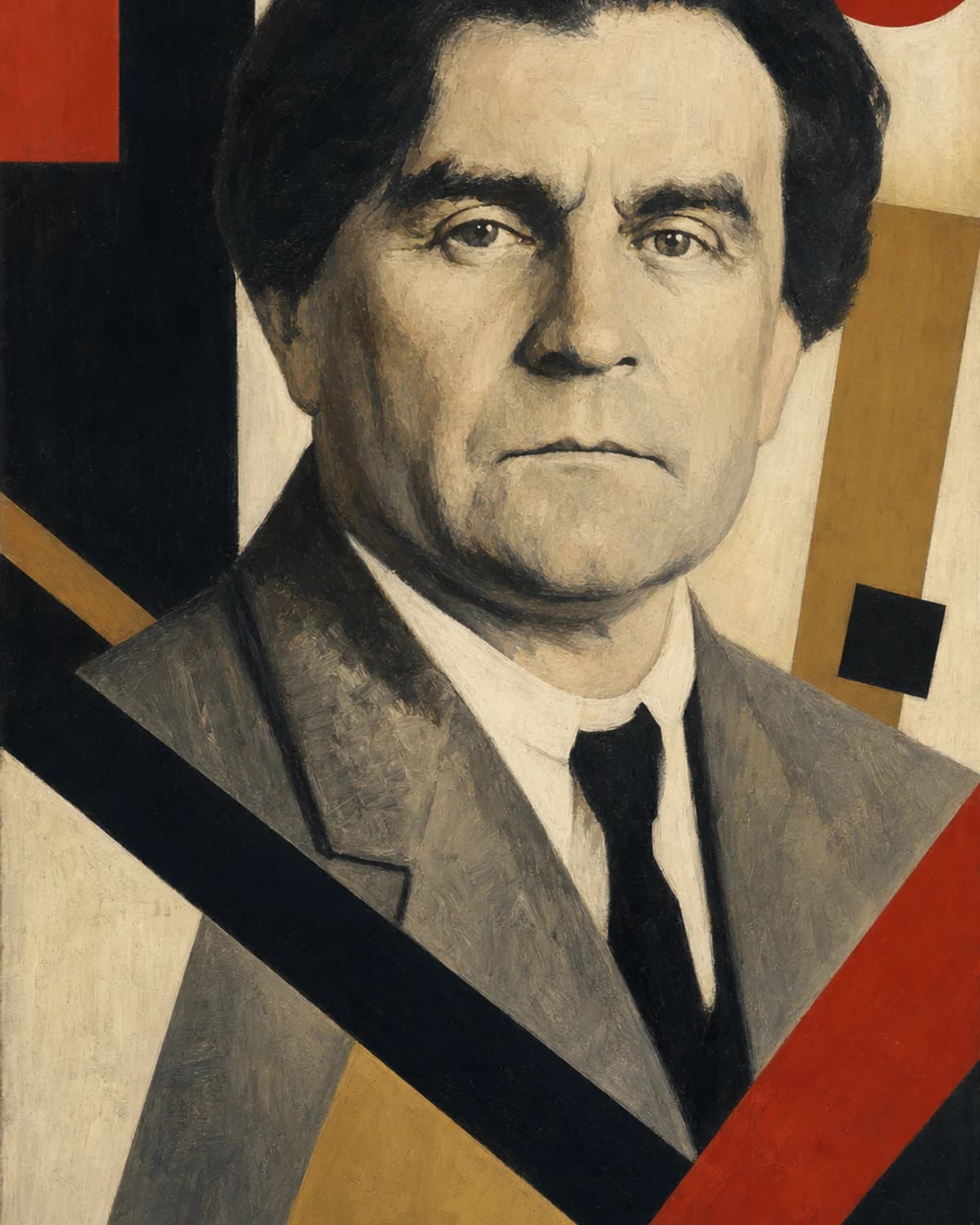
Kazimir Malevich (1879–1935), a native of Kiev from a Polish family, invented Suprematism and in December 1915 showed “Black Square” at the “0,10” exhibition in Petrograd. He led UNOVIS in Vitebsk and GINKhUK in Leningrad and taught in Kiev. He reached non-objective art by way of Impressionism, Neo-Primitivism and Cubo-Futurism, and late in life went back to painting figures and portraits.
Biography
In December 1915 “The Last Futurist Exhibition of Paintings 0,10” opened in Petrograd. In one of the rooms, high up in a corner, where the icon hangs in a peasant hut, Malevich hung a black square on a white ground. His non-objective compositions covered the other walls. He called the new movement Suprematism, from the Latin supremus, “highest”, and at the same time brought out the pamphlet “From Cubism to Suprematism”.
So much has been written about the square that there is almost nothing left to add to the argument. What interests me more is how Malevich got there. The road took about twenty years.
He was born on 11 (23) February 1879 in Kiev, into a Polish Catholic family. His father worked at sugar refineries, the family moved often, and his childhood was spent in Ukrainian villages and small towns, longest of all in Konotop. His first strong impression of colour, as the artist himself later recalled, came from painted cottages, embroidery and stoves. In 1895–1896 he attended Mykola Murashko’s Kiev Drawing School.
In 1896 the family moved to Kursk. There Malevich worked for more than ten years as a draughtsman in the administration of the Moscow–Kursk Railway, painting alongside the job. He settled in Moscow around 1907, studied in Fyodor Rerberg’s studio in 1907–1910, and met Mikhail Larionov at that time. From 1909 he spent long stretches living and working at Nemchinovka outside Moscow, where the father of his second wife had a house.
The years that followed look like a crash course in all of modern painting. Impressionism, then Symbolism. Then, alongside Larionov and Natalia Goncharova, Neo-Primitivism: the lubok print, the shop sign, the icon. In 1910 he takes part in the first Jack of Diamonds exhibition. His peasants of the early 1910s are heavy, as if hammered out of tin, and there is hardly any story in these paintings. “The Knife Grinder” (1912–1913) is already Cubo-Futurist: the figure is broken down into phases of movement, as in chronophotography.
In 1913 he designed the sets and costumes for the opera “Victory over the Sun” by Mikhail Matyushin and Aleksei Kruchenykh. Among the sketches is a square divided diagonally into a black half and a white half; Malevich himself later traced Suprematism back to this work. In 1914 came the “alogical” paintings such as “An Englishman in Moscow”, where a fish, a sabre, a church, a candle and scraps of lettering sit side by side without any logic at all.
After “0,10” things moved quickly. Coloured compositions with flying planes, the Supremus group, and in 1918 “White on White”, where almost nothing is left: a white square turned slightly on a white field.
In 1919 Malevich came to Vitebsk to teach at the People’s Art School, which was run by Marc Chagall. The two programmes could not live together. UNOVIS, the “Affirmers of the New Art”, quickly formed around Malevich; his students covered streets, speakers’ platforms and signboards with Suprematist forms, and in the end Chagall left. In Vitebsk El Lissitzky, Nikolai Suetin, Ilya Chashnik and Vera Yermolaeva worked alongside Malevich.
At the end of 1922 he moved with his students to Petrograd, and in 1924–1926 he was director of the State Institute of Artistic Culture, GINKhUK. Here he worked out his theory of the “additional element” (whatever distinguishes one movement in painting from another) and made arkhitektons, plaster models of future architecture assembled from Suprematist volumes; some of them are now in the Tretyakov Gallery. The institute was closed after a damning article, “A Monastery on State Supply”, in “Leningradskaya Pravda”. In 1927 Malevich travelled to Warsaw and Berlin; on 7 April he visited the Bauhaus in Dessau and met Walter Gropius and László Moholy-Nagy there. His “The Non-Objective World” came out in the Bauhaus book series. He left some of the works he had brought with him in Germany, and today they form the core of Western collections of Malevich.
From 1927 to 1930 he taught at the Kiev Art Institute, alongside Fedir Krychevsky, Mykhailo Boychuk and Victor Palmov. Then came an order to dismiss teachers who were not Party members, and Malevich lost his job. In the autumn of 1930 the OGPU arrested him on suspicion of spying for Germany. He was released in December.
The late Malevich throws many people off. At the end of the 1920s and the beginning of the 1930s he paints peasants again, only now faceless, like mannequins, among coloured strips of fields. Many scholars see this “second peasant cycle” as a response to collectivisation. He made the historians’ job harder himself: he backdated some of these pictures. Then came portraits in Renaissance costume, and on the 1933 self-portrait a small black square stands in place of a signature.
Malevich died on 15 May 1935 in Leningrad. His coffin was made Suprematist, to his own design and with the help of his students. The body was cremated in Moscow, and on 21 May the urn was buried under the artist’s favourite oak near Nemchinovka, with a wooden cube bearing a black square set over the grave. The grave was later lost. Nearby there now stands a cenotaph: a white concrete cube with a red square.
Related context
Associations
Works connected through artistic movements, cultural context and period. Priced works available in this market appear first.








Profile notes
Profile and sources
Image
Artist image
На основе открытого изображения: Unknown author Unknown author; Wikimedia Commons; Public domain.
