
08.07.1867–22.04.1945
Käthe Kollwitz
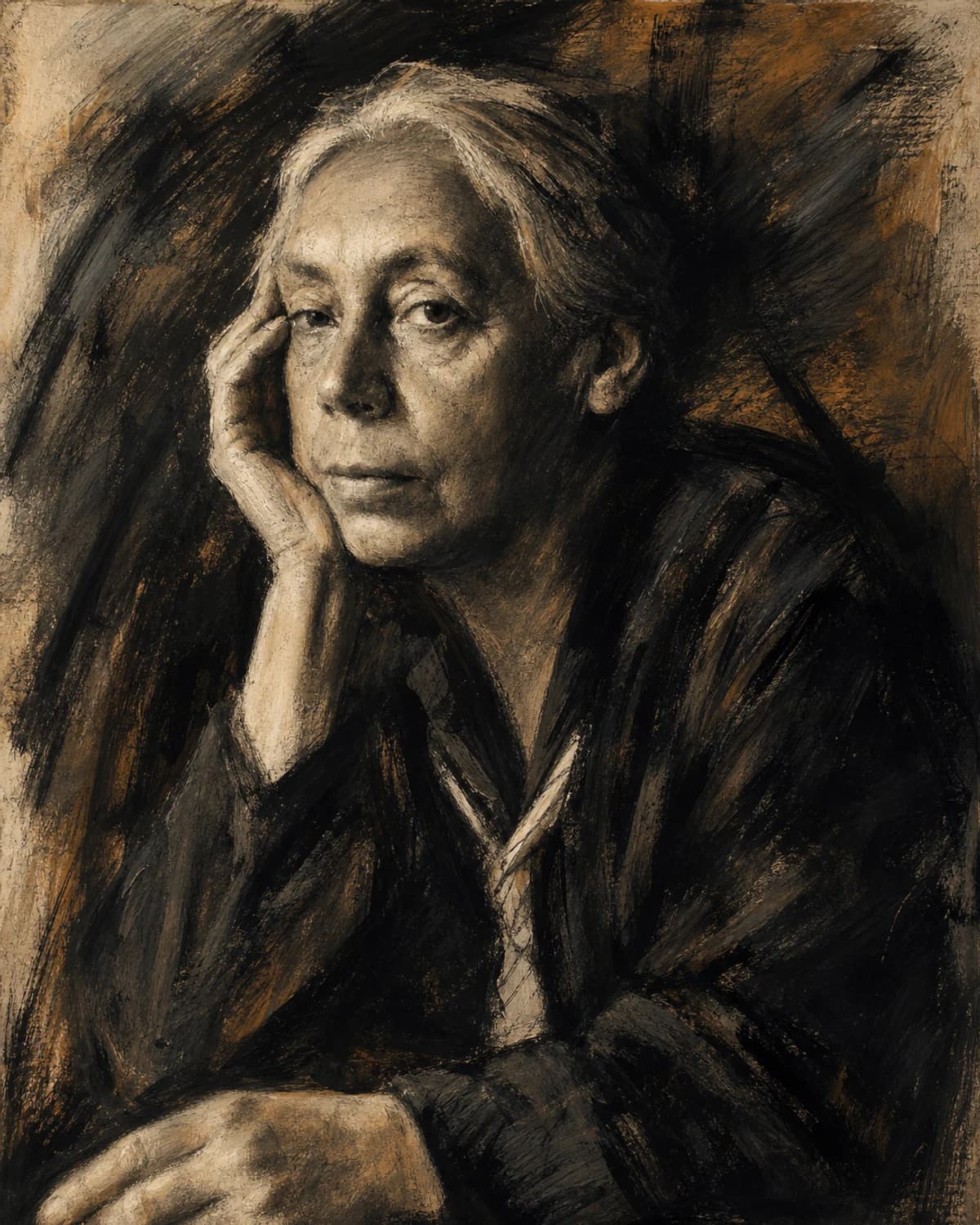
Käthe Kollwitz (1867–1945) made her name with the print cycles “The Weavers” and “The Peasant War”, and after her son was killed at the front in 1914 she worked for almost twenty years on the sculpture group “The Grieving Parents”. In 1919 she became the first woman professor at the Prussian Academy of Arts and in 1933 was forced to leave it. She died in Moritzburg sixteen days before the end of the war in Europe.
Biography
In spring 1898 six prints from “The Weavers” were shown at the Great Berlin Art Exhibition. Adolph Menzel proposed the author for the gold medal. Kaiser Wilhelm II, as her biographers report, refused: orders and medals, he said, belonged on the breasts of worthy men. The artist was thirty, and no other work in Germany at that time could replace her cycle.
Käthe Schmidt was born on 8 July 1867 in Königsberg, Prussia, the fifth child in the family. Her father, Karl Schmidt, a Social Democrat, became a mason and house builder. Her mother, Katherina, was the daughter of Julius Rupp, a Lutheran pastor who had been expelled from the official church and founded an independent congregation; his lessons in religion and socialism strongly influenced her upbringing. Her older brother Conrad became a prominent economist of the Social Democratic Party. She was sent to learn drawing at twelve, on 14 August 1879, by her father’s decision: drawing from plaster casts. Later she studied in Berlin under Karl Stauffer-Bern, and in 1888–1889 in Munich under Ludwig Herterich, where she realized that her strength lay in drawing rather than painting. The etchings of Max Klinger made a great impression on her.
In 1890 she returned to Königsberg, rented her first studio and made her first etchings. In 1891 she married Karl Kollwitz, a doctor who treated poor patients in the north of Berlin, and moved with him into a large apartment above his practice; she lived there until the building was destroyed in the Second World War. She came to know working-class life above all through her husband’s patients. She recalled later that compassion had at first counted for very little: she simply found it all beautiful.
Between the births of her sons, Hans in 1892 and Peter in 1896, she saw Gerhart Hauptmann’s play “The Weavers”, about the revolt of the Silesian weavers in 1844. She abandoned a series of illustrations to Émile Zola’s “Germinal” and took up six prints on the weavers: three lithographs (“Poverty”, “Death”, “Conspiracy”) and three etchings (“March of the Weavers”, “Riot”, “The End”). It is not a literal illustration of the play, nor an idealization of the workers; the prints show misery, hope, courage and, finally, defeat. The series was shown in 1898 and was widely acclaimed, although the author received no medal. From 1898 to 1903 Kollwitz taught at the School for Women Artists in Berlin.
Her second major cycle, “The Peasant War”, took the years from 1902 to 1908, because of the many preliminary drawings and discarded ideas. Its subject was the uprising of the south German peasants in 1524–1525. The series consists of seven etchings, among them “Plowing”, “Raped”, “Arming in the Vault”, “Charge” and “After the Battle”. In the last, a mother searches at night among the dead for her son’s body. To me this is the most disturbing sheet in the cycle, given what happened in her own family six years later. While working on it she visited Paris twice, studied sculpture at the Académie Julian in 1904, and received the Villa Romana Prize for the etching “Outbreak”, which brought her a year in Florence in 1907. By her own account she finished nothing there, but later recalled the impression made on her by early Renaissance art. Her first experiments in sculpture date from 1910.
Peter was killed at the front in October 1914.
By the end of that year she had drawings for a monument to him and his fallen comrades; in 1919 she destroyed the finished work and began again only in 1925. The group “The Grieving Parents” was set up in 1932 in a Belgian cemetery at Roggevelde; when Peter’s grave was moved to the German war cemetery at Vladslo, the statues were moved there too.
In 1917, for her fiftieth birthday, the gallery of Paul Cassirer mounted an exhibition of one hundred and fifty of her drawings. She was a socialist and a pacifist, and she responded to the murder of Karl Liebknecht with a woodcut; for that sheet, having concluded that etching was not enough, she switched to woodcut, inspired by Ernst Barlach. By 1926 she had made about thirty woodcuts. In 1919 she was given the title of professor and became a member of the Prussian Academy of Arts, the first woman among its members. In 1922–1923 came the woodcut cycle “War”, and in 1924 her three best-known posters, among them “Never Again War”. Her work was shown at the first exhibition of German art in Moscow in 1924; in 1927 she visited Moscow herself, and in 1932 a solo exhibition of her work was held in the Soviet Union. In 1928 she took over the Master Class for Graphic Arts at the Academy.
In 1933, after the National Socialists came to power and after she had supported the “Urgent Appeal” (Dringender Appell), she was forced to leave the Academy, and her works were removed from museums. In 1934–1935 she made the cycle of eight lithographs “Death”. In July 1936 the Gestapo visited her and her husband, threatening her with arrest and deportation to a concentration camp; it went no further, because by then she was known abroad as well. For her seventieth birthday in 1937 a solo exhibition was banned; yet more than a hundred and fifty telegrams arrived, along with offers to take her in in the United States, which she declined for fear for her family.
Her husband died in 1940. Her grandson Peter was killed at the front in 1942. In 1943 she was evacuated from Berlin, and the same year her house was bombed, destroying many drawings, prints and documents. She moved first to Nordhausen, then, at the invitation of Prince Ernst Heinrich of Saxony, to Moritzburg near Dresden. There she died on 22 April 1945. She was cremated, and her urn lies in the family grave in the Friedrichsfelde Central Cemetery in Berlin.
Related context
Associations
Works connected through artistic movements, cultural context and period. Priced works available in this market appear first.








Profile notes
Profile and sources
Image
Artist image
На основе открытого изображения: Hugo Erfurth; Wikimedia Commons; Public domain.
