
27.11.1934–present
Kartika Affandi
Kartika Affandi (born 1934) was taught to paint by her father, the artist Affandi, from the age of seven: with her fingers and with paint straight from the tube, without brush or palette. The self-portrait became one of her main themes, and her sitters included fishermen, peasants, beggars and her father himself. She studied conservation in Vienna and Rome and runs the gallery and heritage foundation of Affandi.
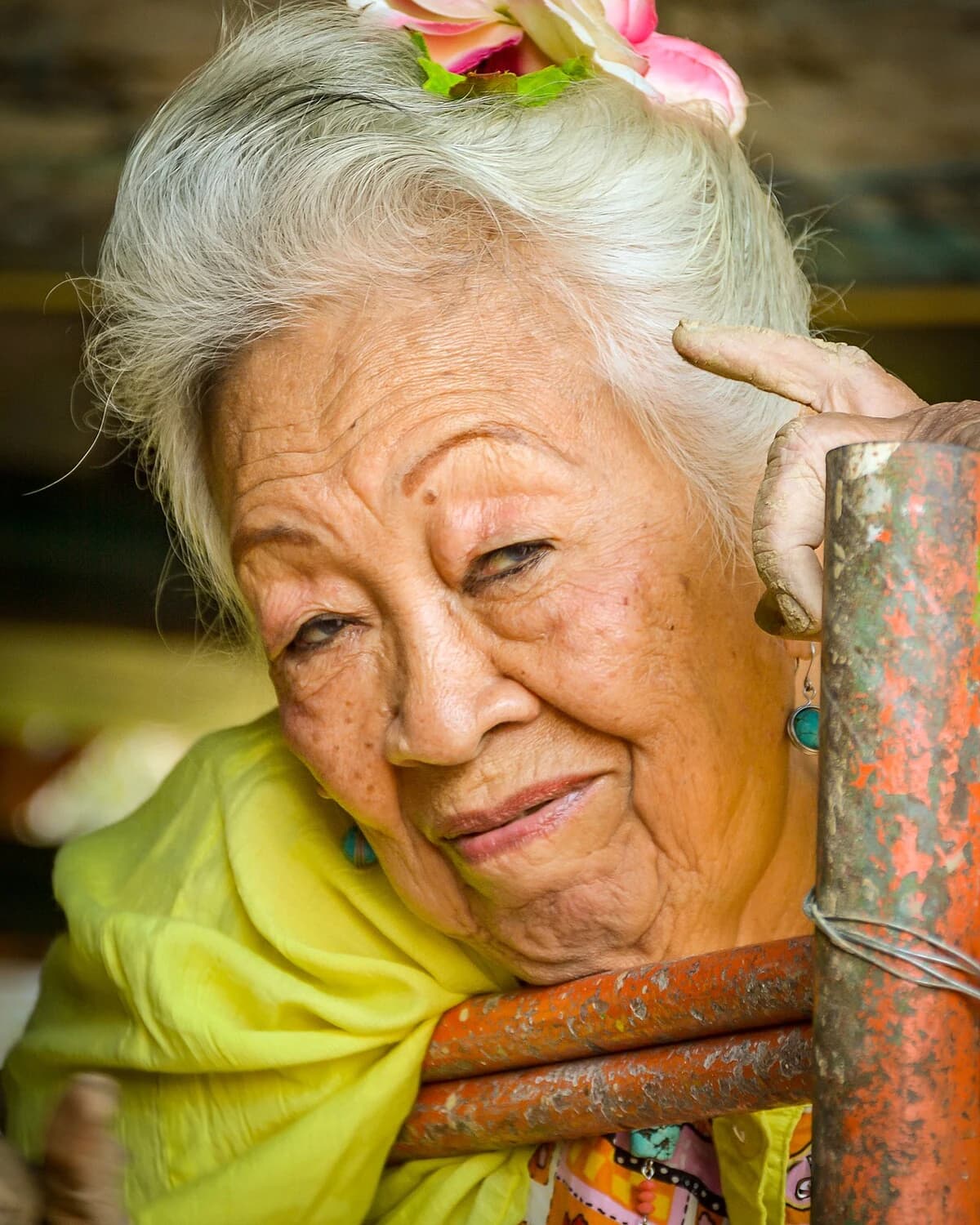
Biography
Her first teacher was her father. From the age of seven Affandi showed his daughter how to apply paint with her fingers and squeeze it from the tube straight onto the canvas, and how to mix colours on her hand and wrist. Kartika kept this method all her life: she has no brush and no palette.
She was born on 27 November 1934 in Batavia, now Jakarta, into a family of artists: her father was Affandi, and her mother, Maryati, also painted. She finished school within the Taman Siswa system, the network of schools founded in the Dutch East Indies as an alternative to colonial education. She then studied at Visva-Bharati University in Santiniketan, India, and at the Polytechnic School of Art in London, where she worked in sculpture; I would check the exact years of her studies separately. Her father, by her own account, never took her painting seriously. He said that society would not accept a woman as an artist, and that if it did, she would remain her father’s shadow. In 1957 Kartika nevertheless took part in a group exhibition of women artists in Yogyakarta. In 1967 she worked with her father on frescoes at the University of Hawaii.
She has no permanent studio. Like Affandi, she prefers to paint outdoors, in the village, beside the people she portrays. Fishermen, peasants, workers and beggars pose while they talk to her and tell her about their lives, which is why these works are better called portraits. Most Indonesian painters of her generation work in the studio, from memory, photographs or sketches. Close up, her canvases break down into energetic strokes of thick oil paint, almost abstract; from a distance they are narrative painting, sometimes gentle and idyllic, sometimes harsh, as in her pictures of beggars, disabled people and suffering animals.
She made the self-portrait one of her main themes. Kartika painted her own nudity directly, without the conventional softening “sweetness”, and the body in these pictures is not an object of pleasure, either someone else’s or her own. She painted her father up to the last years of his life, during his serious illness. Among her other works is “Hindu Priest”: in close-up, an old man walks along a beach, his face absorbed and tense, with none of the Balinese exoticism.
Around 1980 she studied conservation at the Academy of Fine Arts in Vienna, in order to repair Affandi’s deteriorating paintings, and then at the International Centre for Conservation in Rome. The solitude and reflection of those months, in the judgement of scholars, prepared her most unusual portraits.
From the mid-1980s she belonged to a small group of women painters who managed to exhibit regularly and win limited critical recognition. In 1991 her exhibition toured Australia: Canberra, Sydney and Melbourne. In the 1990s she also showed work in the United States; there were further exhibitions in the mid-2000s and in the 2010s. Her paintings are held in many museums.
A documentary about her has been made by the Australian director Christopher Basile, “Kartika Affandi: 9 Ways of Seeing”.
She now runs Affandi’s gallery and cultural heritage foundation.
Profile notes
Profile and sources
Image
Artist image
Charley-ICT; Wikimedia Commons; CC BY-SA 4.0.
