
08.02.1862–18.03.1917
Károly Ferenczy
Károly Ferenczy (1862–1917) took a university degree in law and economics and came to painting as an adult: Italy, the Académie Julian in Paris, the Munich circle of Simon Hollósy. In 1896 he returned to Hungary and, with István Réti and János Thorma, founded the artists’ colony at Nagybánya. From 1906 he taught in Budapest, still returning to the colony each summer.
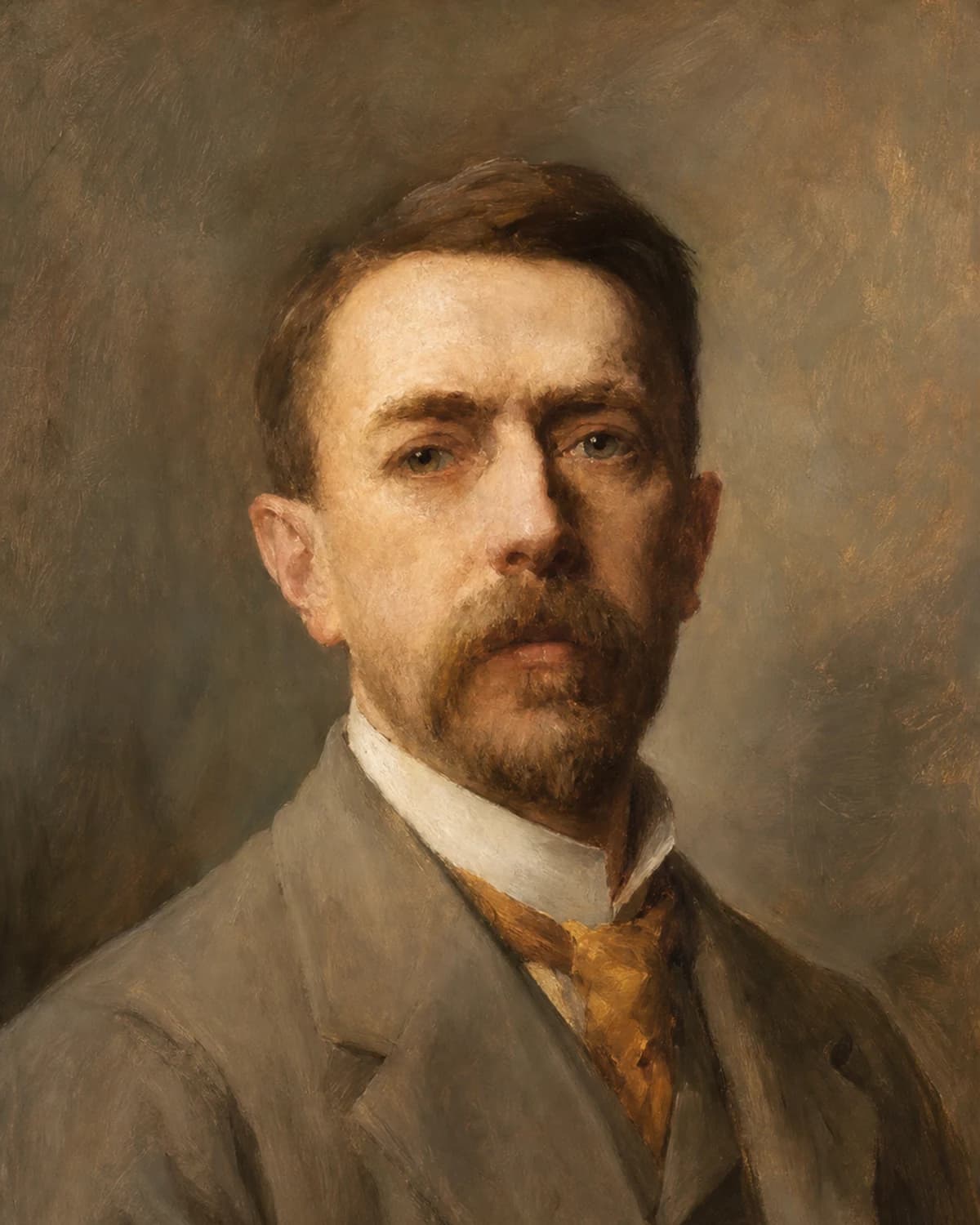
Biography
Károly Ferenczy’s first degree was not in art. He studied law and economics, completed the course, and only then began to paint.
He was born on 8 February 1862 in Vienna. His mother died soon after his birth. His future wife, Olga Fialka, herself a painter, by some accounts encouraged him to paint; he travelled to Italy, and in 1887 began studying at the Académie Julian in Paris. When exactly he visited Italy is not known for certain: both the first half of the 1880s and the period just before Paris are given. In 1889 the family settled in Szentendre, a small town near Budapest. There Ferenczy painted in a naturalistic manner close to Jules Bastien-Lepage, who was then much admired in France. They had three children: Valér was born in 1885 or 1888 (the years given differ), and the twins Béni and Noémi were born in 1890. All three became artists: Valér a painter, Béni a sculptor, Noémi a maker of art textiles. Olga gave up her own painting for the sake of her family and her husband’s career. In 1893 Ferenczy moved the family to Munich, then the art centre of Central and Eastern Europe, and lived there until 1896. He attended the free classes of Simon Hollósy, a Hungarian painter not much older than himself. Hollósy taught his students to look at the French painters and to paint in the open air, and his classes were freer than those at the Munich Academy. In his circle Ferenczy became friends with István Réti and János Thorma. The years of the Munich period are given differently, and 1883–1886 is also found; I take 1893–1896 because they fit the rest of the chronology.
In 1896 the three artists came to Nagybánya together (today Baia Mare, Romania), persuaded Hollósy to move his classes there, and founded a colony where they taught and mentored many Hungarian painters. In winter Ferenczy kept a studio in Budapest, which he retained all his life. At Nagybánya he worked a great deal outdoors.
His first exhibition in Budapest, in 1903, drew enthusiastic reviews from the critics, and from then on he could make a living from his art.
In 1906 he was offered a professorship at the Hungarian Royal Drawing School, from which the Hungarian University of Fine Arts later grew. He moved to Budapest, but returned to Nagybánya every summer to teach, and his name is still linked with the colony. Studio work mattered most to him, and he painted a traditional range of genres: nudes, still lifes, urban scenes with circus performers. In his Budapest years symbolist decorative motifs appeared in his painting; he painted portraits, nudes and Biblical subjects.
Károly Ferenczy died in Budapest on 18 March 1917. In 1972 a museum devoted to the artists of the Ferenczy family opened in Szentendre, at the initiative of Béni’s widow, Erszi Ferenczy; it now bears Károly’s name. The Hungarian National Gallery holds 51 of his paintings, and in November 2011 it opened a retrospective of nearly 150 paintings and 80 prints and drawings, the first such exhibition in a century.
Related context
Associations
Works connected through artistic movements, cultural context and period. Priced works available in this market appear first.








Profile notes
Profile and sources
Image
Artist image
На основе открытого изображения: Károly Ferenczy; Wikimedia Commons; Public domain.
