
12.12.1799–11.06.1852
Karl Bryullov
Karl Bryullov (1799–1852) painted history pictures, portraits, watercolours and dome murals; in the St Petersburg of Nicholas I he was known as “the Great Karl”. European fame, for himself and for the whole Russian school, came with “The Last Day of Pompeii”, which won a gold medal at the Paris Salon of 1834. He was a professor at the Academy of Arts, and Taras Shevchenko was among his pupils.
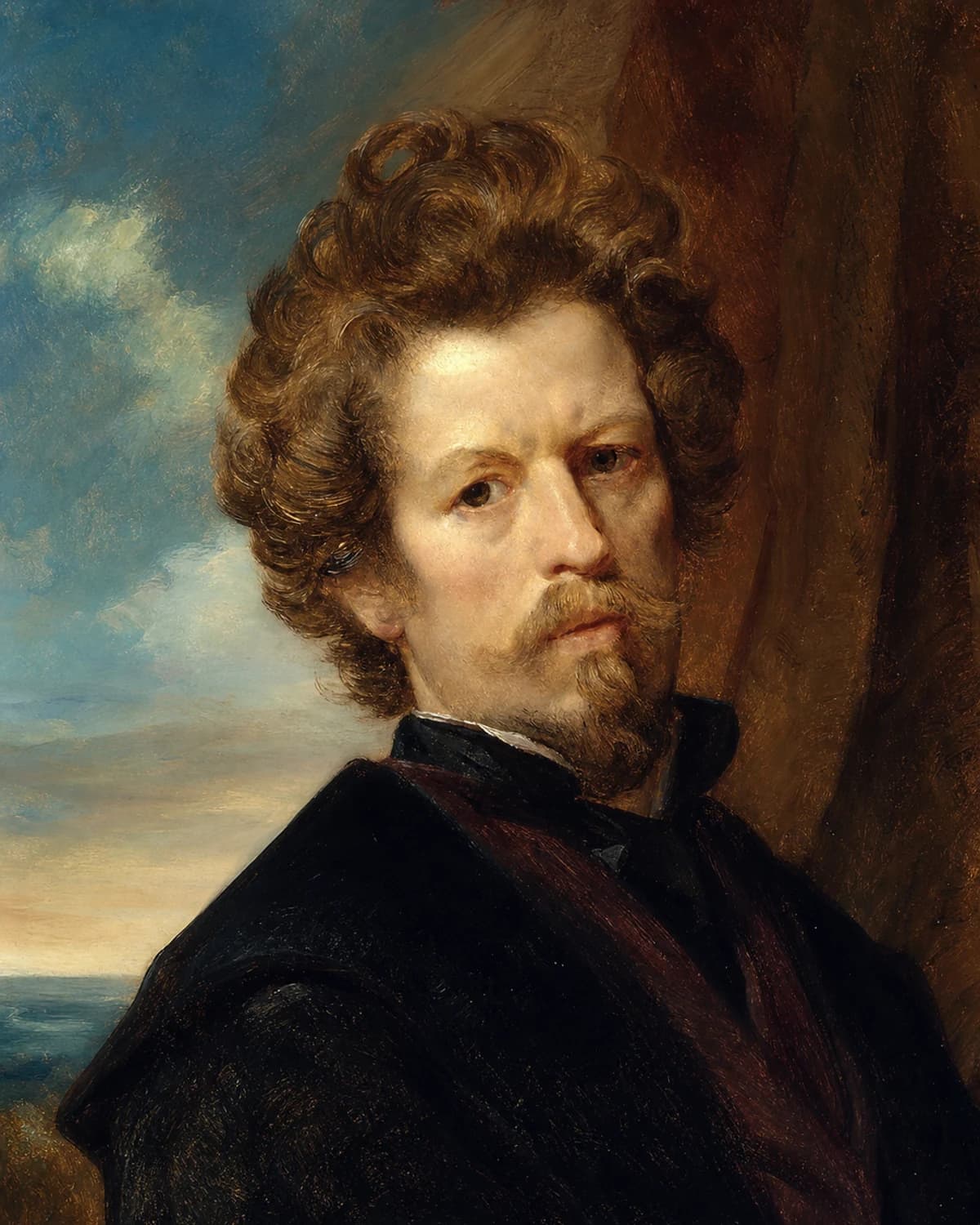
Biography
On the left side of “The Last Day of Pompeii”, among the people fleeing the doomed city, there is a young man with a box on his head. The box holds brushes and paints. This is Bryullov himself, and to my mind that small figure is the easiest place to begin with him: the artist put himself in the crowd, inside the catastrophe, rather than in the seat of a calm spectator.
The picture was brought to St Petersburg in 1834, and for a while, it seems, the city talked of nothing else. Gogol wrote an enthusiastic article about it, and Pushkin jotted down some lines on Vesuvius. Baratynsky answered with a line that everyone went on to repeat: “And ‘The Last Day of Pompeii’ became the first day for the Russian brush.”
Bryullov was born on 12 (23) December 1799 in St Petersburg, and at the time the family name was different: Brullo. His father, Pavel Brullo, an academician of ornamental sculpture, came from French Huguenots who had long been settled in Russia. The “v” was added for the brothers Karl and Alexander in 1822, just before they left for Italy. (Alexander would later become a well-known architect; hence, incidentally, the muddle in some reference books that call Karl an architect.)
He was sent to the Academy of Arts as a boy, in 1809. Twelve years of drawing from antique casts, anatomy, multi-figure compositions on biblical and ancient subjects. His teachers were Andrei Ivanov and Alexei Yegorov, and by all accounts he learned easily. For his graduation programme, “The Appearance of the Three Angels to Abraham at the Oak of Mamre” (1821), he received the major gold medal. The president of the Academy, Alexei Olenin, wanted to keep him on at the Academy, but Bryullov preferred to go to Italy as a stipendiary of the Society for the Encouragement of Artists. In August 1822 the brothers left St Petersburg.
Italy began with things nobody expected of him. “Italian Morning”, “Italian Midday”: a young woman, sunlight, grapes, water, and nothing else. The Society for the Encouragement of Artists grumbled that he had chosen an “ignoble” model. At the same time he was copying Raphael’s “School of Athens”, and in St Petersburg the copy was praised. It seems to me that the whole of Bryullov is already visible here. He could do what the Academy required, and right beside it do something it was certain to dislike.
“Pompeii” was commissioned by Anatoly Demidov. The idea came to him after a visit to the excavations, and the canvas was painted in 1830–1833. The subject is drawn from history, not myth: the destruction of the city in the eruption of Vesuvius in AD 79. There is no main hero. There is a crowd: a mother clutching her daughters to her, sons carrying their old father in their arms, a woman who has fallen from a chariot. Such a choice is very much of the Romantic age. The composition, though, is strictly academic, the groups are balanced, and the lightning picks out the figures like stage lighting. The canvas was shown in Rome and Milan, won a gold medal at the Paris Salon of 1834, and Demidov then presented it to Nicholas I. Today the painting is in the Russian Museum.
Bryullov took a long road home, through Greece and Turkey. Moscow, where he stayed for several months, gave receptions in his honour, and at one of them he met Pushkin. In 1836 he was fêted at the Academy of Arts, and from that same year he taught there as a professor.
For the next thirteen years he was the central figure of artistic life in St Petersburg; people called him “the Great Karl” without irony. Above all there were portraits. “The Horsewoman” (1832), with young Giovannina Pacini on a black horse, was still painted in Italy, while in St Petersburg came, one after another, Nestor Kukolnik (1836), Vasily Zhukovsky (1837–1838), Ivan Krylov (1839) and Alexander Strugovshchikov (1840). Look at them in a row and you get a portrait of a generation: thoughtful, nervous people, a little tired of their own time. He painted himself in 1848, already ill. A pale face, an armchair, a hand hanging limp from the armrest. That self-portrait is the one I would show to anyone who thinks of Bryullov only as a master of effects.
The Shevchenko story is well known, but it is worth recalling: in 1838, to buy the young serf artist his freedom, Bryullov’s portrait of Zhukovsky was raffled off in a lottery.
The large projects of the 1840s fared worse. “The Siege of Pskov by the Polish King Stefan Batory” was never finished. For Saint Isaac’s Cathedral he undertook to paint the main dome and the pendentives and completed almost all the principal figures of the ceiling, but illness made him ask to be released from the work. The background and the remaining pictures were finished from his cartoons by Pyotr Basin.
On 27 April 1849, at his doctors’ insistence, Bryullov left for treatment on Madeira. There he painted watercolour portraits of friends and acquaintances, then moved on to Italy, and in the spring and summer of 1850 travelled to Spain to look at Velázquez and Goya. He died on 11 (23) June 1852 at Manziana near Rome. He is buried in the Non-Catholic Cemetery at Testaccio in Rome.
Related context
Associations
Works connected through artistic movements, cultural context and period. Priced works available in this market appear first.








Profile notes
Profile and sources
Image
Artist image
На основе открытого изображения: Karl Bryullov; Wikimedia Commons; Public domain.
