
26.11.1969–present
Kara Walker
Kara Walker (born 1969) cuts life-size silhouettes out of black paper and assembles them into panoramas of the slaveholding American South; the first such wall, “Gone”, appeared in 1994, when she was twenty-four. In 2014 she built a sphinx of sugar about twenty-three metres long in the closing Domino refinery in Brooklyn. She teaches at Columbia and Rutgers.
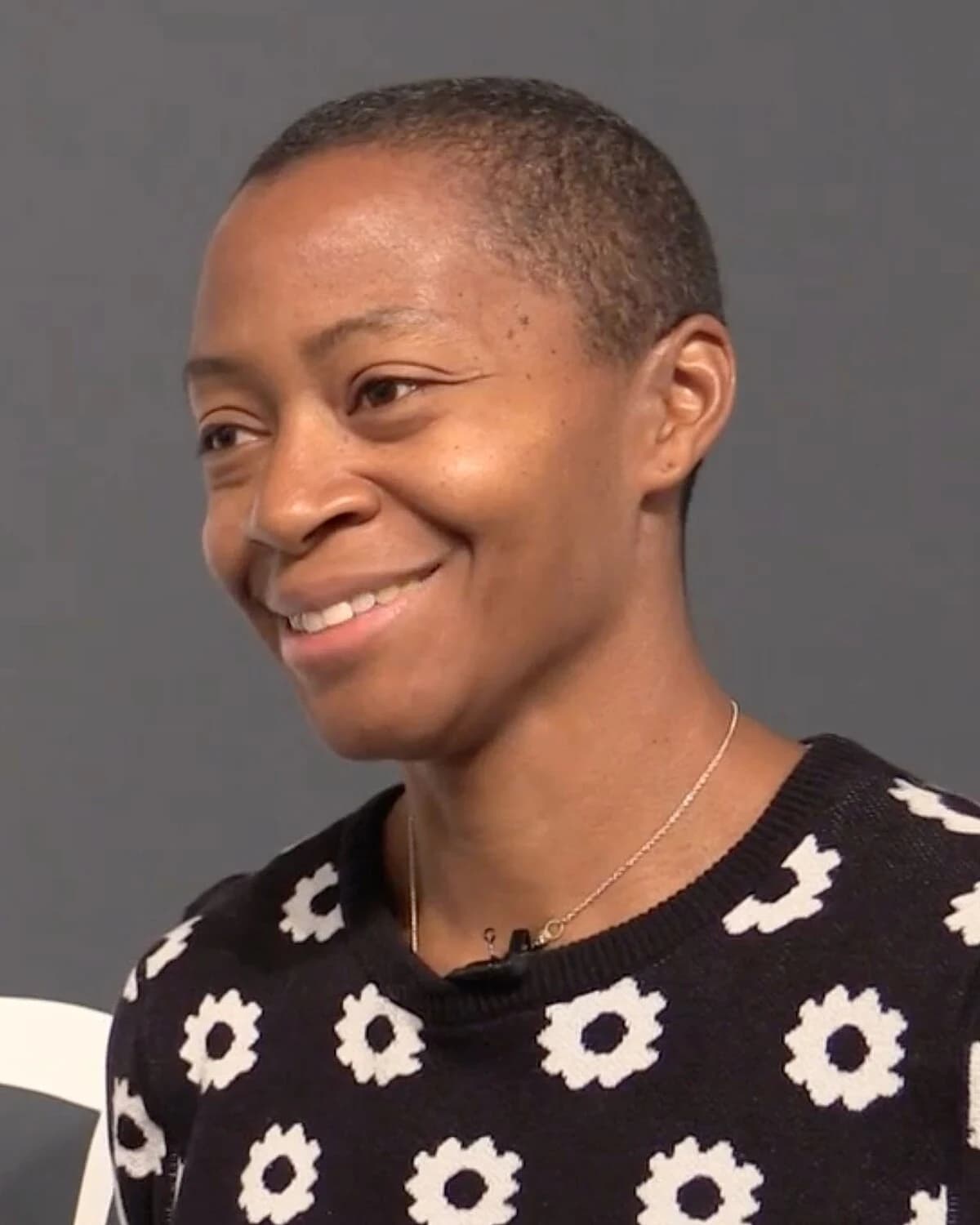
Biography
In the spring of 2014, in an empty shed of the Domino sugar refinery in Williamsburg, Brooklyn, which was being prepared for demolition, Kara Walker set up a sphinx: about twenty-three metres long and nearly eleven high, made of machine-cut polystyrene blocks coated with eighty tons of white sugar. The sphinx had the face of a “mammy”, the stereotyped Black nursemaid. In front of it stood fifteen life-size boys: five cast in sugar, ten in resin coated with molasses. Over eight weekends more than a hundred and thirty thousand people came, after which the factory and the sculpture were demolished, as had been planned.
Walker was born on 26 November 1969 in Stockton, California. When she was thirteen her father, the painter Larry Walker, took a post at Georgia State University, and the family moved to Stone Mountain, outside Atlanta.
She took her bachelor’s degree at the Atlanta College of Art in 1991 and her master’s in painting at the Rhode Island School of Design in 1994. In her first college years she avoided the subject of race, afraid it would be taken as “typical”, and only turned to it in graduate school. The 1994 wall “Gone, An Historical Romance of a Civil War”, its title pointing to Margaret Mitchell’s “Gone with the Wind”, was assembled from black paper silhouettes on a white wall: an antebellum South full of sex and slavery, with figures resembling Disney animation of the thirties. The silhouette in American art had been a genteel genre of family portraits and book vignettes; Walker turned it into a panorama of violence, enclosing the viewer in a circle, as in the cycloramas of the nineteenth century, between Spanish moss on the trees and a huge moon behind clouds. In 1997 she took part in the Whitney Biennial and that same year, still short of thirty, received a MacArthur fellowship, one of the youngest in the award’s history; the sources disagree on her exact age, twenty-seven or twenty-eight. At the same time the artist Betye Saar sent two hundred colleagues a letter against her “revolting” stereotypes; in 1998 Harvard held a symposium on racist imagery in her work; and in 1999 the Detroit Institute of Arts withdrew her “The Means to an End” from an exhibition after protests by Black artists and collectors.
She described her method as “two parts research and one part paranoid hysteria”.
In “Insurrection!” of 2000 the silhouettes were laid over coloured light projections, and the viewers’ shadows fell on the wall alongside the figures. In 2002 Walker represented the United States at the São Paulo Biennial. In 2005 came “8 Possible Beginnings”, with moving images, shadow puppets and sound; in 2006 the Metropolitan Museum showed “After the Deluge”, a response to Hurricane Katrina. In 2007 the Walker Art Center in Minneapolis mounted the first museum survey of her work, “My Complement, My Oppressor, My Enemy, My Love”, which travelled to the Whitney, the Hammer Museum and Paris; that year “Time” put her among the hundred most influential people. Then came “Katastwóf Karavan” of 2018 for the New Orleans festival, an old-time wagon with silhouettes along its sides and a steam calliope playing songs of Black protest; the fountain “Fons Americanus” of 2019 in the Turbine Hall of Tate Modern, up to four metres high, with a nod to the Victoria Memorial outside Buckingham Palace and to Turner’s “The Slave Ship”; and a retrospective of drawings at the Kunstmuseum Basel in 2021. In 2023 she took a plasma cutter to the decommissioned Charlottesville bronze of the Confederate general Jackson by Charles Keck and reassembled the pieces as “Unmanned Drone”; the work entered the 2025 exhibition “Monuments” in Los Angeles, which Walker co-curated with Hamza Walker and Bennett Simpson. From July 2024 to May 2026 her “Fortuna and the Immortality Garden (Machine)” stood in the San Francisco Museum of Modern Art.
Since 2003 Walker has taught visual arts in the graduate programme at Columbia University, and since 2015 she has held the Tepper Chair at the Mason Gross School of the Arts at Rutgers. In 2012 she was elected to the American Academy of Arts and Letters, in 2018 to the American Philosophical Society, in 2019 an Honorary Royal Academician of the Royal Academy of Arts in London. Her work is in the Metropolitan Museum, Tate, the Museum of Contemporary Art, Los Angeles, and the Menil Collection in Houston. In 2017 a mosaic portrait of her by Chuck Close was installed in the New York subway station at 86th Street.
Profile notes
Profile and sources
Image
Artist image
studio international; Wikimedia Commons; CC BY-SA 3.0.
