
10.02.1800–21.08.1860
Kanuty Rusiecki
Kanuty Rusiecki (1800–1860) studied in Vilnius, Paris and Rome, where he was the informal leader of the Polish artists, and from 1831 lived in Vilnius and taught drawing. He painted altarpieces, landscapes, watercolour portraits and scenes of peasant life. About 330 of his works were kept in the studio of his son Bolesław and later passed to museums.
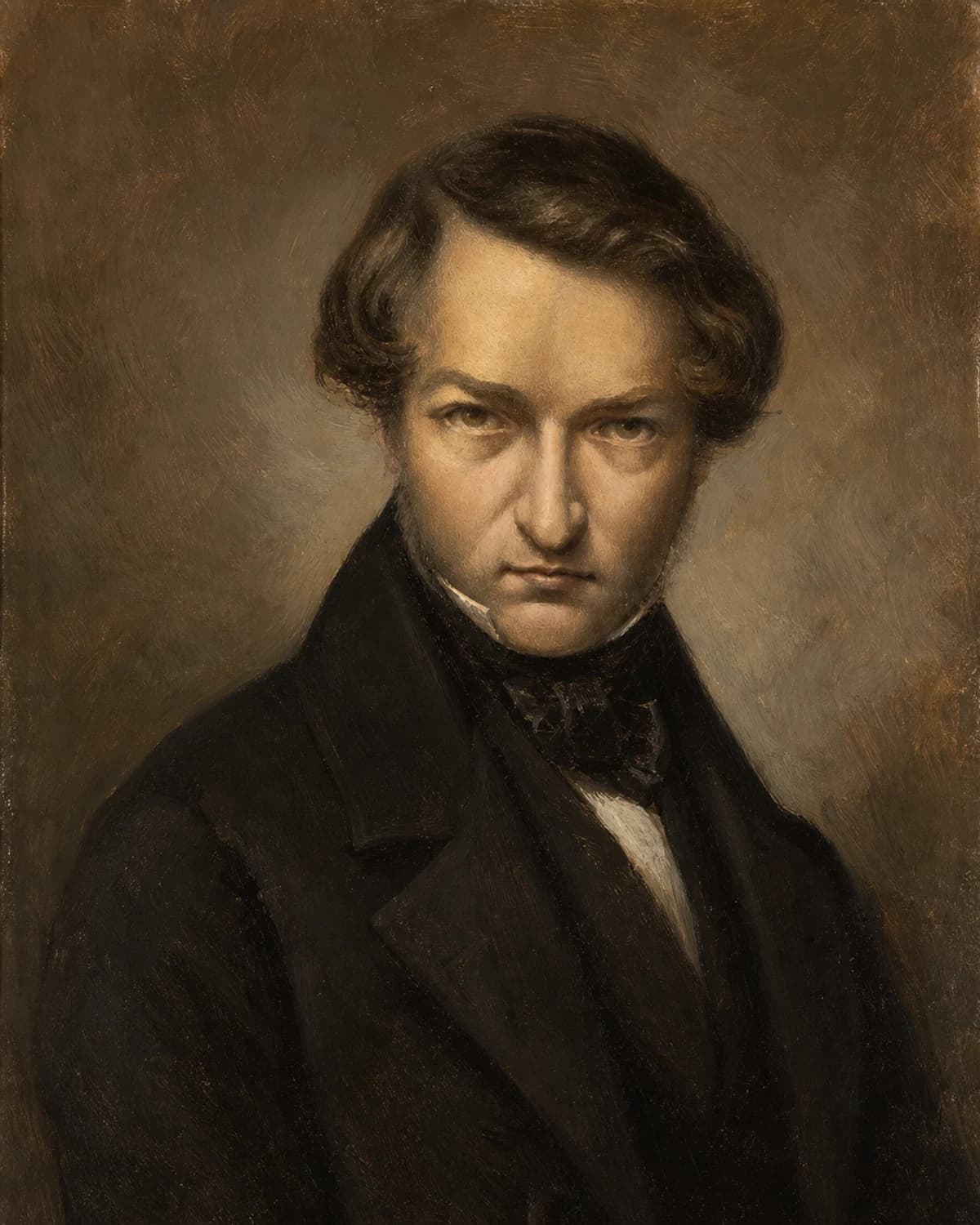
Biography
In 1927 restorers working on the icon of Our Lady of the Gate of Dawn found that the crossed hands of the Virgin, in their present form, were not part of the original image. They had been painted by Rusiecki when he renovated the icon.
He grew up in an impoverished noble family. His father, Jan Rusiecki, was a magistrate in Vilnius; his mother was Teresa, née Romanowicz. He finished the primary school run by the Bernardine monks at Troškūnai in 1815, and in 1816 entered Vilnius University: first law, then architecture as well, in the faculty of physics and mathematics. In 1818 he moved to the school of art under Jan Rustem and from then on worked only at painting; sculpture he learned from Kazimierz Jelski. He made his debut at the first Vilnius exhibition of fine arts in 1820, and at the university he came close to the Philomaths, a secret society of Polish students.
In 1821–1822 he studied in Paris, at the École des Beaux-Arts, under Guillaume Guillon-Lethière. In a diary entry of 17 June 1822 he wrote that, once back in his homeland, he would not look for subjects among the Greeks and Romans, because they were exhausted, but would work with the history of his own country. He then moved to Rome and from 1823 studied at the Accademia di San Luca under Vincenzo Camuccini, and took sculpture lessons in the workshop of Bertel Thorvaldsen. There he became the informal leader of the Polish artists and was the first to put forward a programme for Polish Romantic art. He painted Roman landscapes and portraits, and copied Raphael and Titian. In 1826 he received a scholarship from Vilnius University for study abroad. Among his Italian works are “The Smiling Italian” (1823), “The Oath of the Carbonari” (1826) and “The Flight into Egypt” (1828).
He returned to Vilnius in 1831 and at first gave private drawing lessons. From 1834 he taught at the boarding school for the nobility attached to the gymnasium, later at the Institute for the Nobility. Albert Žamett, Alfred Römer, Tadeusz Horecki and Jan Zienkiewicz began their studies with him. From 1839 he sat on the committee for the restoration of Vilnius Cathedral, restored paintings in the Chapel of St Casimir and painted altarpieces for churches, among them the Church of St Teresa and those of small towns. In 1841 he travelled to the Białowieża Forest and made studies from nature there for “The Bison Hunt”, on which he worked in 1844–1851. In 1843 he visited St Petersburg, and in 1852 his “St Mary Magdalene” was shown at an exhibition of the Imperial Academy of Arts, for which he received a cash prize. In 1856–1858, together with Wincenty Dmochowski and Jelski, he tried without success to open a public gallery and an art school in Vilnius: the local authorities did not support him.
His later works are closer to peasant life: “The Reaper” and “Portrait of the Artist’s Father” (1845), “Lithuanian Girl with Palm Sunday Fronds” (1847), “Peasant with Brooms” (1851), “Lithuanian Fisherwoman” (1856). He repeated the “Lithuanian Girl” several times. According to one view, the original shows a Belarusian woman in folk costume against the background of St Michael’s Church in Vilnius; Ivan Lutskevich bought it for the Belarusian Museum, and today it is shown in Minsk. The three large canvases in the Cathedral of Sts Stanislaus and Ladislaus in Vilnius, “The Annunciation”, “The Flight into Egypt” and “The Last Supper” (1855), are also his.
He was married to Antonina Czerwińska, and they had five children: Anna, Bolesław, Tadeusz, Michał and Prosper. Bolesław also became a painter.
Rusiecki died in Vilnius on 21 August 1860 and was buried in the Bernardine Cemetery in Užupis. His studio was kept by Bolesław, who in 1913 gave his father’s works to the Vilnius museum. About 330 of them are now in the Lithuanian Art Museum; there are also works in museums in Kraków, Warsaw, Telšiai and Minsk. The fate of most of the large canvases from private collections and churches is unknown. His biographer Vladas Drėma thinks that much has most likely been lost.
Related context
Associations
Works connected through artistic movements, cultural context and period. Priced works available in this market appear first.








Profile notes
Profile and sources
Image
Artist image
На основе открытого изображения: autor nieznany; Wikimedia Commons; Public domain.
