
1417–1464
Kang Hŭian
Kang Hŭian, a scholar and painter of the early Joseon period, regarded painting as an idle pastime and turned away those who asked him for pictures, so little of his work survives. He passed the gwageo examination in 1441, served in the Hall of Worthies under Sejong, took part in work on the hangul script and wrote the first Korean treatise on gardening. The best-known work attributed to him is “A Scholar Contemplating Water”.
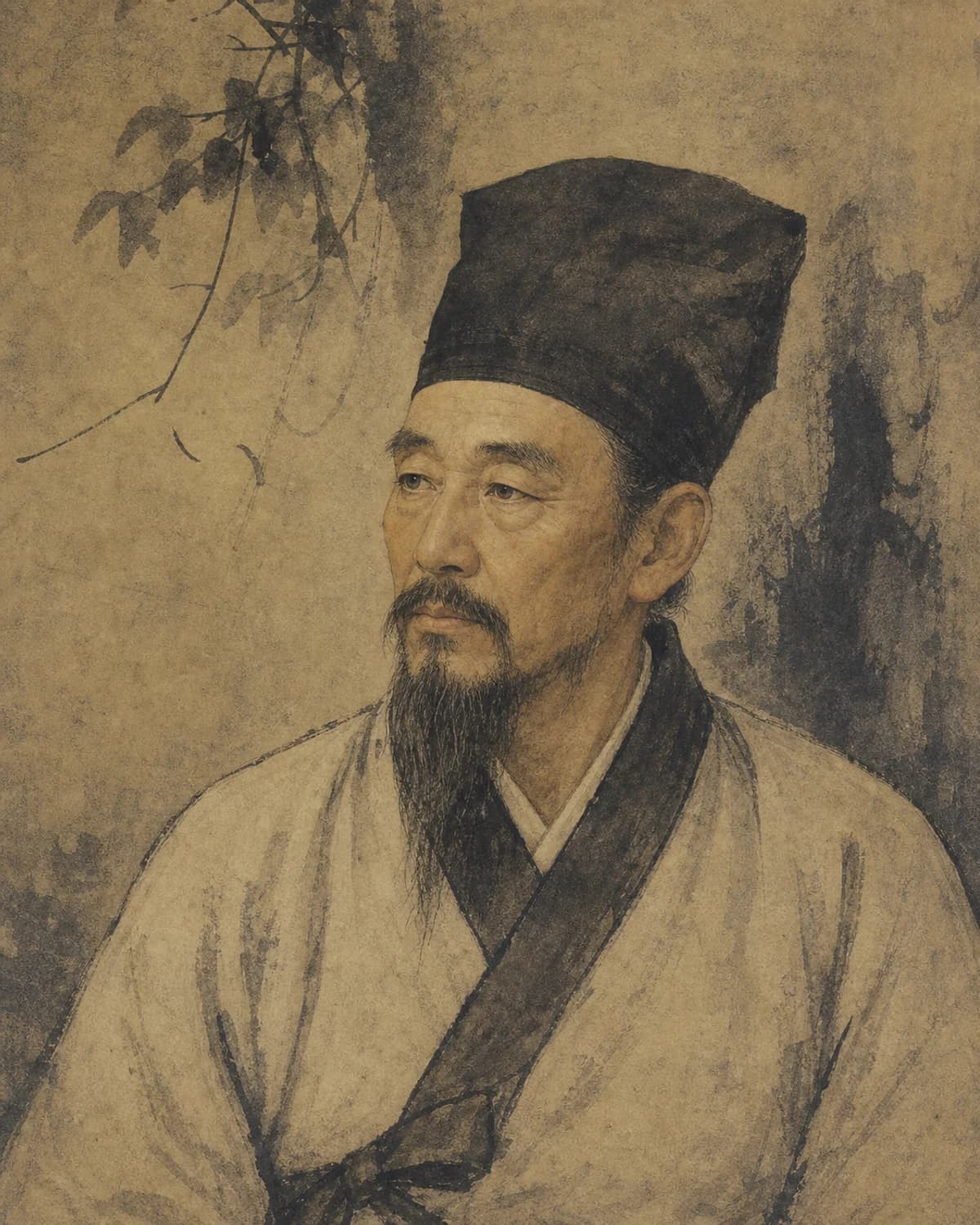
Biography
The year of Kang Hŭian’s birth is not known for certain: some sources give 1417, others 1419, and none of the authors explains the discrepancy. The year of his death is also given differently, 1464 or 1465; 1464 is the more common.
His family was distinguished. His father, Kang Sŏktŏk (1395–1459), was a relative of the ruling house: Hŭian’s mother was a daughter of Sim On and a sister of Queen Soheon, the wife of Sejong, so that the king was his uncle by marriage to his maternal aunt, and the future rulers Munjong and Sejo were his cousins. His younger brother Kang Hŭimaeng (1424–1483) also became a well-known writer and painter. His grandfather and father were, according to tradition, accomplished in the “three perfections”: poetry, calligraphy and painting. Hŭian himself took the art name Injae.
He passed the gwageo, the state civil service examination, in 1441, during Sejong’s reign. His career then continued in the Hall of Worthies (Jiphyeonjeon), the royal academy, where he held the post of jikhakse. Together with Sin Sukchu, Sŏng Sammun and Chŏng Inji he took part in compiling the explanations of the “Hunminjeongeum”, the new Korean alphabet, and in the commentaries on the “Songs of the Dragons Flying to Heaven”. According to tradition, Sejong trusted him to write the inscription for the royal seal, as no one better at writing could be found at the time.
Painting was, for him, a second-rate occupation. In old age he spent his time on poetry, calligraphy and drawing, but he accepted no commissions from others, calling it a lowly craft. It is said that he was embarrassed by the thought of his pictures passing to posterity; that might explain why so little has survived. Mentions are known of his landscapes, plum blossoms, bamboo, flowers, grasses and insects. He preferred ink to colour. In 1462, according to some accounts, he visited China, studied the works of the Ma–Xia school, and local artists spoke well of his pictures. Embassies of 1455 and 1462 are also mentioned; how far he really had contact with Chinese painters such as Dai Jin is hard to verify. I think it safer to speak only of a journey and an acquaintance with Chinese painting.
The best-known work linked with his name is “A Scholar Contemplating Water” (in Korean, “Gosa gwansudo”). A man lies in a relaxed pose on a rock by the water, leaning against it, and gazes into the distance. The sparse composition, with only a large rock, a tree and an empty background, derives from the landscapes of the Southern Song masters. But the attribution of the sheet is disputed: Burglind Jungmann, for example, finds in its dynamic brushwork a resemblance to the second generation of the Korean Zhe school, and a similar print appears in the “Mustard Seed Garden Manual of Painting”, published in the late seventeenth century. The sheet is probably of a later date.
Hŭian is also credited with the “Yanghwa sorok”, regarded as the first Korean treatise on growing flowers and plants in gardens.
He died in 1464, or by other accounts in 1465. Ri Pulhae, Ham Yundŏk, Yun Ingol and Yi Kyŏngyun are named as followers of his manner, and his influence on the Zhe school in Korea lasted until the middle of the Joseon period.
Related context
Associations
Works connected through artistic movements, cultural context and period. Priced works available in this market appear first.
Profile notes
Profile and sources
Image
Artist image
На основе открытого изображения: Kang, Huian; Wikimedia Commons; Public domain.
