
11 июня 1815–26 января 1879
Julia Margaret Cameron
Julia Margaret Cameron picked up a camera at forty-eight: a Christmas present from her daughter and son-in-law, meant to amuse her in her solitude on the Isle of Wight. She turned a henhouse into a glass studio and in eleven or twelve years made about nine hundred photographs: large close-up heads of Tennyson, Carlyle and Darwin, and scenes from the Bible and literature. Critics scolded her for soft focus, but in 1865 a museum bought eighty of her prints.
Biography
On 29 January 1864 Cameron photographed nine-year-old Annie Philpot and called the picture her first real success. She sent the print to the girl’s father with a note saying that everything, from taking the picture to toning and framing it, had been done by her alone the same day, between one o’clock in the afternoon and eight in the evening.
By then she had owned the camera for about a month.
She was born on 11 June 1815 at Garden Reach, near Calcutta, the daughter of James Pattle, who served in the East India Company, and Adeline de l’Etang, the daughter of a French aristocrat. As a girl she was sent to France, and from 1818 to 1834 she lived with her grandmother at Versailles, then returned to India. In 1835, recovering her health at the Cape of Good Hope, she met the astronomer and photochemist Sir John Herschel and Charles Hay Cameron, a lawyer twenty years her senior. They were married in Calcutta on 1 February 1838. Herschel became godfather to their first child and later told her about the invention of photography, and in 1842 he sent her two dozen calotypes and daguerreotypes: the first photographs she ever saw. In Calcutta she entertained as a hostess of Anglo-Indian society, and in 1845 the family moved to England. In London Cameron visited her sister Sara Prinsep at Little Holland House, where Pre-Raphaelite painters, poets and aristocrats gathered; there she met Henry Taylor and Alfred Tennyson. In 1847 she published a translation of Bürger’s ballad “Leonora”. In 1860 the family bought a house next to Tennyson’s at Freshwater on the Isle of Wight and named it Dimbola, after one of their coffee plantations in Ceylon. A private gate led to the neighbours, and in both houses there were musical evenings, poetry readings and amateur plays.
She learned to use the camera with no teacher. The coal-house became her dark room and a glazed henhouse, built for the children, her studio; the hens, she wrote, were set free and, she hoped, not eaten. She wiped out her first picture by rubbing her hand over the emulsion side of the glass. She worked with the wet collodion process and printed on albumen paper from glass negatives.
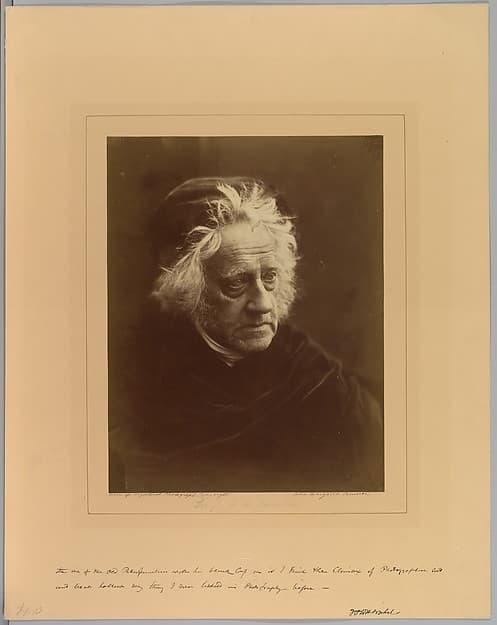
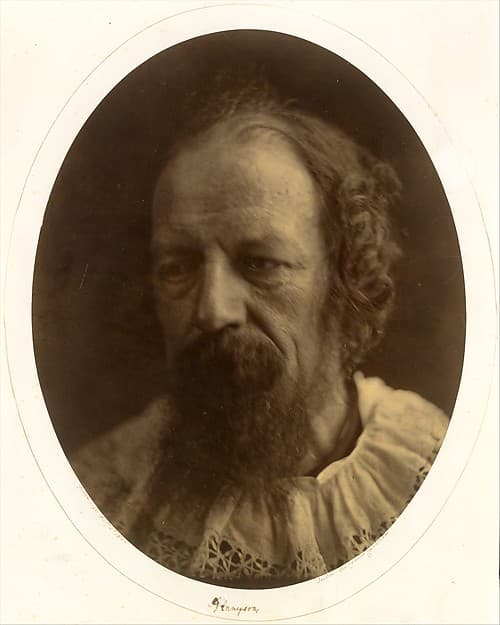
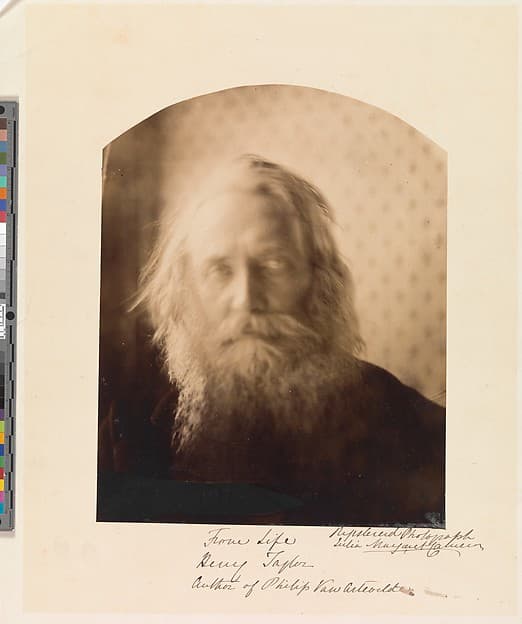
Her sitters were relatives, neighbours, servants and famous visitors. Tennyson, Darwin, Carlyle, Herschel, Robert Browning, Henry Wadsworth Longfellow, the painter George Frederic Watts, Henry Taylor: she treated the men almost with reverence and wrote to Carlyle that such a photograph was for her “almost the embodiment of a prayer”. She photographed women more gently and almost always young ones; according to a story told by a biographer of Darwin, she refused to photograph his wife, remarking that no woman should be photographed between the ages of eighteen and seventy. Her servant Mary Hillier posed as the Madonna many times: there are more than fifty such images of the Virgin. She also took subjects from Shakespeare, Tennyson, Christina Rossetti and George Eliot. The children in her group scenes did not always cooperate, and their boredom or indignation stayed in the frame.
Her contemporaries were severe. In 1865 The Photographic Journal wrote of “out-of-focus portraits”, and The Photographic News suggested hiring a small boy with a wash leather to rub the dirt off the prints. Yet in that same year she joined the Photographic Society of Scotland, arranged for her prints to be sold through the London dealers Colnaghi, held her first solo exhibition and won awards in Berlin. In August the South Kensington Museum, now the Victoria and Albert Museum, bought eighty of her photographs, and three years later gave her two rooms for a portrait studio; she became the museum’s first artist-in-residence. She considered her finest work to be “The Kiss of Peace” (1869).
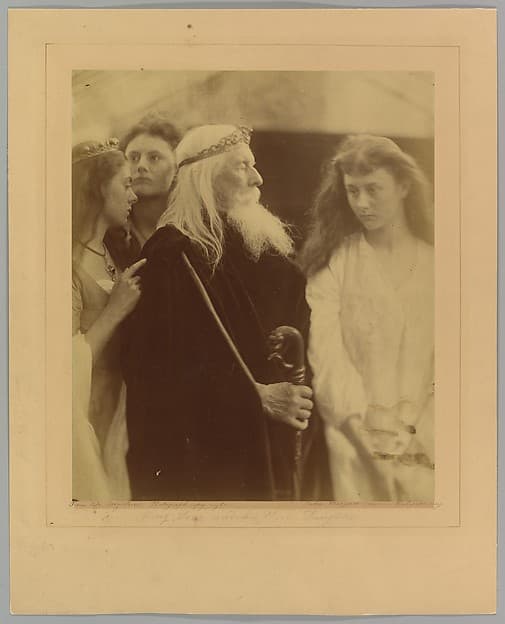
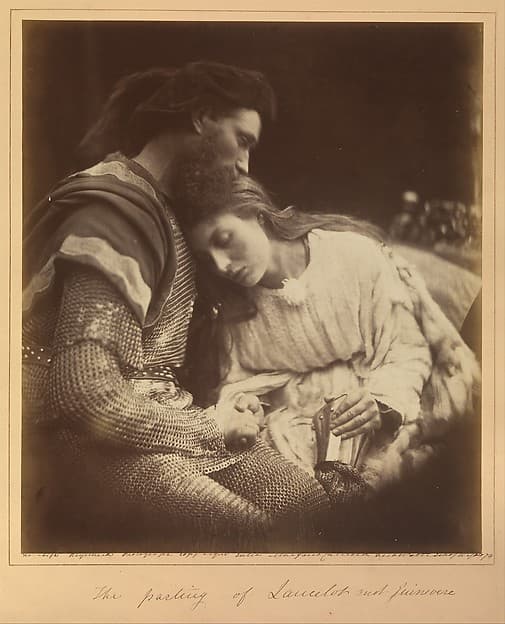
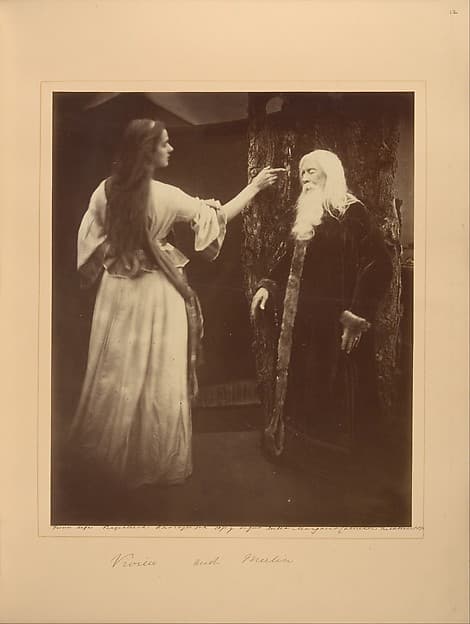
In 1874 Tennyson asked her to make illustrations for his “Idylls of the King”. In a few months she took about two hundred and fifty exposures. According to some accounts, only three small pictures were printed in the book, and she was unhappy with the result; she then published her own album of twelve large-format prints, which was not a commercial success. To my mind, it is these late scenes that show how far she went in wanting to make photography “High Art”: she herself wrote that she wished to combine the real and the ideal, sacrificing nothing of truth.
In October 1873 her daughter died. In 1875 the Camerons left for Ceylon, where their sons managed the coffee plantations. She took with her a cow, her photographic equipment and two coffins. The island lacked clean water, and collodion did not stand up well to the heat; fewer than thirty photographs survive from these years, mostly of Tamil servants and workers. She died on 26 January 1879 at the Glencairn estate near Kalutara. It is commonly reported that her last word was “beauty”.
Artist works
Works by the artist
Works by Julia Margaret Cameron available in this edition of NEOARCA.

Related context
Associations
Works connected through artistic movements, cultural context and period. Priced works available in this market appear first.
Profile notes