
17.05.1877–09.03.1896
Juana Borrero
Juana Borrero wrote her first poem at seven, studied painting at the San Alejandro academy in Havana and with Armando Menocal, and lived only eighteen years. She left the collection “Rimas” (1895), an extensive correspondence and a few paintings of everyday scenes; two of them, “Los pilluelos” and “Las niñas”, are in the National Museum of Fine Arts of Cuba.
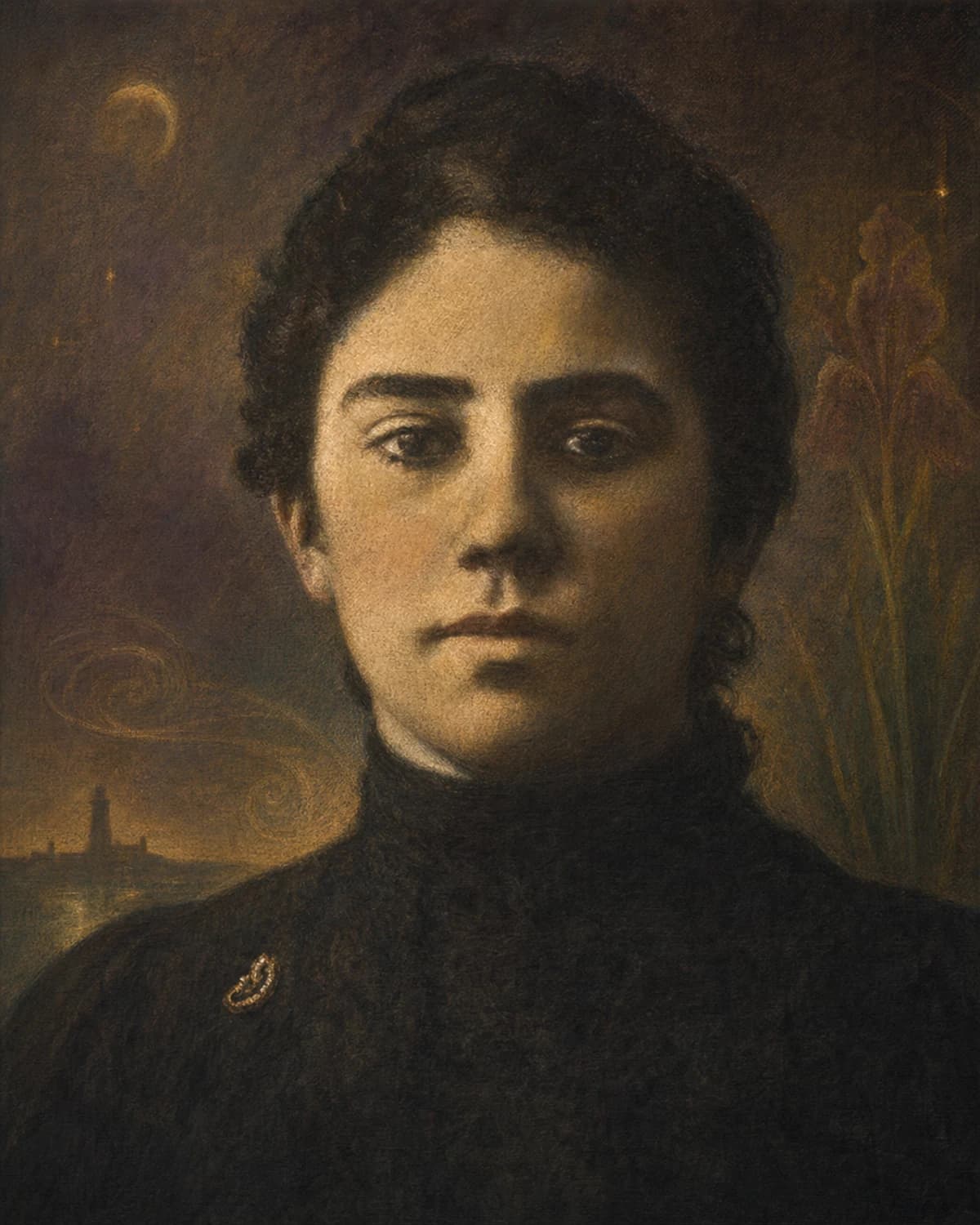
Biography
In 1892, at Chickering Hall in New York, José Martí held an evening in honour of a fifteen-year-old Cuban girl, Juana Borrero. She had come to New York with her father, the writer Esteban Borrero: officially to study painting, though her father also used the visit to meet exiles from the Cuban Revolutionary Party.
She was born in May 1877 in the Havana district of Santos Suárez, when Cuba was still a Spanish colony.
The Borrero house was a literary one. Her father, Esteban Borrero Echeverría, a doctor, poet and writer of stories, received writers at home; among the visitors were the brothers Carlos Pío and Federico Uhrbach and the poet Julián del Casal, a friend of the family, who encouraged the girl to write. Her mother was Consuelo Pierra. Juana’s sister, Dulce María Borrero, also became a poet and in 1914 published a book of verse. Juana herself was considered a child prodigy: she wrote her first poem at seven and by ten spoke several languages. She had begun drawing even earlier, took her first lessons from Dolores Desvernine, and in the mid-1880s entered the San Alejandro Academy of Fine Arts in Havana. She also studied with Armando Menocal, one of the most prominent Cuban painters of his century. By 1891 her poems were being printed in the Cuban magazines La Habana Elegante, El Fígaro and Gris y Azul.
In 1893 she returned from New York to Cuba. Her poems were included in an anthology of Cuban women writers compiled by Manuela Herrera de Herrera, and in 1895 in the family collection “Grupo de familia, poesías de los Borrero”. That same year her only book appeared, “Rimas”, which contained the poems “Indomable”, “Sol y nieve”, “Íntima”, “En el templo” and “Rêve”.
She left few paintings. They are everyday scenes, painted in the manner of the academic school, attentively and in bright colour. “Los pilluelos” (The Urchins) and “Las niñas” (The Girls) are in the National Museum of Fine Arts of Cuba; “Doña Crucecita” and “El señor de la tabaquera” (The Gentleman with the Snuffbox) are also known. Drawings survive in the margins of her letters as well. I have not been able to find detailed descriptions of the paintings themselves, and I would not judge them by their titles alone.
The letters make up perhaps the main part of her legacy. Her extensive correspondence with the poet Carlos Pío Uhrbach was published in Havana in two volumes in 1966–1967.
In 1895 the war of independence began in Cuba. Esteban Borrero was connected with its supporters, and the family had to leave for the United States, for nearby Key West. Her last poem, “Última rima”, Juana no longer wrote down herself but dictated. She died in Key West on 9 March 1896, at the age of eighteen.
She was buried in a vault belonging to friends of the family, and over time the place of burial was forgotten. It was found only in 1972, by researchers from the Cuban Society of Archaeology and Ethnology in Exile. Her remains were moved to a grave of her own, whose stone bears the words “Glory of Cuba”.
Related context
Associations
Works connected through artistic movements, cultural context and period. Priced works available in this market appear first.








Profile notes
Profile and sources
Image
Artist image
На основе открытого изображения: inconnu. Photo antérieure à 1897; Wikimedia Commons; Public domain.
