
08.06.1830–15.04.1901
Juan Manuel Blanes
Juan Manuel Blanes (1830–1901) painted the central pictures of Uruguayan history, “The Oath of the Thirty-Three Orientals”, “The Battle of Sarandí” and Artigas at the gate of the Ciudadela, and lived all his life from portraits. He trained in Florence under Antonio Ciseri, decorated the Palacio San José for Urquiza and died in Pisa; his remains were brought back to Montevideo.
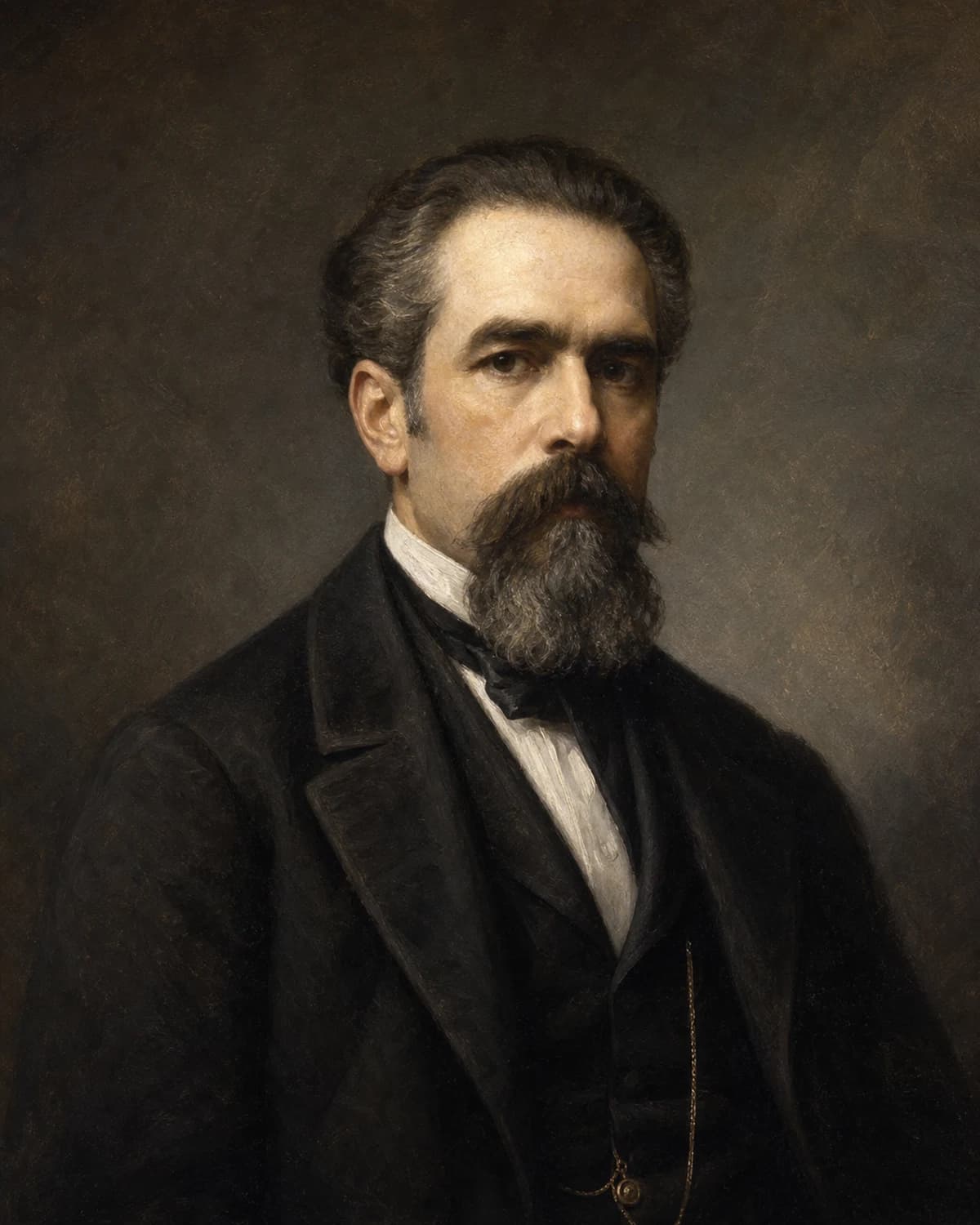
Biography
The first drawing by Juan Manuel Blanes that anyone remembers dates from 1844: the British schooner “Commodore Purvis” in the roads of Montevideo. The boy was fourteen, the city was under siege, and his mother had taken the children to the besiegers’ camp; his father stayed in Montevideo and died there in 1848.
Blanes was born on 8 June 1830 in Montevideo, the third of the six children of Pedro Blanes Mendoza; the family was supported by the eldest brother, Gregorio. Back in the city, he drew for the daily newspaper El Defensor de la Independencia Americana, earned extra money with watercolours and in 1854 opened his first studio. In 1855 he married María Linari and left for Salto to paint portraits, and in 1857 he crossed the Uruguay River to Concepción del Uruguay in Argentina. There the Argentine president Justo José de Urquiza commissioned portraits, allegories and landscapes from him for his estate, the Palacio San José. In 1861 Blanes returned to Montevideo, obtained a scholarship from the Uruguayan government and went with his family to Florence, where he studied under Antonio Ciseri until 1864.
The Florentine training became his calling card: he came home the most sought-after portraitist in Uruguay, and, it seems to me, the portraitist fed the history painter in him all his life.
In 1871 the yellow fever epidemic in Buenos Aires gave him the subject of his first well-known painting; he showed it in the city, which had not yet recovered, and it was a success. In 1872 his portrait of General José de San Martín, the hero of the Argentine War of Independence, “The Review at Rancagua”, was received there just as well, and Blanes was invited to show the canvas in Chile. Back in Uruguay he undertook “The Oath of the Thirty-Three Orientals”, a group portrait of the conspirators whose rising against Brazilian rule led the country to independence in 1828; the picture was shown in 1877. He then went to Florence a second time and there finished “The Battle of Sarandí”, another episode of Uruguay’s birth. Neither the history canvases nor the rural scenes from home aroused in Italy the interest he had counted on, and in the early 1880s the family returned to Montevideo. He painted portraits again, and local society commissioned them readily; friends of President Máximo Santos ordered a portrait of the ruler from him as a gift, and among the female portraits of these years “Doña Carlota Ferreira de Regunaga” stands out. Between commissions came pictures with no client, “The Paraguayan Woman” (1879) or “The Chaste Susanna”. The best-known work of the late period was “Artigas at the Ciudadela” (1884), an image of José Gervasio Artigas, one of the most revered fathers of Uruguayan independence.
In 1889 his wife died, and Blanes spent two years in Rome with his younger son, Nicanor, where the elder son, Juan Luis, had settled. He returned home alone and went on painting history and landscape. A few years later Juan Luis was killed in an accident, and in 1899 Nicanor went missing in Pisa. Blanes went to Tuscany to look for his son; an acquaintance from an earlier visit, Signora Manetti, took him into her house on the Via di Mezzo. The search lasted almost two years. There, in Pisa, the seventy-year-old painter died on 15 April 1901. His remains were taken to Montevideo and buried on 29 June of the same year in the Central Cemetery.
In 1930 Montevideo opened the Municipal Museum of Fine Arts bearing his name in the Prado park; most of Blanes’s work stands there in the permanent display, and many well-known canvases are also in the National Museum of Visual Arts. The bronze statue of Artigas in Washington, cast in Uruguay during the Second World War as a gift to the United States, was made from his portrait.
Related context
Associations
Works connected through artistic movements, cultural context and period. Priced works available in this market appear first.








Profile notes
Profile and sources
Image
Artist image
На основе открытого изображения: Unknown author Unknown author; Wikimedia Commons; Public domain.
