
25.10.1857–07.12.1899
Juan Luna
Juan Luna (1857–1899) made his name in 1884, when his “Spoliarium”, a canvas more than seven and a half metres long, won a gold medal at the National Exhibition of Fine Arts in Madrid. He trained in Manila, Madrid and Rome, kept a studio in Paris, turned to realist subjects by the 1890s, and at the end of his life served on diplomatic delegations of the Philippine revolutionary government.
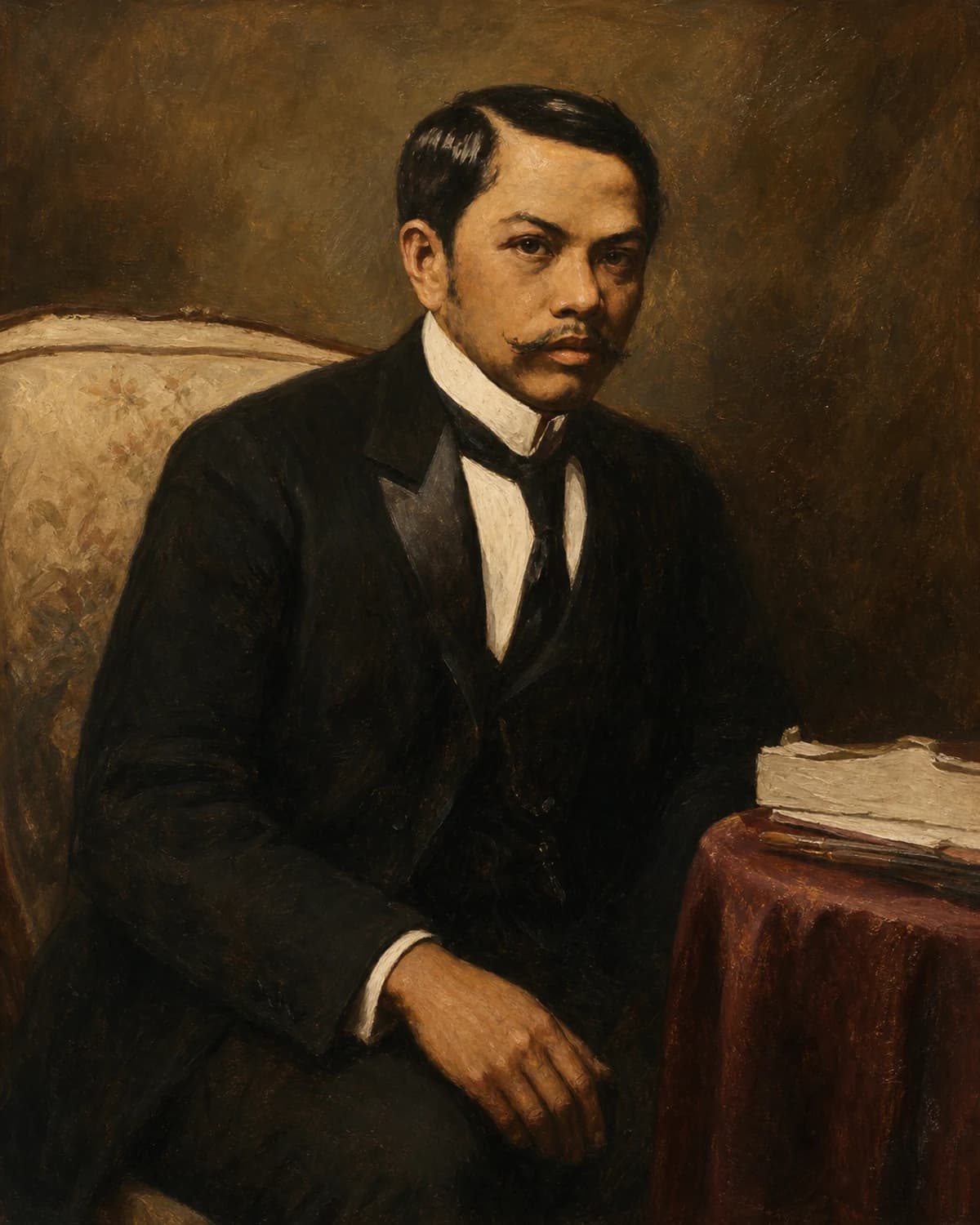
Biography
On 25 June 1884 Filipinos in Madrid and their Spanish friends gathered for a dinner in honour of two painters from the archipelago. Juan Luna had just received the first of three gold medals at the National Exhibition of Fine Arts, and Félix Resurrección Hidalgo a silver one. José Rizal raised a toast to them both and called their success fresh proof of the equality of races.
The picture that won the gold shows a vault beneath a Roman circus: the bodies of slain gladiators are being dragged across the floor and stripped of their weapons and clothing. Luna spent eight months painting it. The canvas measures 4.22 by 7.675 metres, which makes it the largest painting in the Philippines.
He was born on 25 October 1857 in Badoc, in the province of Ilocos Norte, the third of seven children. In 1861 the family moved to Manila. After the Ateneo he took a Bachelor of Arts degree, entered the nautical school and for some time went to sea as a sailor. He studied drawing with Lorenzo Guerrero of Ermita and at the Academy of Drawing and Painting in Manila under the Spaniard Agustín Sáez; according to one account, Sáez so disliked his sweeping brushwork that the pupil was dismissed. Guerrero, on the contrary, urged him to go to Madrid. His elder brother Manuel, who later studied music in Europe, also painted, and Rizal is said to have thought him a stronger painter than Juan.
The brothers left for Europe in the mid-1870s (both 1875 and 1877 are given). At the Royal Academy of Fine Arts of San Fernando in Madrid, Juan soon grew disillusioned with the teaching and went to work with the painter Alejo Vera, who took him along to Rome. There Luna saw the painting of the Renaissance and painted “Daphnis and Chloe” and “The Death of Cleopatra”. “Cleopatra” won a silver medal at the National Exhibition of 1881, and the Spanish government acquired it. At about the same time the Manila city council granted him an annual stipend of 600 pesos on one condition: he was to paint a picture on Philippine history that would become the city’s property.
Before it was sent to Madrid, the “Spoliarium” had been shown in Rome, and in the mid-1880s the provincial government of Barcelona bought it. The exhibition’s Medal of Honour, its highest award, was withheld from Luna in 1884, and this is put down to attitudes towards a man born in a colony. By way of compensation King Alfonso XII commissioned from him “The Battle of Lepanto” for the halls of the Spanish Senate, where it was to hang beside Francisco Pradilla’s “The Surrender of Granada”. “Lepanto” brought him a second gold medal, at the Barcelona exhibition of 1888.
In 1885 Luna moved to Paris and opened a studio that became a meeting place for Filipinos living far from home; it was there that Rizal gathered the anti-colonial circle known as the Indios Bravos. Here he settled his debt to Manila: a year later “The Blood Compact” was finished, showing the 1565 ritual of brotherhood between Datu Sikatuna, ruler of the island of Bohol, and the Spanish governor Miguel López de Legazpi. Together with a full-length portrait of Legazpi the painting went to Manila in return for the stipend, and it now hangs in Malacañang Palace. Historical scenes in the Graeco-Roman taste won him success at the salons, but he himself, judging by his letters to friends, had grown tired of them. I would be wary of calling this a break with the academic school: Luna sided with the progressive wing of the Paris Salon and never became an Impressionist. By 1891 he was reading Marx and the Belgian economist Émile de Laveleye, and in a letter to Rizal he called himself a socialist. In “Les Ignorés” (1890–1891) a labourer’s funeral procession moves along a winter street: a plain wooden coffin, the poor clothes of the mourners. It was followed by “The Parisian Life” and works on the French Revolution, among them “Peuple et Rois” (People and Kings).
On 4 December 1886 he married María de la Paz Pardo de Tavera, the sister of his friends Félix and Trinidad Pardo de Tavera. They had a son, Andrés, and a daughter who died at the age of three. Luna suspected his wife of infidelity. In September 1892 he fired at a door behind which she was standing, killing her and her mother and wounding one of her relatives. In February 1893 a French court acquitted him, ruling that the crime had been committed in a state of passion, and ordered him to pay compensation to the Pardo de Tavera family. Five days after the verdict Luna left for Madrid with his son.
In 1894 he returned to the Philippines, in 1896 he made a trip to Japan and came back when the revolution was already in full swing. On 16 September 1896 the Spanish authorities arrested him together with his brother Antonio on charges of links with the insurgent society Katipunan. In prison he went on painting and gave one work to a priest who visited him. On 27 May 1897 he was pardoned, and in July he sailed for Spain.
In 1898 the executive board of the revolutionary government made Luna a member of the Paris delegation seeking recognition of the Philippine Republic. After the Treaty of Paris, which ended the Spanish–American War, he was sent with a delegation to Washington for the same purpose. There he learned of the death of his brother Antonio and set off for home. He never reached Manila: Juan Luna died in Hong Kong on 7 December 1899.
Five years later his last major work, “Peuple et Rois”, was judged the best exhibit at the World’s Fair in St. Louis. Some of his paintings were lost to fire during the Second World War. The “Spoliarium” had suffered earlier, in 1937, when a museum in Barcelona burned and was looted during the Civil War; after restoration in Madrid, Spain handed the painting over to the Philippines in 1958, and it now opens the display of the National Museum of Fine Arts in Manila.
Luna was buried in Hong Kong. In 1920 his remains were brought home; for a time they were kept in his son’s house and were later placed in a niche in the crypt of San Agustin Church in Manila.
Related context
Associations
Works connected through artistic movements, cultural context and period. Priced works available in this market appear first.








Profile notes
Profile and sources
Image
Artist image
На основе открытого изображения: Unknown author Unknown author; Wikimedia Commons; Public domain.
