
20.09.1864–28.11.1932
Juan Lepiani
Juan Lepiani (1864–1932) painted scenes from the war over the coast that Peru fought against Chile in 1879–1884, and from the Spanish conquest of the Incas. The best known, “The Answer” (1891), shows Colonel Francisco Bolognesi rejecting a demand to surrender Arica. From the 1900s Lepiani lived in Rome, where he mostly copied the Old Masters.
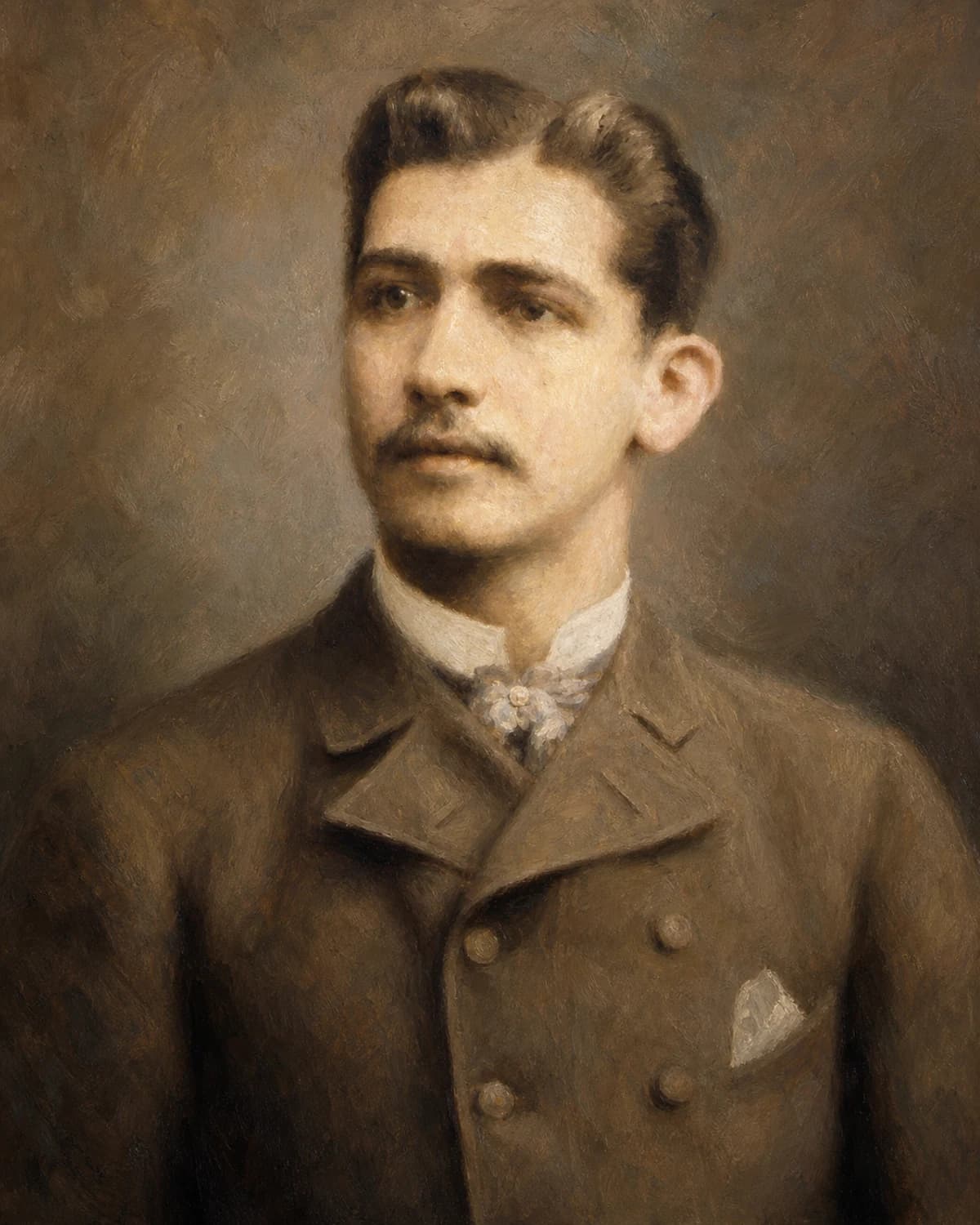
Biography
The first of his famous pictures is called simply “The Answer”. In it Colonel Francisco Bolognesi and his staff at Arica refuse the Chilean envoy Juan de la Cruz Salvo; the scene dates from 5 June 1880. The picture was painted in 1891, and it was after it that the Peruvian government granted the artist a subsidy for a trip to Europe.
Lepiani was born on 20 September 1864 in Lima. As a young man he took modest jobs and worked as a paymaster on the Central Railway. He saw his calling in painting and studied in Lima with the Peruvian Francisco Masías and the Spaniard Ramón Muñiz, about whom little is known. In the 1890s he began a series of historical canvases. “The Third Redoubt of Miraflores” (1894) shows the fight for the defence of Lima, where hastily gathered civilian volunteers stood against superior forces. “The Entry into Cocharcas” (1896) shows Nicolás de Piérola on horseback at the city gate of Lima during the civil war of 1894–1895. In 1899 came “The Last Cartridge”: Bolognesi lies on the ground with a revolver in his hand, keeping his oath to fight until the last cartridge was spent. Later he turned to other periods: “The Thirteen of the Isle of Gallo” (1902), “The Proclamation of Independence” (1904), “The Conference of Punchauca”, on the meeting of the Spanish viceroy José de la Serna and the liberator José de San Martín (1921), and “The Capture of Atahualpa” (1920). Around 1922 he painted “Alfonso Ugarte”: the Peruvian officer who, by tradition, rode his horse over the cliff at Arica rather than surrender the flag.
He went to Europe twice, and the sources disagree: by some accounts his first trip was in 1892, by others he went to Europe in 1903. It is certain that he settled in Rome.
By some accounts he lived there among the local bohemians and not very strictly, by others in comfort, and for several years. He painted few new pictures. His main occupation became copying Raphael and Titian: American tourists bought the copies, and the best of them, as the sources note, were valued for their neatness and sent to Peru. In Rome he sometimes signed himself J. Leppiani. The copying cost him his eyesight: he often worked in poor light. In 1928 Lepiani came to Lima for a short stay, already aged and almost blind. A year later he was in Europe again, and the stock market crash of 1929 ruined him. He died in Rome on 28 November 1932, completely blind and in poverty.
Professional critics treated his work coolly. It seems to me that it is valued for its directness of narrative and unfeigned patriotic feeling. How widespread that appreciation is, though, is hard to check.
Related context
Associations
Works connected through artistic movements, cultural context and period. Priced works available in this market appear first.








Profile notes
Profile and sources
Image
Artist image
На основе открытого изображения: Desconocido, c. 1890; Wikimedia Commons; Public domain.
