
23.03.1887–11.05.1927
Juan Gris
Juan Gris (1887–1927) was born José Victoriano González-Pérez and took his pseudonym in 1905, a year before leaving for Paris. He first earned his living with satirical drawings for magazines, began to paint seriously in 1911 and joined the circle of the Cubists. He exhibited through Daniel-Henry Kahnweiler, worked for Diaghilev’s Ballets Russes, and in 1924 gave a lecture at the Sorbonne on the possibilities of painting.
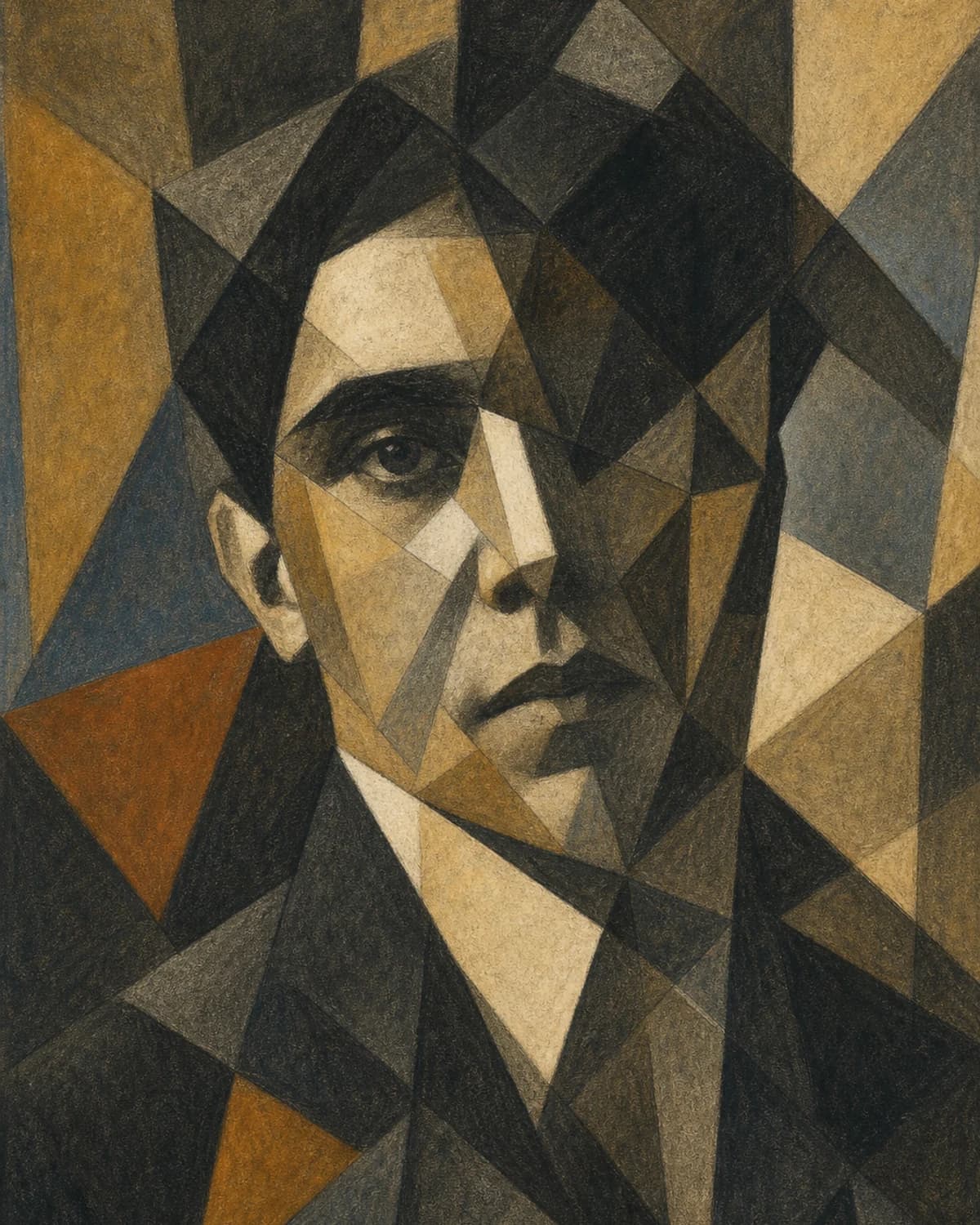
Biography
In 1912 a painting called “Homage to Pablo Picasso” hung at the Salon des Indépendants in Paris. It was the first public showing of a work by Juan Gris, and the title said whom he was learning from at the time. Picasso, according to Gertrude Stein, took no pleasure in such a pupil.
Gris was born on 23 March 1887 in Madrid and was named José Victoriano González-Pérez. He studied at the Madrid School of Arts and Sciences, according to some accounts in engineering. From 1902 to 1904 he published drawings in local periodicals, then spent a year studying painting with the academic artist José Moreno Carbonero. The name Juan Gris appeared in 1905.
In 1906 he sold his possessions and went to Paris. He lived in Montmartre, at the Bateau-Lavoir, and became friends with Guillaume Apollinaire, Max Jacob, Henri Matisse, Georges Braque, Fernand Léger, Jean Metzinger and Picasso. For Paris magazines, among them the anarchist satirical weekly L’Assiette au Beurre, as well as Le Rire, Le Charivari and Le Cri de Paris, he made darkly humorous drawings. In 1909 his son Georges was born, his only child. Until 1911 the family lived at the Bateau-Lavoir; later, in 1913 or 1914, Josette Herpin, who became his second companion, moved in there too, and they stayed until 1922. He began to paint seriously in 1911, giving up caricature. The art historian John Richardson links this turn to Metzinger’s painting “Tea Time” (1911): in his view it convinced Gris of the importance of mathematics in painting. The critic Peter Brooke distinguishes two procedures in the early Gris: in one a grid of lines is visible, reminiscent of Metzinger; in the other the lines are not drawn but only implied, by heavy, often triangular shading in the angles between them. Both differ from Picasso and Braque in the clarity and measurable quality of their construction.
In 1912 Gris showed work at the Cubist exhibition at the Galeries Dalmau in Barcelona, at the Der Sturm gallery in Berlin, in Rouen, and at the Salon de la Section d’Or in Paris. That same year he signed a contract giving Daniel-Henry Kahnweiler exclusive rights to his work. He began in the manner of Analytical Cubism, a term he himself coined later, and after 1913 moved to Synthetic Cubism, working extensively with papier collé and collage. Picasso and Braque were then painting almost monochrome pictures, while Gris used bright, harmonious colours, like his friend Matisse. In 1915 Amedeo Modigliani painted his portrait. In November 1917 he made one of his few sculptures, the polychrome plaster “Harlequin”.
From late 1916 through 1917 the construction of his pictures grows simpler and the distinction between object and background fades. This is clearly seen in “Woman with Mandolin, after Corot” (September 1916) and in “Portrait of Josette Gris” (October 1916, Museo Reina Sofía). The geometric framework here governs the details, and even the small planes of the face become part of the whole. His clarity and order influenced the Purists, Amédée Ozenfant and Le Corbusier, and in the years after the war made Gris himself an example of the “return to order”.
Gris’s first solo exhibition took place in Paris in 1919. In 1923 he was shown at the Galerie Simon in Paris and at the Galerie Flechtheim in Berlin, and in 1925 again at Flechtheim’s, in Düsseldorf. By this time he had painted “The Artist’s Table” and “The Blue Carpet” (both 1925).
In 1924 he designed ballet sets and costumes for Sergei Diaghilev and the Ballets Russes. He illustrated books by Apollinaire, Reverdy and Huidobro. He formulated his main aesthetic views in 1924–1925; in 1924 he gave a lecture at the Sorbonne, “Des possibilités de la peinture” (“On the Possibilities of Painting”). To my mind, one idea conveys it best: in art, as in biology, there is continuity, but no resemblance to one’s ancestors.
From October 1925 he was often unwell. He died on 11 May 1927 in Boulogne-Billancourt, a western suburb of Paris, at the age of forty. He left Josette and his son Georges.
Related context
Associations
Works connected through artistic movements, cultural context and period. Priced works available in this market appear first.








Profile notes
Profile and sources
Image
Artist image
На основе открытого изображения: Guillaume Apollinaire; Wikimedia Commons; Public domain.
