
1646–1716
Juan Correa
Juan Correa (1646–1716) was born and died in Mexico City and became one of the leading Baroque painters of New Spain. He painted the sacristy of the capital’s cathedral, produced hundreds of religious pictures and trained several pupils. His workshop was a family business, so it is not always clear whose hand is on the canvas.
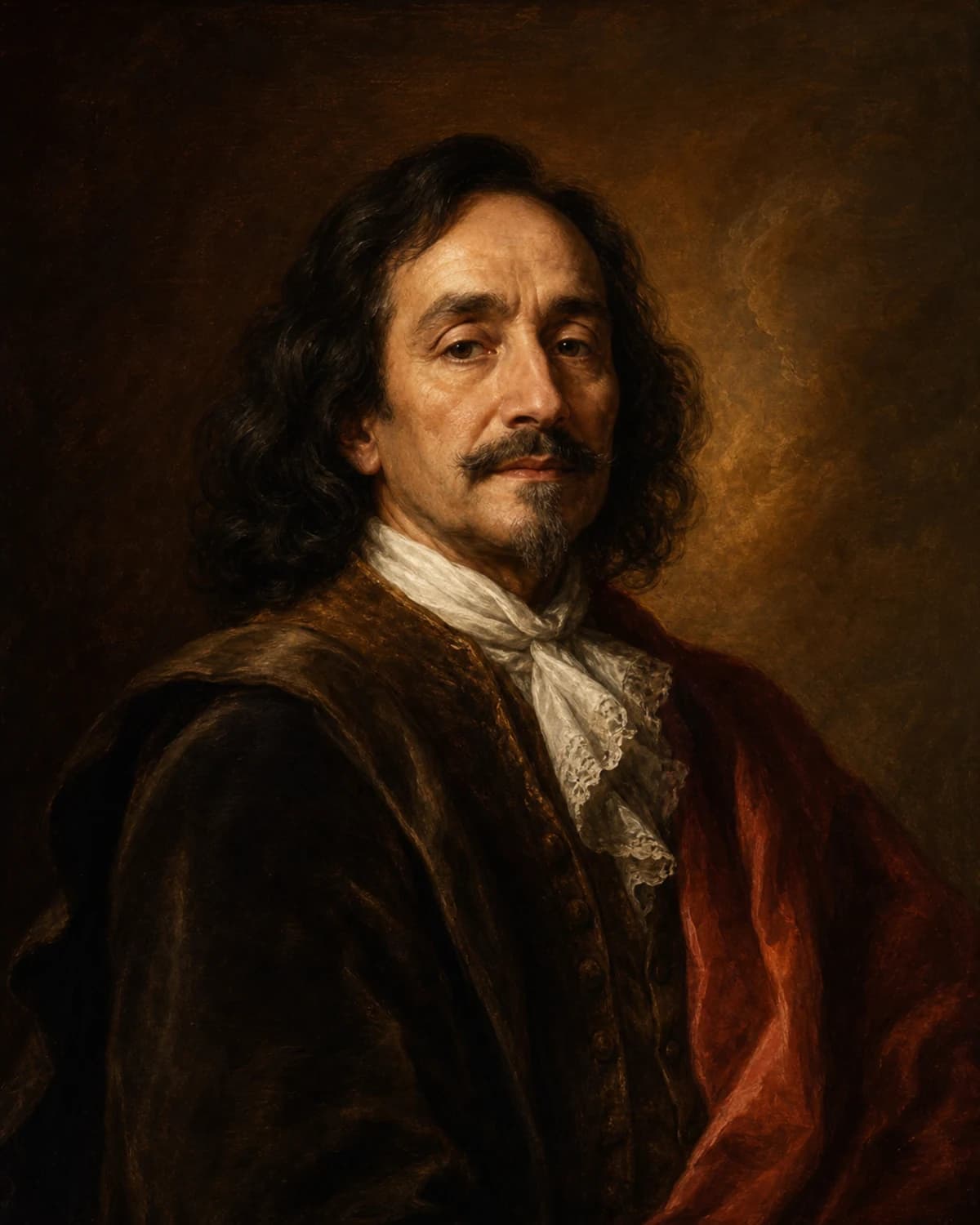
Biography
In the documents that survive, Correa signed himself “free mulatto, master painter”. The formula suggests how he saw his own position in the guild: in New Spain it stood in the way of neither the rank of master nor an office.
He was born in 1646 in Mexico City. His mother, Pascuala de Santoyo, was a “free black woman”; his father, also named Juan Correa, was a surgeon to the tribunal of the Inquisition, helped run the chair of anatomy and, so it is written, carried out the first teaching dissection at the Royal and Pontifical University of Mexico. Some sources describe the father as a native of Cádiz; others do not specify. Correa learned painting in the capital in a workshop, in the seventeenth-century manner: there were no academies in New Spain yet. Some scholars think his teacher may have been Antonio Rodríguez Beltrán (1635–1692), because their drawing and manner of rendering faces are similar. As far as I can judge, there are no documents for this. His first works are dated to the late 1660s. Around 1669 he painted an image of the Virgin of Guadalupe and four canvases on her apparitions; three years later the set arrived in Rome, intended for a chapel of the church of Sant’Ildefonso e Tommaso da Villanova. Doubts have been raised, however, whether the image venerated in that church today is the same one. Correa is regarded as the first painter permitted to trace the original image in the shrine at Tepeyac. The missionary Eusebio Francisco Kino received from him a gift of a painting of Our Lady of Sorrows and in 1687 named his first mission in the Pimería Alta after it.
In 1687 new regulations of the painters’ guild came into force, and Correa received the title of master after an examination conducted by Cristóbal de Villalpando, Juan Sánchez Salmerón and José de Rojas. In 1707 he was elected veedor, or inspector: he saw that the guild’s rules were observed and assessed candidates for the rank of master.
His best-known works are in the Cathedral of Mexico City. For the sacristy he painted the “Assumption and Coronation of the Virgin” (1689) and the “Entry into Jerusalem” (1691), completing the decoration that Villalpando had left unfinished. The cathedral also has his “Vision of the Apocalypse” and other versions of the “Assumption and Coronation”. In the Chapel of the Holy Angels two side altars carry sixteen of his canvases on the choirs of angels and on biblical scenes, dated around 1713; they are counted among his last works. He carried out large commissions for the Jesuit church at Tepotzotlán (now the National Museum of the Viceroyalty) and for the Chapel of the Rosary at Azcapotzalco, where an altarpiece of Saint Anne signed by him and dated 1681 survives. The altarpieces for Durango Cathedral he made from other artists’ designs. Secular works are fewer. He is credited with a few portraits and with allegorical folding screens based on French and Flemish prints. “The Four Parts of the World” is known in two versions, in the Museo Soumaya and in the Banamex collection; on the reverse of the second is the first meeting of Moctezuma and Hernán Cortés.
The art historian Elisa Vargaslugo documented about 400 signed works and concluded that only about sixty are entirely by the master’s own hand, while in the rest assistants took part. Some estimates of his output go as high as five hundred paintings. His brother José Correa, his nephews and later his grandsons worked in the workshop; all of them were painters. Among his pupils are named José de Ibarra and Juan Rodríguez Juárez. The curator Ilona Katzew describes his early style as a bright palette, elegant composition, attention to decorative detail and subtle gradations of colour that give an impression of iridescence. Manuel Toussaint saw in Correa and Villalpando the main exponents of Baroque painting in Mexico. Works from various years are now in the Denver Art Museum, the Los Angeles County Museum of Art (its first Correa arrived there in 2013) and the Gilcrease Museum in Tulsa.
Correa died in 1716 in Mexico City. The exact day is unknown.
Related context
Associations
Works connected through artistic movements, cultural context and period. Priced works available in this market appear first.
Profile notes
Profile and sources
Image
Artist image
На основе открытого изображения: PPazo1995; Wikimedia Commons; CC BY 4.0.
