
10.06.1822–29.05.1884
Juan Cordero
The Mexican painter Juan Cordero left for Rome in 1844 on money raised by his family, and there won a prize from the Roman academy for a study of a nude figure. His “Columbus at the Court of the Catholic Monarchs” was shown in Rome and Florence, and in 1874 he painted in Mexico City the country’s first mural on a secular philosophical theme; it was destroyed in 1900.
Biography
The sources do not agree on the date of his birth. It is given as 16 May 1822, 10 June 1822 and 10 June 1824; he was baptised on 11 June 1822 in Teziutlán, in the state of Puebla. The safest statement is that he was born in Teziutlán in 1822, and I write it so from here on.
His father, Tomás Cordero, was a trader, and the son was expected to join the business. But the boy drew so well that his parents gave way and enrolled him at the Academy of San Carlos in Mexico City; according to one account, the family moved to the capital for this purpose. The academy was in poor straits in those years, and his teacher Miguel Mata y Reyes advised him to go to Rome. There were no scholarships at the time. The money was raised by the family itself, by selling, so the story goes, the family piano, and on 1 June 1844 Cordero set out for Italy.
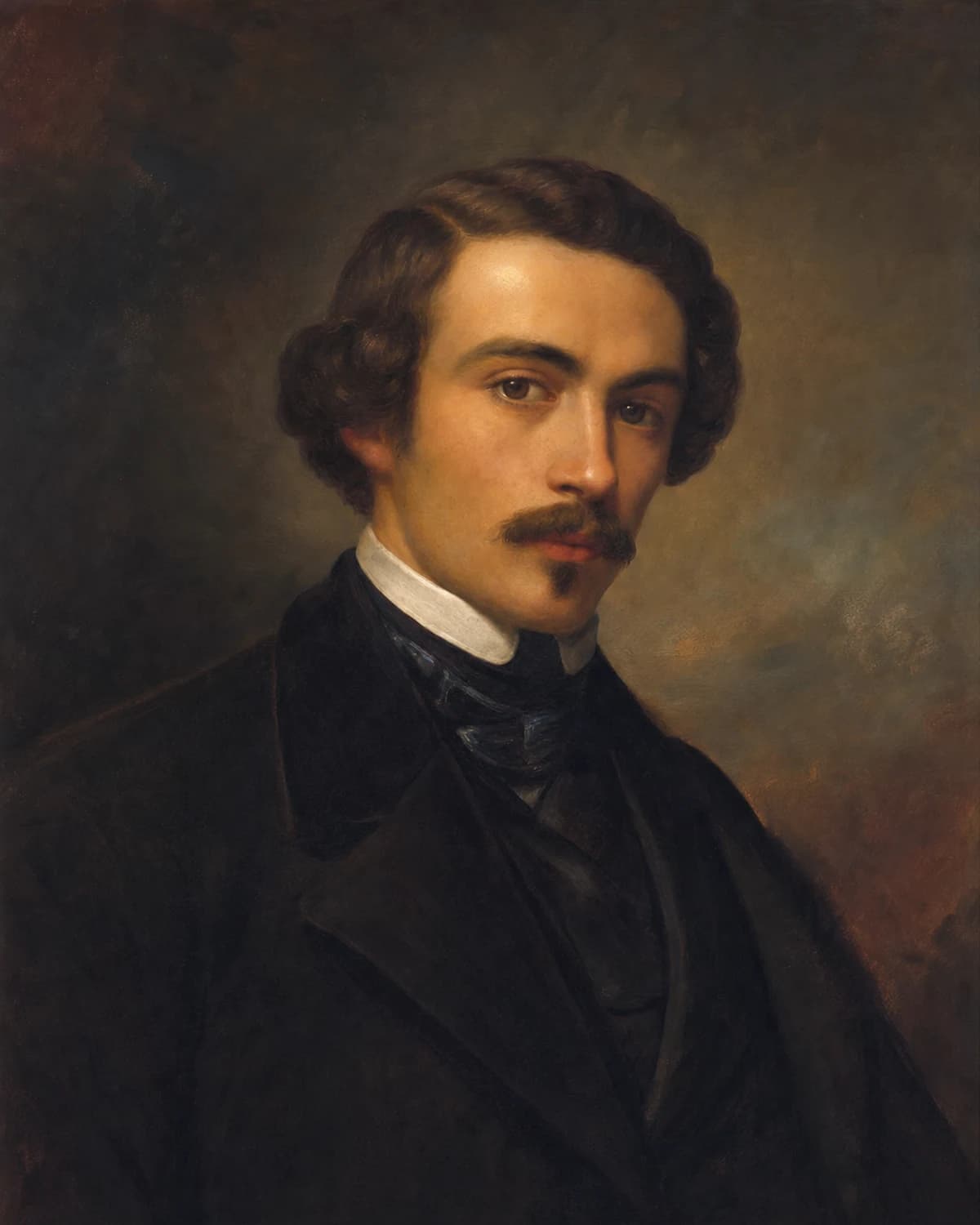
In Rome he was short of money, studied under Natale Carta, an advocate of classicism, and worked at the Academy of St Luke. Other teachers are named in the literature: the Catalan Pelegrí Clavé, the influence of the Nazarenes (a group of German painters in Rome) and Filippo Agricola; how closely he worked with each, I find hard to judge from these texts. In November 1844 the former president of Mexico, Anastasio Bustamante, then living in exile, helped him to a post as attaché at the Mexican legation to the Papal States, with a small salary. In August 1845 Cordero won first prize in a competition of the life-drawing school of the Academy of St Luke. From 1846 the Academy of San Carlos granted him a pension for eight years, until October 1853, on condition that he send at least one painting a year. He sent portraits of Roman and Neapolitan women, a portrait of two sculptors, a portrait of the Agea architects, a self-portrait, an “Annunciation” in the manner of Raphael, the biblical “Moses at Rephidim” and the Orientalist “La Mora”. In 1851 “Columbus at the Court of the Catholic Monarchs” was sent to Mexico City: after his first voyage Columbus presents Native Americans and specimens of American nature to the king and queen. The painting was a success in Rome, was reproduced in engravings, and was shown in Florence in the palace of Prince Poniatowski before it was sent on to Mexico. In the same year Cordero was admitted to the Congregation of the Virtuosi, a Roman association of artists.
In 1853 he came home with a large canvas, “The Redeemer and the Woman Taken in Adultery”. Critics and public were divided. The director of the academy, Bernardo Couto, offered him the post of assistant head of the painting department, but Cordero refused: he believed he should replace Clavé. A Liberal in politics, he sought the support of General Santa Anna and in 1855 painted an equestrian portrait of him and a portrait of his wife, Dolores Tosta. Santa Anna signed a decree appointing Cordero, but the academy’s board saw it as interference with its autonomy, and the decree had to be revoked. Clavé, a Conservative, kept his post.
Cordero then turned to murals. First he painted a lunette of the boy Jesus in the Temple for the presbytery of the church of Jesús María, then around 1857 he decorated the church of Santa Teresa la Antigua, whose dome had collapsed in the earthquake of 1845 and been rebuilt by the architect Lorenzo de la Hidalga. On the dome, “God the Father Surrounded by the Theological and Cardinal Virtues”, he worked for two years with an assistant, Primitivo Miranda. The painting survives in the building, which now houses the contemporary art centre Ex Teresa Arte Actual. In 1858–1859 he decorated the dome of the church of San Fernando with an “Immaculate Conception”, free of charge; it has not survived.
From 1860 to 1867 Cordero travelled around the country, including Guanajuato, Xalapa and Mérida, painting portraits on commission. Female figures with a Romantic cast date from these same years: “The Sleepwalker” (1867, National Museum of Art, Mexico City), “The Bather” (1864) and “The Woman in the Hammock” (1865).
In 1874 Gabino Barreda, the first director of the National Preparatory School and his friend, commissioned a mural for the main staircase of the former college of San Ildefonso, where the school was then housed. “The Triumph of Science and Labor over Envy and Ignorance” is regarded as the first Mexican mural on a secular philosophical theme. Later the walls of the same building would be given over to murals by Diego Rivera, José Clemente Orozco and David Alfaro Siqueiros. But Cordero’s own mural was by then gone: in 1900, on the order of the school’s director, it was removed and replaced with a stained-glass window, “The Welcome”. Juan de Mata Pacheco may have made a copy of it, but there is no certainty that his painting of the same title accurately reproduces Cordero’s work.
In 1875 Cordero took part for the last time in an exhibition of the academy, showing the religious “Stella Matutina” and a group portrait of his nieces, “The Daughters of Licenciate Don Manuel Cordero”. After that he did not exhibit. The reason may have been the political climate after Porfirio Díaz’s coup in 1876, but there is no direct evidence.
Cordero died on 29 May 1884; according to some sources in Coyoacán, according to others in Popotla in Mexico City. He is buried in the Tepeyac cemetery. In 1945 the Palace of Fine Arts in Mexico City showed a retrospective of 46 of his works.
Related context
Associations
Works connected through artistic movements, cultural context and period. Priced works available in this market appear first.








Profile notes
Profile and sources
Image
Artist image
На основе открытого изображения: Juan Cordero de Hoyos; Wikimedia Commons; Public domain.
