
25.10.1777–05.10.1830
Józef Oleszkiewicz
Józef Oleszkiewicz (1777–1830) studied anatomy in Vilnius but became a portraitist: in Paris he worked under Jacques-Louis David, and in Saint Petersburg he painted about a hundred portraits and in 1812 was made an academician. His sitters included Adam Jerzy Czartoryski, Mikhail Kutuzov and Adam Mickiewicz. In the Polish circle of the capital he was also the head of the Masonic lodge of the White Eagle.
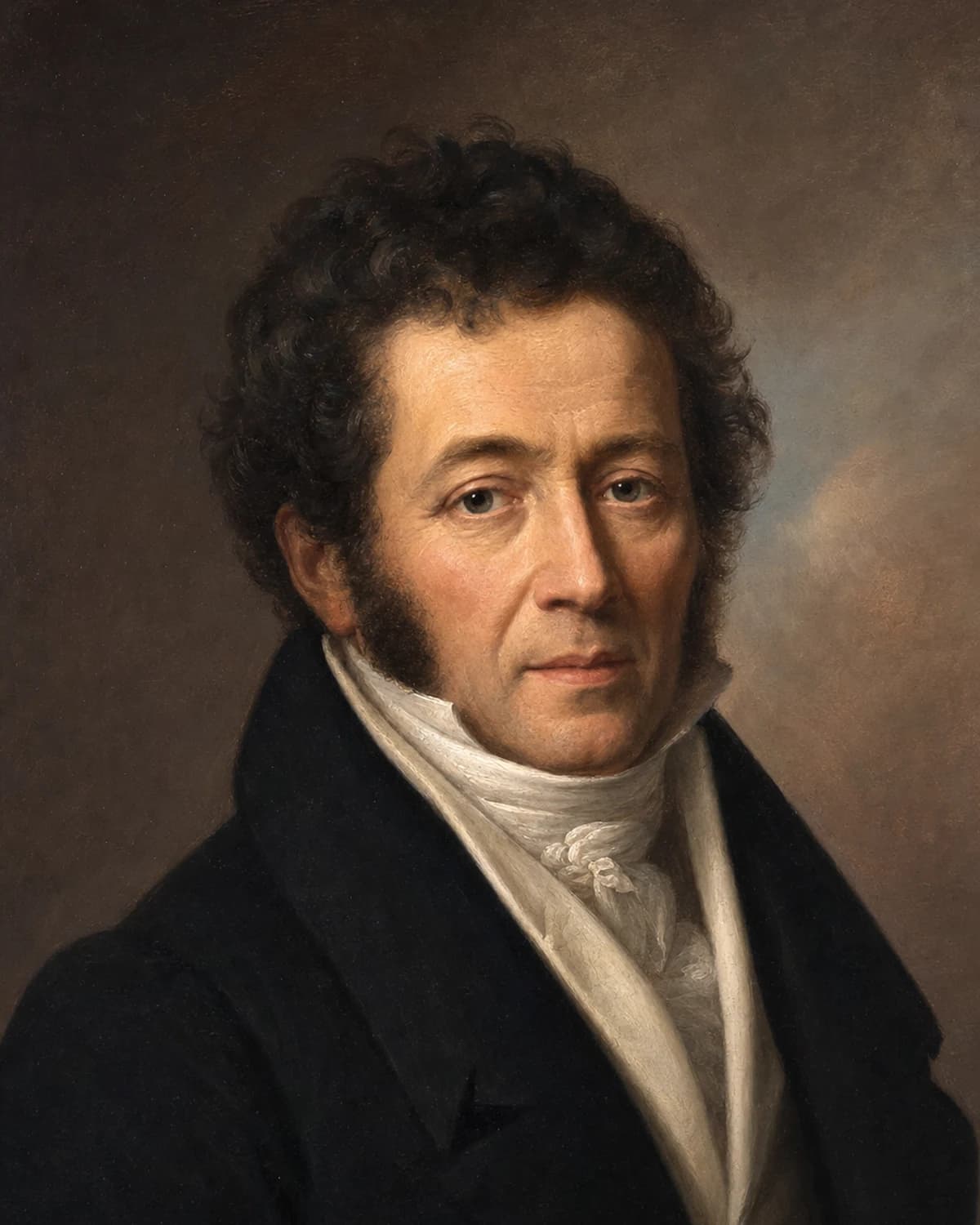
Biography
In 1809 a huge canvas was put on show in the building of Vilnius University: the ailing hetman Jan Karol Chodkiewicz taking leave of his wife before the Battle of Khotyn in 1621. Contemporaries wrote that people flocked to it in crowds, as if in processions. It was, apparently, the first public art exhibition in Vilnius, and it was organised by a young painter who then hoped for a university chair.
His name was Józef Oleszkiewicz. In Russia he was called Iosif Ivanovich.
He was born on 25 October 1777 (14 October, Old Style) in Šiluva, in Samogitia. His father was a poor musician who directed the choir at the church in Radoshkovichi and had come to Šiluva on duty; soon after the son’s birth the family went back. In 1797, with the support of a patroness in Vilnius, Oleszkiewicz entered the university and began with anatomy and physiology, but soon moved to drawing and painting under Franciszek Smuglewicz and Jan Rustem. He earned his living by giving lessons, copied pictures in the gallery of the magnate Prozor family, and tried his hand at large independent compositions. In 1801 Count Aleksander Chodkiewicz, a playwright and chemist who was looking for a drawing teacher, visited his studio; he liked the huge canvas “Olympus” so much that he bought it. He then invited the painter to his estate of Pekalov in Volhynia, and in 1803 paid for his studies abroad. The road led through Dresden to Paris. On 4 October 1803 Oleszkiewicz was enrolled at the École des Beaux-Arts, in the class of the history painter Jean-Simon Berthélemy. The main influence on him was David: from him Oleszkiewicz took composition and precision of drawing, a manner of painting people in motionless, dignified poses, and mythological subjects with a hint of the present day. Stanisław Morawski later recalled that to the end of his life he spoke of David with reverence. From Paris Oleszkiewicz sent Chodkiewicz copies, among them one after Guido Reni from the Louvre, to show his progress. In 1806 he returned, lived with his patron at Pekalov, painted at neighbouring manors and married Karolina Andrzejewska, the sister of one of his pupils.
After the exhibition of 1809 the chair of painting at the university, vacant since the death of Smuglewicz, went not to him but to Rustem. Oleszkiewicz then left for Saint Petersburg, in 1810 by one account, in 1811 by another. There he quickly became a fashionable portraitist: he painted the imperial family, Kutuzov, the physician Nikolai Arendt, and Aleksei Lvov, an engineer and musician. For the painting “The Beneficent Care of Empress Maria Feodorovna for the Poor” he was elected in 1812 an academician of the Imperial Academy of Arts. Portraits brought in money but, to my mind, were too cramped for the painter himself: for the Church of Saint Stanislaus in Saint Petersburg he painted altarpieces, among them “The Madonna and Child” and “Christ on the Cross”. Later his portraits became softer, with a touch of sentimentalism and Romanticism, although in his last works he seems to have returned to a strict classicism.
Among the Poles of Saint Petersburg he was a prominent figure, and well beyond his painting. From 1820 he headed the lodge of the White Eagle (other sources give the date as 1822), was an honorary member of the lodges in Vilnius and Grodno, and, according to contemporaries, his authority among Russian Freemasons was very great. He was thought a man of extraordinary kindness: he gave money to the poor, was a convinced vegetarian and kept a houseful of cats. He acquired a reputation as a soothsayer, supposedly having foreseen the Petersburg flood. No manuscripts of his mystical writings survive, and we judge his views from the sparse testimony of acquaintances. Adam Mickiewicz was introduced to him in 1824 by Wacław Przecławski. The poet remembered Oleszkiewicz as almost a prophet and dedicated to him the “Digression” in the third part of “Dziady” (“Forefathers’ Eve”). In 1828 Oleszkiewicz painted a portrait of Mickiewicz leaning on books.
In his last years he worked little because of gout. He died on 5 October 1830 in Saint Petersburg and was buried, as is generally believed, in the Smolensky Orthodox Cemetery; the grave is lost.
Related context
Associations
Works connected through artistic movements, cultural context and period. Priced works available in this market appear first.








Profile notes
Profile and sources
Image
Artist image
На основе открытого изображения: Scotch Mist; Wikimedia Commons; Public domain.
