
1734–1804
José Nicolás de la Escalera
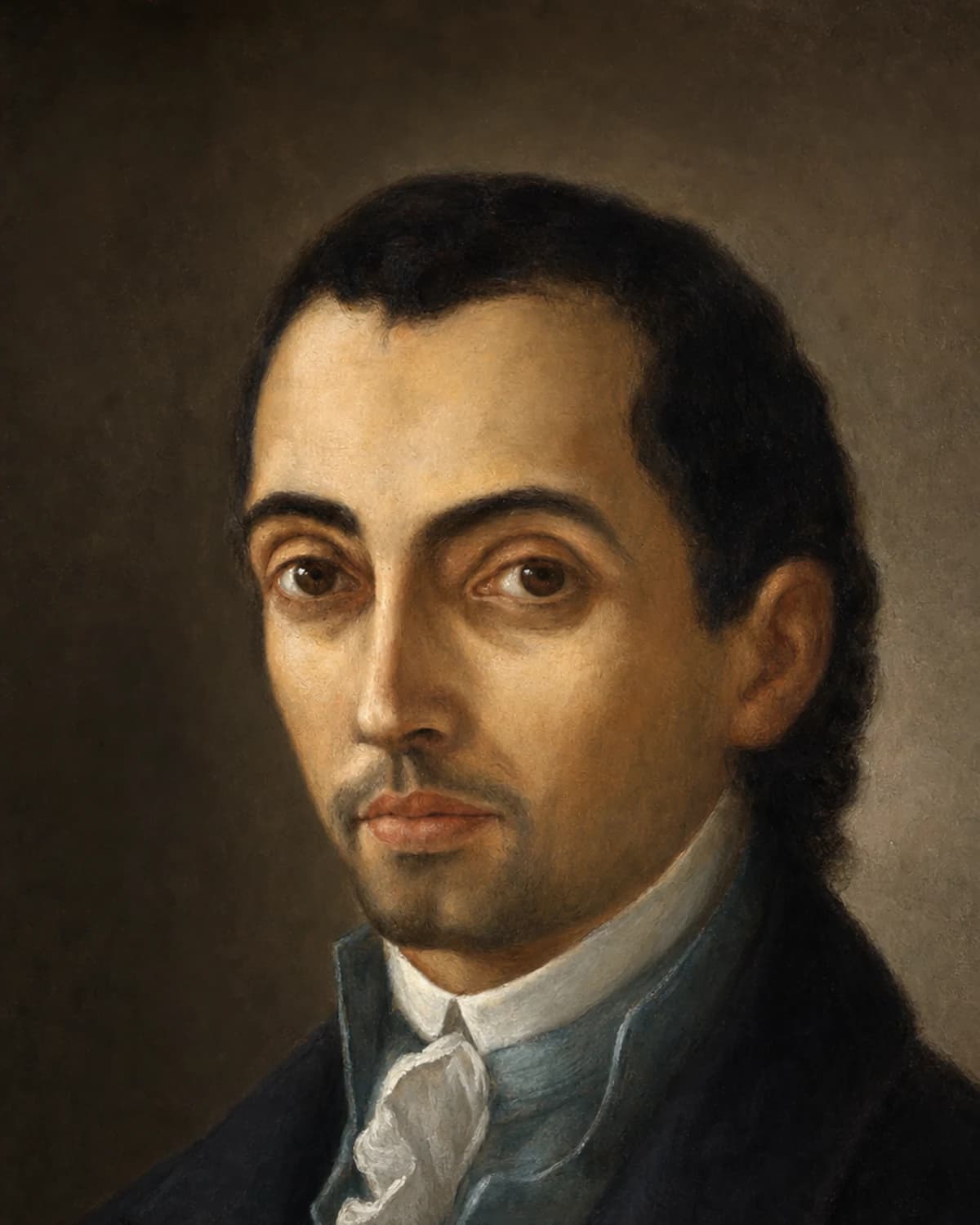
José Nicolás de la Escalera (1734–1804) painted the cupola of the church of Santa María del Rosario near Havana and made pictures for it, among them a group portrait of the family of the Counts of Bayona. He was self-taught and worked in the manner of the Andalusian school, closest to Murillo. About fifty of his works survive in Cuba, Spain and the United States.
Biography
In 1763 a portrait of Luis Vicente de Velasco, a naval captain killed during the British siege of Havana, was presented to King Charles III. Today it is in the Naval Museum in Madrid, but under the name of an unknown artist: the museum has no information on the canvas’s origin. It is the only evidence of Escalera’s early period, and he painted it, apparently, before he was thirty.
He was born in Havana on 8 September 1734 and baptised in the city’s main parish church on 15 September. His father, Agustín Francisco Isidoro de Escalera Tamariz, came from Écija in Andalusia; his mother, Manuela Domínguez, was a native of Havana. The third of the children, he had two sisters. He signed most often “Jph. Nicolas de Escalera” or simply Escalera, although in notarial documents his family appears as Escalera Tamariz: before the introduction of civil registration the order of surnames was not fixed. Little is known of his training. Most likely he was self-taught, though some scholars suggest that Dominican friars from the convent of San Juan de Letrán in Havana may have taught him the techniques of painting and sculpture. There is no direct confirmation; no sculpture by his hand has survived at all. His tie to the Dominicans is, however, visible in the paintings themselves: many subjects are Dominican saints, and he was buried in the Dominican habit.
His main work is the decoration of the parish church of Santa María del Rosario, which the Counts of Bayona built in 1760–1766 (in what is now the Cotorro district of Havana). He painted large canvases for the pendentives of the cupola, fixed to the wall by the marouflage technique, and decorated nine altarpieces, some of them signed by him. One of the canvases, “Santo Domingo and the Noble Family of Casa Bayona”, shows members of the Chacón family. Beside them is a Black man, and this is, as scholars have remarked, the first notable appearance of a Black figure in Cuban painting. Local tradition connects him with the count’s slave who was given his freedom; this is hard to verify, and I would treat the legend with caution.
The rest is altar pictures and portraits. In the National Museum of Fine Arts in Havana are “The Holy Trinity”, once part of an altarpiece in the church of the convent of San Francisco, “Regina Angelorum” and “The Annunciation”, as well as portraits of Bishop Luis Ignacio María Peñalver y Cárdenas (1797) and of Luis de las Casas. Abroad survive the portrait of Antonio Feliu y Centeno, Bishop of Santiago de Cuba (1789), “Our Lady of the Rosary” of 1778 in the Cathedral Museum in Oviedo, and drawings of militia uniforms of 1764 in the Archive of the Indies in Seville. One of his late works, “Virgen” of 1801, is considered freer in colour than his usual pieces.
The Cuban critic Guy Pérez de Cisneros wrote that his saints are “professionals” and painted in a sugary manner, as with Murillo. The scholar Guillermo Sánchez Martínez saw in the portraits a provincial rococo, with stiff figures in wigs and embroidered coats. Escalera himself seems to have considered himself a craftsman fulfilling commissions in a common baroque manner.
He died in Havana on 3 July 1804, unmarried. He was buried the next day in the church of the convent of San Juan de Letrán, before the altar of Saint John Nepomuk.
Related context
Associations
Works connected through artistic movements, cultural context and period. Priced works available in this market appear first.








Profile notes
Profile and sources
Image
Artist image
На основе открытого изображения: José Nicolás de Escalera (1734-1804); Wikimedia Commons; Public domain.
