
06.07.1840–26.08.1912
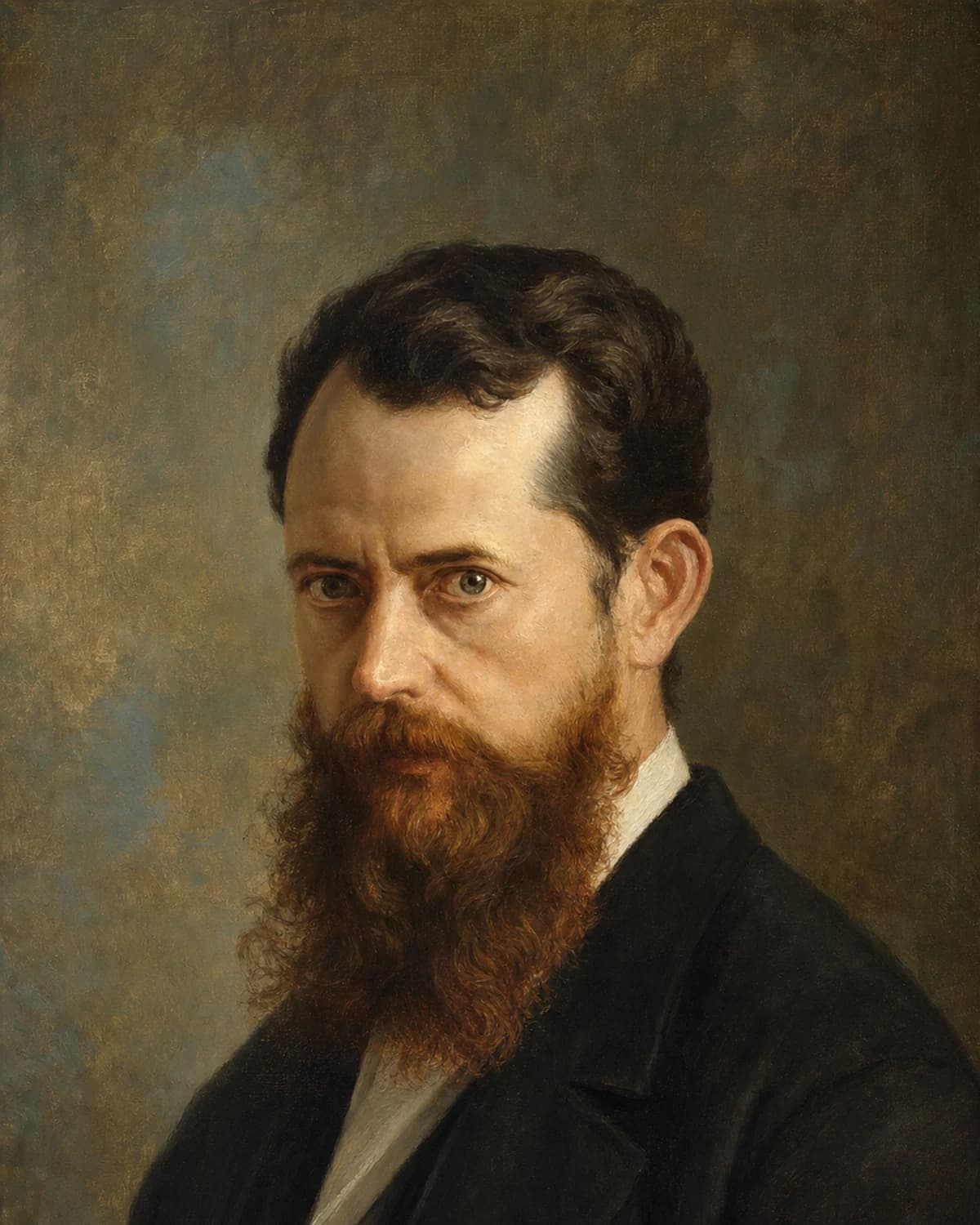
José María Velasco Gómez
José María Velasco (1840–1912) painted the Valley of Mexico for almost his whole life and made its landscape an image of the country: “The Valley of Mexico” alone he repeated in seven versions. A pupil of the Italian Eugenio Landesio, he taught for decades at the Academy of San Carlos, won medals in Philadelphia and Paris, illustrated scientific publications and even described a new species of salamander.
Biography
In 1879 the Mexican scientific journal La Naturaleza published a description of a new species of Ambystoma, a salamander from Lake Santa Isabel, north of Mexico City. The author named it Siredon tigrina and described the animal’s metamorphosis and habits in detail. Nine years later the naturalist Alfredo Dugès renamed the species in honor of its discoverer, and it became Ambystoma velasci. The discoverer was a landscape painter.
Velasco took up science before painting: mathematics, geology and surveying, and later, already a student, zoology and botany at the nearby medical school.
He was born on 6 July 1840 in Temascalcingo, into a family of merchants, the eldest of five children; at his baptism he received the names José María Tranquilino Francisco de Jesús. At the end of 1849 the family moved to Mexico City, and after his father’s death his mother and her children were taken in by the father’s brother. From 1855, having finished primary school, the boy worked by day behind the counter of his uncles’ shop, which sold rebozo shawls at the market by the Plaza del Volador, and in the evenings attended the Academy of Fine Arts of San Carlos as an auditing student. In January 1858 he passed the entrance examination, became a full student and gave up his job.
His studies stretched over ten years, and the central figure in them was the Italian Eugenio Landesio, engaged in 1855 to teach perspective and landscape. Landesio raised landscape painting in Mexico to the status of high art and introduced a demanding program for future landscape painters that included biology, geology, physics and mathematics. Velasco’s first oil study from nature was the house of his uncle on Calle Don Toribio, where he had lived since his father’s death (1859). In 1860, for “Courtyard of the Former Convent of San Agustín”, a picture of how the reforms were changing the face of the city, he won a stipend of fifteen pesos a month. In 1865 he went as draftsman on an expedition to Metlaltoyuca in the state of Puebla, to a recently discovered Totonac site. In 1866 he painted “La Alameda de México”, the most complex work of his student years: in the capital’s main park in the time of the Second Empire, people of every class are strolling, and among them the Empress Charlotte rides by on horseback with her retinue. Landesio later dedicated a memoir to him, calling him the most accomplished of his pupils.
In 1868 Velasco completed the course and began teaching perspective at the same academy. That same year he married, and Landesio was a witness at the wedding.
From the mid-1870s the Valley of Mexico became his main subject. A view from the hill of Santa Isabel, painted in 1875, won him a medal at the 1876 International Exposition in Philadelphia, held for the centenary of American independence, and the national exhibitions in Mexico City of 1874 and 1876 awarded him gold medals. In 1877, after Landesio had left, he was given the chair of landscape and taught many, among them the young Diego Rivera. In the same year came a new “Valley of Mexico” for the Paris exposition of 1878, painted from nature from a different point on the same hill: May, around three in the afternoon. He replaced the Indigenous figures in the foreground of the earlier versions with a nopal cactus and an eagle, an allusion to the legend of the founding of Tenochtitlan. I think this canvas shows well how a landscape was turning into a coat of arms. In his views of the valley the railway and factories appear beside the traces of the past, details are worked out both close at hand and at the very horizon, and critics called him the “architect of the air”. One of these landscapes was given to Pope Leo XIII and is in the Vatican Museums.
He remained a scientist. His illustrations for “La Flora del Valle de México” opened the way for him into the Mexican Society of Natural History, which he chaired in 1881; he drew hummingbirds for an ornithological essay by Rafael Montes de Oca (1875). In 1878, at the request of the director of the National Museum, he took part in expeditions to Teotihuacan and to the hill of Tezcutzingo and painted “The Pyramid of the Sun”, and from 1880 to 1910 he served as draftsman of the National Museum. At the 1889 Exposition Universelle in Paris he headed the fine arts section of the Mexican delegation, showed 68 of his works, received a medal and was made a knight of the Legion of Honor. In 1893 he was Mexico’s commissioner for fine arts at the World’s Columbian Exposition in Chicago and exhibited seventeen oil paintings there. Scholars divide his career into the academic years (1860–1889), a short period in 1890–1892 when he came into contact with the French Impressionists, and the personal manner of his last twenty years.
In October 1901 a tram he was traveling in was involved in an accident, and Velasco was injured. From 1902 he stopped teaching perspective, and from 1905 he painted almost only at home, in Villa de Guadalupe. He still worked a great deal. In 1906, for the vestibule of the National Geological Institute, he painted ten mural canvases on the development of life in the different geological eras, reworking a cycle by the Austrian landscape painter Josef Hoffmann for the Natural History Museum in Vienna. In 1908 his essay “El arte de la pintura” (The Art of Painting) appeared, on how landscape should be taught.
Velasco died on 26 August 1912 in Villa de Guadalupe and was buried in the Tepeyac cemetery. In 1943 his work was declared a historical and artistic monument of Mexico. In 2025 the National Gallery in London opened the exhibition “José María Velasco: A View of Mexico”, the first devoted to him in Britain, and it then traveled to Minneapolis.
Related context
Associations
Works connected through artistic movements, cultural context and period. Priced works available in this market appear first.








Profile notes
Profile and sources
Image
Artist image
На основе открытого изображения: José Luiz; Wikimedia Commons; CC BY-SA 4.0.
