
06.09.1785–1841
José Gil de Castro
José Gil de Castro (1785–1841) was born in Lima to a free father and an enslaved mother, and made his name in Chile, where he painted portraits of leaders of the wars of independence. Most of his canvases carry a plaque with a text about the sitter. By the surviving evidence he left no self-portrait, and the place and exact date of his death are unknown.
Biography
His contemporaries called him “the mulatto Gil”. Later biographers took his second name for a surname, and in reference books he became “Gil de Castro”, although his full name was José Gil de Castro y Morales.
He was born on 6 September 1785 in Lima, and his baptism is recorded in the parish register of the church of El Sagrario. His father, José Mariano Carvajal Castro, was according to some sources a free “pardo” (a free man of mixed descent) and a captain of militia in Trujillo, and according to others probably white. His mother, María Leocadia Morales, was Afro-Peruvian and enslaved. No documents say where or with whom he learned to paint. Various masters from Lima and Trujillo have been named, among them Julián Jayo and José del Pozo, as has the academy founded by Viceroy Abascal in 1808. None of these versions is confirmed; some also think he was largely self-taught, building on the Lima tradition. The scholar Natalia Majluf sees him as the product of a long tradition of courtly painting in Lima.
His life before 1813 has to be pieced together from competing versions. In one, he went to Chile around 1805, moved on to Argentina in 1811, joined the Army of the Andes and returned with it to Chile in 1814. In another, he stayed in Lima: in 1807 he painted a series of pictures for the confraternity of the Virgin of Chiquinquirá, and he appeared in Chile around 1813 without any explanation. I would not choose between them.
What is beyond dispute is that in Chile he was in demand. He opened a studio there and in 1816, according to some sources, was appointed head of the painters’ guild, and then entered the Army of the Andes as an officer in the Corps of Engineers, working on maps and surveys as he had earlier in Peru. In Santiago on 8 June 1817 he married María Concepción Martínez; whether they had children is unknown. He became a captain in the Rifle Battalion and one of the first members of Chile’s Legion of Merit. The house he built in what is now the Barrio Lastarria gave rise to the Plaza Mulato Gil de Castro. In 1820 he became a cartographer for the new Chilean government.
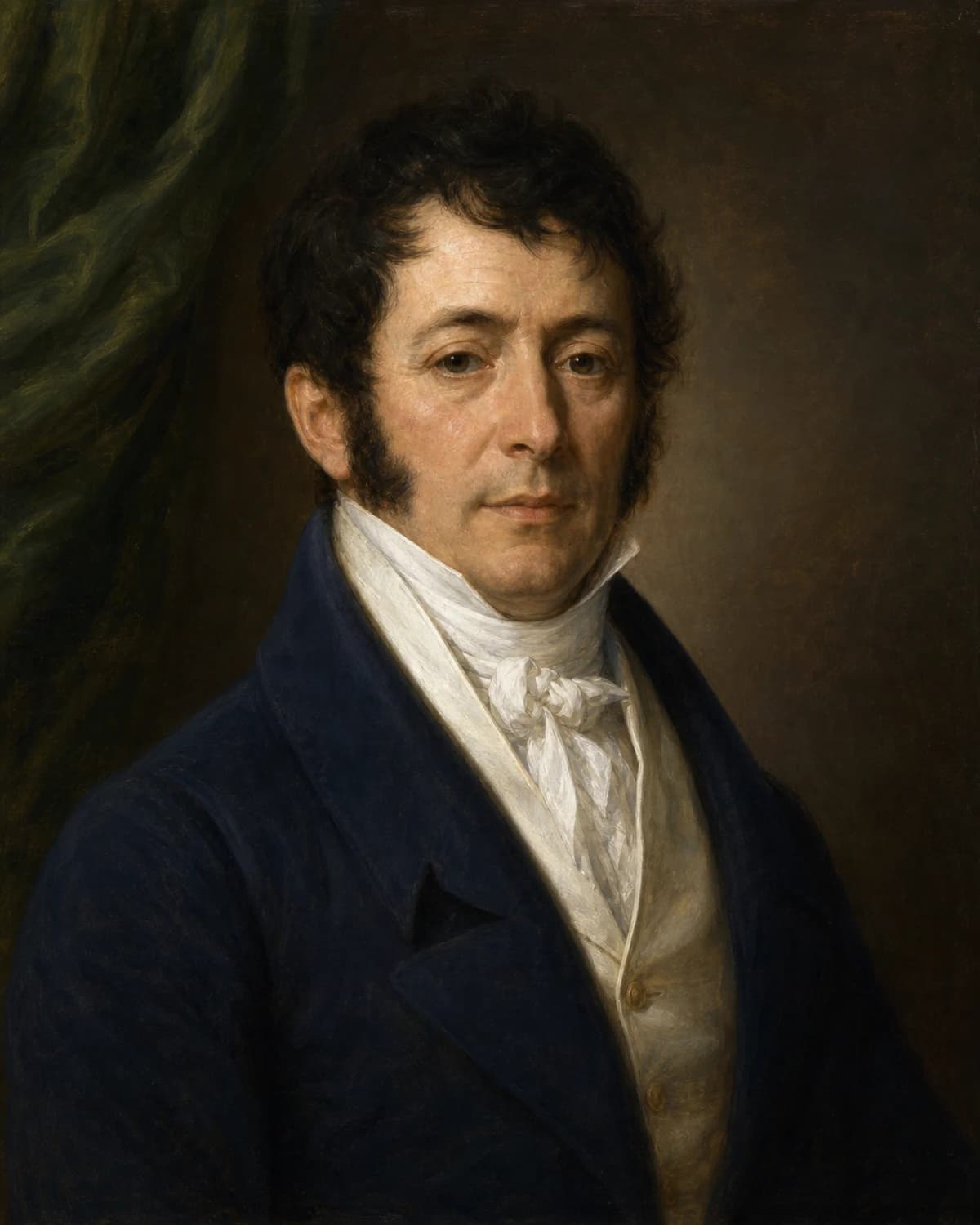
His clients were civil and military figures of the transition from colony to republic, and he travelled to them across Chile and Argentina. His sitters included participants in the wars of independence of the Spanish colonies, among them Bernardo O’Higgins, under whom he served. His compositions are symmetrical, the figures static and flat, the background conventional; yet the faces are recognisable, and uniforms and decorations are rendered in precise detail. Many canvases carry a plaque or banner with a text about the sitter, and sometimes with details about the artist himself.
One portrait stands apart: that of José Olaya, a fisherman who served the patriots and became a hero of Peru’s struggle for independence. It is the only known work in which the sitter is a man of the common people rather than of the elite; Gil de Castro placed him alongside viceroys and aristocrats. He apparently never painted a self-portrait, and the art historian Luis Eduardo Wuffarden called him a portraitist without a face.
He returned from Chile to Peru, probably around 1825, and by report became an official painter to the government. The date and place of his death are unknown: later sources from the 1870s say he was sixty-five, and his death has been placed anywhere from 1839 to 1850, most often in 1841. His works are held in the Museo de Arte de Lima, the National Museum of Fine Arts in Santiago, the National Historical Museum of Chile and museums in Buenos Aires. The Chilean writer Antonio Gil Íñiguez made him the hero of the novel “Cosa Mentale”.
Related context
Associations
Works connected through artistic movements, cultural context and period. Priced works available in this market appear first.








Profile notes
Profile and sources
Image
Artist image
На основе открытого изображения: José Gil de Castro; Wikimedia Commons; Public domain.
