
03.05.1857–20.09.1917
José Gallegos y Arnosa
José Gallegos y Arnosa, the son of a winery employee from Jerez, sold the painting “Arab Wedding” to the government in 1878 and used the money to go to Rome, where he stayed for the rest of his life. He painted church and clerical scenes, won a gold medal in Berlin in 1891, and in 1900–1906 made a marble altar for the church of Santiago in his home town.
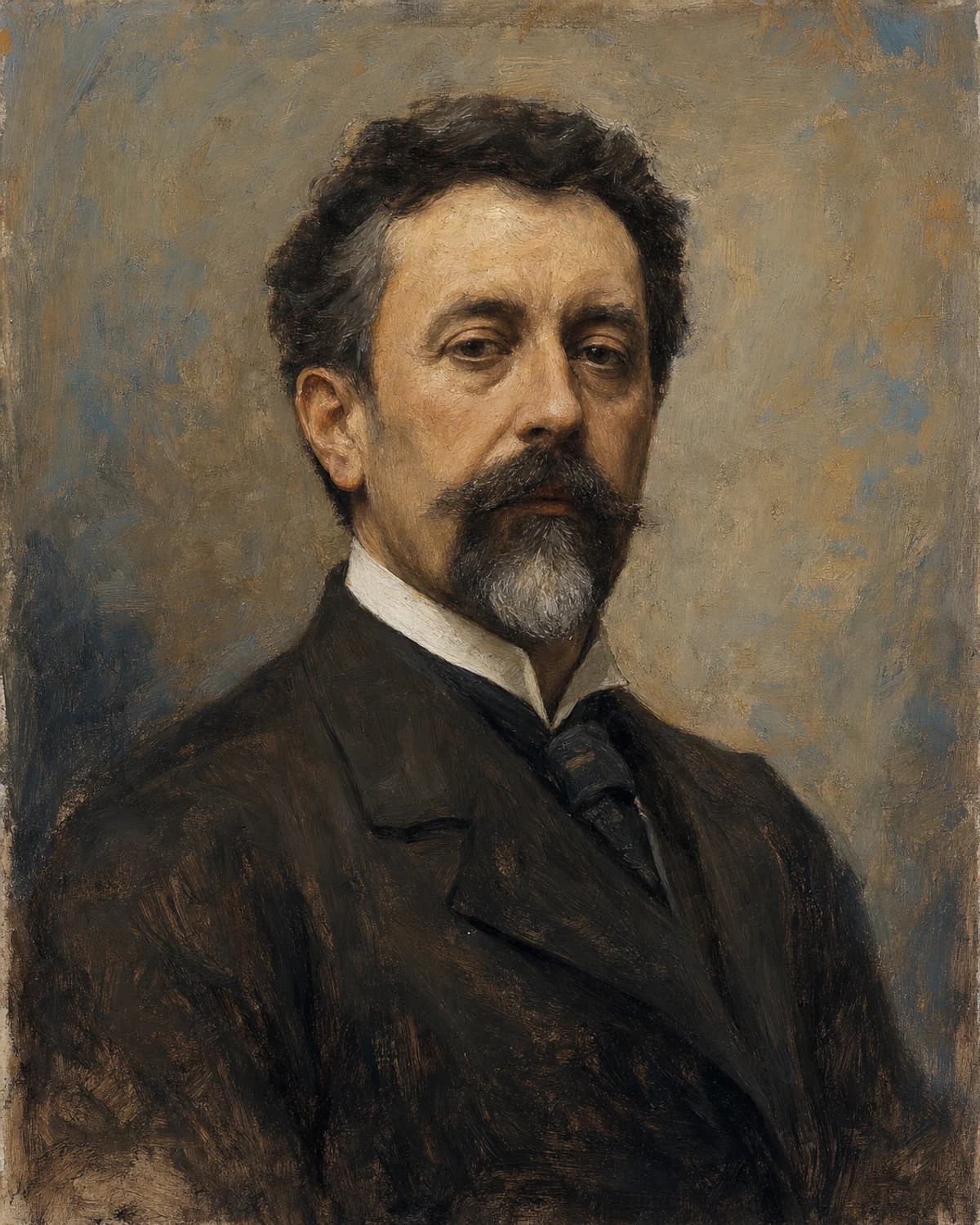
Biography
In 1878 the Spanish government bought a painting by a young artist, “Arab Wedding”. He spent part of the money on a trip to Italy, as his patron had wanted.
José Gallegos y Arnosa was born on 3 May 1857 in Jerez de la Frontera, in the province of Cádiz. His father worked for a winery. The boy took to drawing and painting early; with his friend Salvador Sánchez Barbudo he went to the studio of a local artist, Luis Sevil. Sources give different years of birth, 1857 and 1859; 1857 is used here.
In 1873 he left for Madrid with the support of Guillermo Garvey, a wine merchant and businessman who employed his father, and enrolled at the Royal Academy of Fine Arts of San Fernando. At his father’s insistence he began in the architecture department, believing that the profession would secure his son a comfortable living, but he soon moved to painting. His teacher was Federico de Madrazo.
Then he travelled to Tunisia and Morocco, worked for a time in Tangier, and from these journeys his painting kept its patterned surface and bright colour. His first solo exhibition in Madrid, on his return, was a success with critics. After “Arab Wedding” he went to Rome; around 1880 he decided to settle there for good, although the sources disagree on the date of the move (1881 and 1894 are also given). He lived briefly in Venice, where Mariano Fortuny was working, and came under his influence.
Rome remained his home, but he exhibited in many places: Madrid, Seville, Munich, London, Paris and Berlin. His pictures sold well. He worked with the Dutch dealers, the Van Baerle brothers, one of whom was based in Berlin, and in London his work was sold by Arthur Tooth & Sons. Under his contract he was to deliver one painting a month, but with his painstaking attention to detail he never kept to the schedule. He had regular buyers in Russia, the United States and Britain; the publisher William Randolph Hearst owned one of his works. Few of his paintings are in Italy: by one account, after a vandal attacked a canvas of his at an exhibition in Rome he stopped showing work in the city; by another, he simply feared the jealousy of the many Spanish artists there.
At 54 Via Margutta he had three studios. The walls were decorated with carved Baroque mirrors, columns, and Greek and Roman statues. He chose the most beautiful models and paid them 5 lire a day, requiring them to stay in the studio all day whether he was drawing them or not. With José Villegas Cordero and Salvador Sánchez Barbudo he founded the Society of Spanish Artists Living in Italy, a kind of painters’ club. Every year he spent several weeks in Assisi with his friend, the sculptor Mariano Benlliure.
The main subject of his pictures is the Catholic clergy, both their services and their daily life. In some, cardinals play chess; he knew this life from the inside, since he lived in the same house as the Superior General of the Jesuits. Other known works include “Choir Boys” (1885–1890), “Rumours” (“Rumores”, 1893), in which all the figures in the scene are women, and “Leaving Church” (1894), which is in the Hermitage. Judging by the descriptions, he was more interested in texture and tonality than in storytelling.
In 1887 he married an Italian, Giuseppina Trelanzi, and they had four children. One of the sons, Jorge Gallegos Trelanzi, became an architect. In 1891 Gallegos received a gold medal at the International Exposition of Fine Arts in Berlin. Giuseppina died in 1897, and soon afterwards he married an Englishwoman, Constance Harding; they had five children.
In 1900, visiting Spain, he received a commission from his former patron Garvey for the altar of the church of Santiago in Jerez. The work ran from 1900 to 1906, and he made the sections in Rome. The facing is Carrara marble, the base grey Bardiglio marble, the height about ten and a half metres, with 43 large blocks, 36 bronze statues and a shrine of gilded bronze. At the centre is the figure of the Redeemer in high relief, surrounded by a heavenly choir. The altar was unveiled on 8 August 1906.
Every summer he rented a villa at Nettuno, near Anzio, where he painted outdoors and hunted. He died on 20 September 1917, or, by other accounts, the next day; the sources give the day differently. His son by the second marriage, Lucas, had died less than twelve hours before him. They were buried together in Nettuno. His widow was left with debts: a German dealer paid in devalued marks, and she had to sell the remaining paintings. She opened a tea room in Rome.
Gallegos y Arnosa’s works are in the Prado, in the State Museum in Bautzen, in the Museum of Fine Arts, Boston, in the Museum of Modern Art in Madrid, and in the State Museum of the History of Religion in Saint Petersburg.
Related context
Associations
Works connected through artistic movements, cultural context and period. Priced works available in this market appear first.








Profile notes
Profile and sources
Image
Artist image
На основе открытого изображения: José Gallegos y Arnosa; Wikimedia Commons; Public domain.
