
23.11.1883–07.09.1949
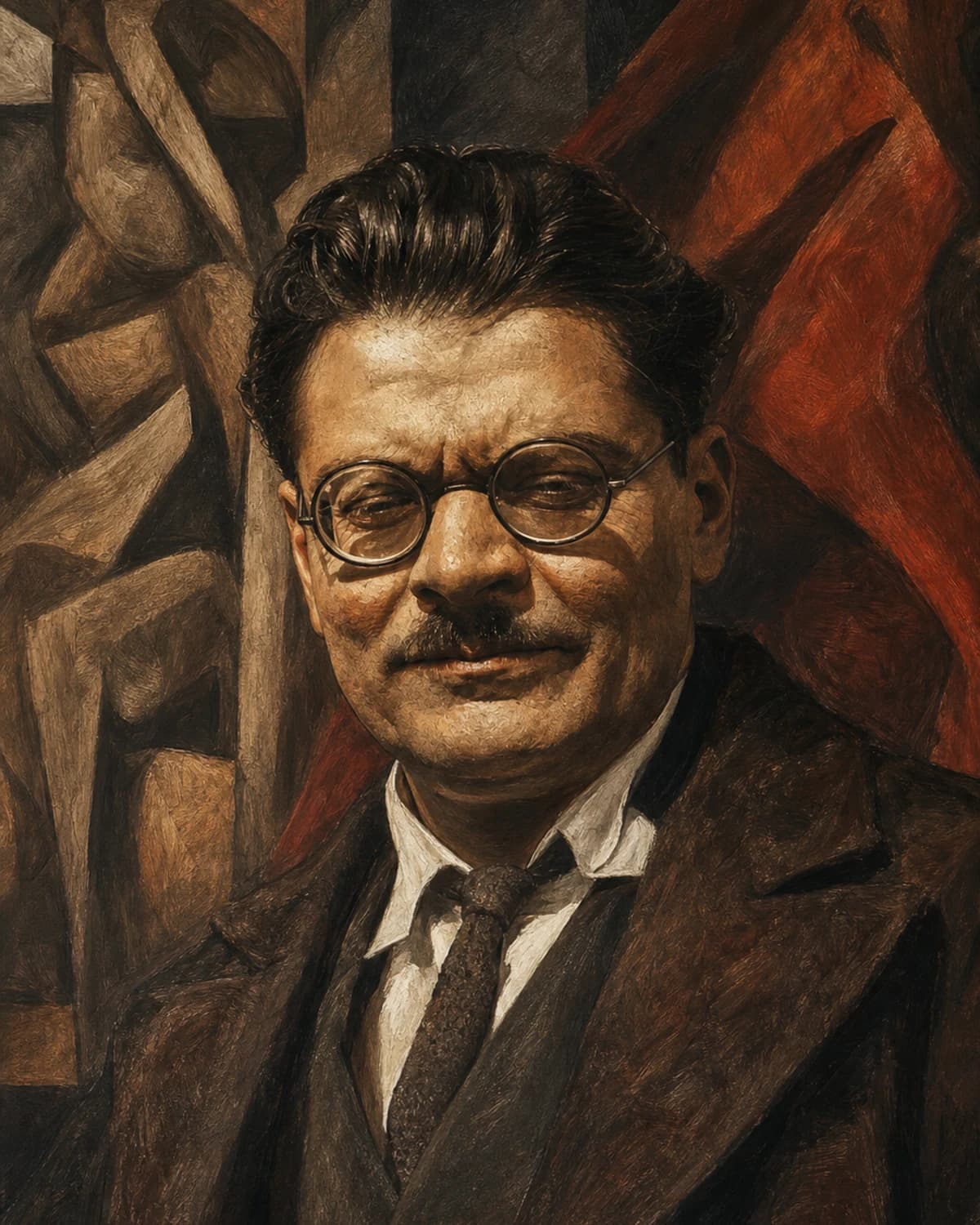
José Clemente Orozco
José Clemente Orozco (1883–1949), together with Diego Rivera and David Alfaro Siqueiros, launched Mexican muralism, but he painted the revolution more darkly than his fellows. His frescoes cover the walls of the National Preparatory School in Mexico City and of Pomona College and Dartmouth in the United States, and in Guadalajara he painted the Hospicio Cabañas, with “Man of Fire” at its centre.
Biography
On his way to school the boy would stop at a shop window in Mexico City behind which the engraver José Guadalupe Posada worked in full view of passers-by. In his autobiography Orozco recalled those few enchanted minutes and called them the push that first set his imagination in motion and made him cover paper with his first little figures. It was from Posada too, he said, that he learned about colour.
José Clemente Orozco was born on 23 November 1883 in Zapotlán el Grande (now Ciudad Guzmán), in the state of Jalisco, the eldest of the children. Around 1890 the family, after a spell in Guadalajara, moved to Mexico City. He studied first at the agricultural school in San Jacinto, then in the mathematics and architecture section of the National Preparatory School, and in the evenings attended classes at the Academy of San Carlos. As a young man, working with gunpowder for fireworks, he lost his left hand.
From 1906 to 1914 Orozco studied at the Academy of San Carlos, and in 1911 he took part in a student strike together with Siqueiros. He drew for the capital's newspapers, worked as an illustrator for one of Venustiano Carranza's Constitutionalist armies, and fell strongly under the influence of Dr. Atl, a Symbolist and an advocate of a national art; in 1914 he followed him to Orizaba. When the revolutionaries split, Orozco sided with Carranza and Obregón against Villa and Zapata. “The world was torn apart around us,” he later recalled; troop trains went past on their way to slaughter, and trains were blown up.
In 1916, stung by the reception of his exhibition in Mexico, he left for the United States. There, unable to sell his pictures, he spent some time painting dolls' faces in a toy factory. He returned to Mexico City around 1920 and went back to drawing cartoons.
In the early 1920s the education minister José Vasconcelos began commissioning young artists to paint murals in public buildings. In 1923 Orozco started work at the National Preparatory School in the Colegio de San Ildefonso, where he had once studied himself. The murals came to fill three floors of the courtyard and the stairway. Some of the frescoes he knocked off himself and painted again, others were defaced by conservative students, and in 1926 he had to repaint a great deal. On the ground floor is “The Trench”: three fighters at a barricade of stones and beams, their faces hidden, the central figure with arms flung out as if on a cross. Beside it are “The Trinity”, in which a leader of the revolution, blinded by a red Jacobin cap, threatens the very peasants he is fighting for, and the caricatural “Banquet of the Rich”. Higher up is “The Farewell”, and by the stairway “Cortés and Malinche”, with almost Michelangelesque bodies. In 1925 he painted the House of Tiles in Mexico City, and in 1926 the Industrial School in Orizaba.
In the same years Rivera was glorifying the revolution on his walls. I think the difference between them is easiest to see in “The Trench”: for Orozco the revolution is made up of nameless dead.
From 1927 to 1934 he lived in the United States, and even after the crash of 1929 he had plenty of work. From March to June 1930, in the dining hall of Pomona College in Claremont, he painted “Prometheus”, in his own words the first fresco painted outside Mexico by a painter of the contemporary Mexican school. That same year came the murals at the New School for Social Research in New York, and in 1932–1934, in the lower level of the Dartmouth College library, “The Epic of American Civilization”, twenty-four panels covering almost three hundred square metres: migrations of peoples, human sacrifice, Quetzalcoatl, corn, Anglo-America and Hispano-America.
After his return, in 1934 he painted “Catharsis” in the Palacio de Bellas Artes in Mexico City and then moved to Guadalajara. There he painted murals in the university and in the Government Palace (“The People and Their False Leaders”), and in 1936–1939 in the Hospicio Cabañas, some twelve hundred square metres of painting; the frescoes of the nave are set against each other in pairs, “Despotism” and “Mercy”, “Dictators” and “Demagogues”, and at the centre of the whole scheme is “Man of Fire”. The building is now a UNESCO World Heritage Site. In 1940 he worked in the Gabino Ortiz Library in Jiquilpan and, at the same time, painted “Dive Bomber” for the Museum of Modern Art in New York; in 1942–1944 he painted the church of the Hospital de Jesús in Mexico City, as well as a hall of the Supreme Court. In 1947 he illustrated John Steinbeck's “The Pearl”, and in 1948 he painted the huge portrait “Juárez Reborn”.
Orozco died in his sleep in Mexico City on 7 September 1949, leaving unfinished a mural in the Miguel Alemán housing complex. That same year his house and studio opened in Guadalajara.
Related context
Associations
Works connected through artistic movements, cultural context and period. Priced works available in this market appear first.








Profile notes
Profile and sources
Image
Artist image
На основе открытого изображения: Los Angeles Times; Wikimedia Commons; CC BY 4.0.
