
08.01.1925–19.04.2010
José Bernal
José Bernal (1925–2010) grew up in Santa Clara, graduated there from the teachers' college and an art school, and in 1962 left Cuba for the United States with his wife and three children. In Chicago he first worked in a factory making art materials, then at the Marshall Field's department store, and later returned to teaching. His paintings, collages and assemblages are in the Art Institute of Chicago and the Reina Sofía museum in Madrid.
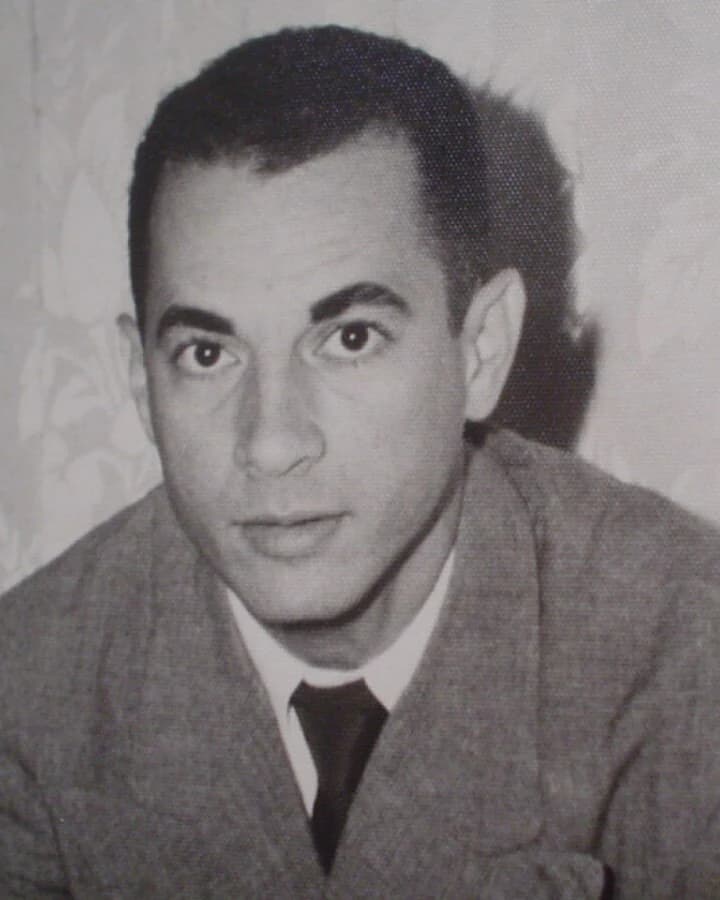
Biography
For the first few months in America José Bernal lived in Miami and could not find work. In the autumn of 1962 the family moved to Chicago.
He was born on 8 January 1925 in Santa Clara, Cuba, in the former province of Las Villas (now Villa Clara). As a child he was privately tutored in art and music. In 1945 he graduated from the Normal Teachers College and began teaching in public and private schools in the province. At the same time he studied at the Escuela de Artes Plásticas Leopoldo Romañach, the art school in Santa Clara, and earned an MFA there. His work was exhibited in Santa Clara and Havana; according to some accounts, his music was also performed there. One source states that he had begun making art as early as 1937. In 1961, during the Bay of Pigs invasion, Bernal was arrested with many other Cubans for “unpatriotic behavior”. His offence was refusing to work cutting sugar cane. He spent eleven days confined in the gymnasium of the Marta Abreu University in Santa Clara. After his release he and his wife feared a new arrest and cautiously began preparing to leave with their three young children. The visas took more than a year. With the help of the Methodist Church, the family flew to the United States on a Pan Am flight in June 1962.
In Chicago, because of his limited English, Bernal took a job in a factory that designed art materials for commercial use, and made his own work in his free time. Critics observed that the change of place showed in his painting. In Cuba his palette had not reflected the bright, intense colours of his native land, but in Chicago tropical hues of the Caribbean began to appear in his pictures. I find this curious: the colour of his homeland came back to him only in exile.
In 1964 an executive at Marshall Field's saw his portfolio and offered him a position as senior designer. The director of the company’s fine arts gallery persuaded Bernal to exhibit his impressionist portraits, landscapes and still lifes. Soon afterwards Betty Parsons, an art dealer, artist and collector, noticed his work and began ordering paintings to be shown and sold at the Dayton’s galleries in Minneapolis. The income allowed him to leave Marshall Field's and return to school, where he could teach and paint at once. In 1970 the School of the Art Institute of Chicago confirmed his MFA. Bernal taught, kept working and kept exhibiting. Lydia Murman, a critic for the New Art Examiner, wrote of his 1981 solo exhibition of collage and assemblage that these works restore to art the role of a means of communication: found objects, warm wood, old newsprint, tarnished metal and antique pieces act on the viewer together. Among the works she named “Balancing the Unbalanced”, in which a faucet remains a faucet.
From the 1980s he found it hard to work; the final diagnosis came in 1993, but he did not give up painting. In 2004 he donated several paintings to the National Parkinson Foundation in Miami, which auctioned them for its own benefit. The number of works he donated later grew to about three hundred.
Dorothy Chaplik, a scholar of Latin American art, wrote about him: in her two books on Latin American art and in the essay “The Art of José Bernal” she discusses his work and his path, including the political unrest in Cuba. He became a United States citizen in 1980. Critics describe his work as modernist, abstract and expressionist; the term “postmodernism” is applied to it in part because he rejected the very idea of the new in art.
Bernal’s work is held by the Art Institute of Chicago, the San Antonio Museum of Art, the McNay Art Museum, the Mary and Leigh Block Museum of Art in Evanston, the Art Museum of the Americas in Washington, El Museo del Barrio in New York, the DePaul Art Museum and the Loyola University Museum of Art in Chicago, the Tucson Museum of Art, the Asheville Art Museum, the Cameron Art Museum in Wilmington and the Museo Nacional Centro de Arte Reina Sofía in Madrid. A retrospective was held at the Cameron Art Museum. Documents on his life and work are kept at the Institute for Latino Studies at the University of Notre Dame.
He died on 19 April 2010 at home in Skokie, Illinois.
Profile notes
Profile and sources
Image
Artist image
Lucrecia Schneider; Wikimedia Commons; CC BY-SA 3.0.
