
10.05.1920–11.02.1999
John Brack
John Brack, a Melbourne painter of the Antipodeans group, painted post-war Melbourne with biting irony in the 1950s: rush hour on Collins Street, the crush in a bar before closing time, the suburbs. Spare forms and deliberately drab browns and greys became his signature. He taught at Melbourne Grammar School and from 1962 to 1968 headed the National Gallery of Victoria Art School.
Biography
In 1936 the sixteen-year-old John Brack, having obtained his intermediate certificate, took a job as a clerk with an insurance company on Collins Street in Melbourne. Almost twenty years later, in 1955, he painted “Collins St., 5 pm”: rush hour, a crowd heading home from work, all the faces almost identical, everything in browns and greys. The picture became one of the most recognisable images in Australian painting.
By then he had already been teaching schoolchildren to draw for three years.
Cecil John Brack was born on 10 May 1920 in South Melbourne, to the printer Cecil William Brack and Edith May. He did well at his studies and won a scholarship to Ivanhoe Grammar School, but his parents could not afford the uniform, and the boy went to the ordinary high school at Box Hill. From 1938, while already working, he attended evening classes at the National Gallery of Victoria Art School under the painter Charles Wheeler and spent his evenings at the State Library.
From 1940 to 1946 he served as a lieutenant in the field artillery; drawings from 1943–1945 survive from the war years.
Recognition came in the fifties. His early, fairly conventional manner gave way to simplified, almost bare forms and deliberately drab colour, in which brown often dominates. “The Bar” (1954) is modelled on Manet’s “A Bar at the Folies-Bergère” and mocks the “six o’clock swill”: Australian pubs closed at six, and drinkers hurried to get drunk before closing time. At the same time he painted the racecourse, the school playground and weddings, but most often the new post-war suburbs and the people who lived in them, and nearly all of it was open satire on the “Australian Dream”. In the fifties he joined the Antipodeans, a group that opposed Abstract Expressionism. One critic wrote that the early Brack captured the oddities of his time more powerfully and succinctly than any Australian artist before or since, and forged the image of a decade on canvas as sharply as Barry Humphries did on stage. I think the comparison with a comedian is no accident: there is more mockery than pity in his crowds and bars.
Brack worked as art master at Melbourne Grammar School, a private school in Melbourne, from 1952 to 1962, and then for six years headed the National Gallery of Victoria Art School. There he influenced many artists and took part in creating the expanded school attached to the gallery’s new building.
He usually developed his themes in series, returning to one subject for years: shop windows (1963–1977), ballroom dancers (1969), gymnasts (1971–1973), postcards and implements, pens and pencils laid out in complex patterns that he intended as allegories of contemporary life, and finally mannequins (1989–1990). Portraits, self-portraits and the nude he painted all his life. “Laughing Child” (1958) shows his four-year-old daughter Charlotte. Brack’s wife, Helen Maudsley, was herself an artist; they had four daughters.
A major retrospective was held at the National Gallery of Victoria in 1987–1988. John Brack died on 11 February 1999 in Melbourne. In 2007 the National Portrait Gallery in Canberra showed a retrospective of his work, the last major exhibition at Old Parliament House before the gallery moved. At the opening Helen Maudsley said that her husband had never cared about a sitter’s social standing; what interested him was only what the sitter gave to the picture. In 2009 another retrospective was mounted by the Ian Potter Centre of the National Gallery of Victoria.
Profile notes
Profile and sources
Image
Artist image
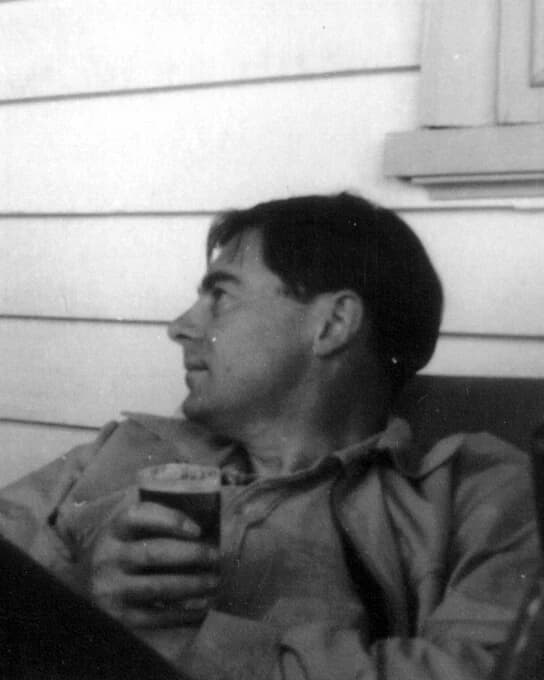
photographer unknown, no other copies of this photo are know.; Wikimedia Commons; Public domain.
