
24.02.1788–14.10.1857
Johan Christian Dahl
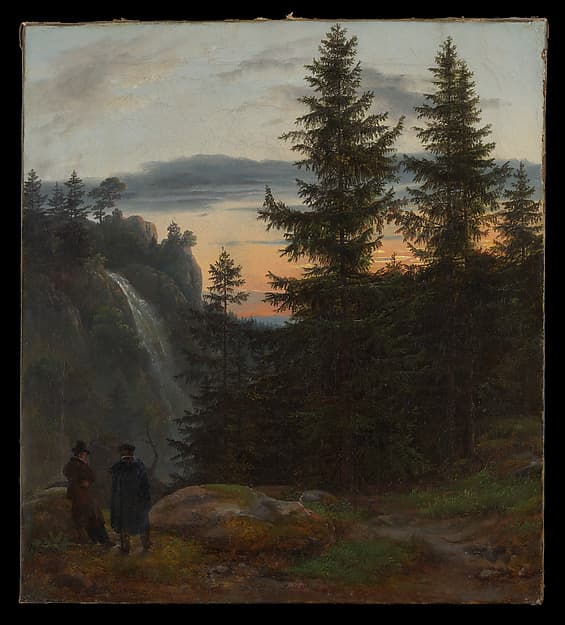
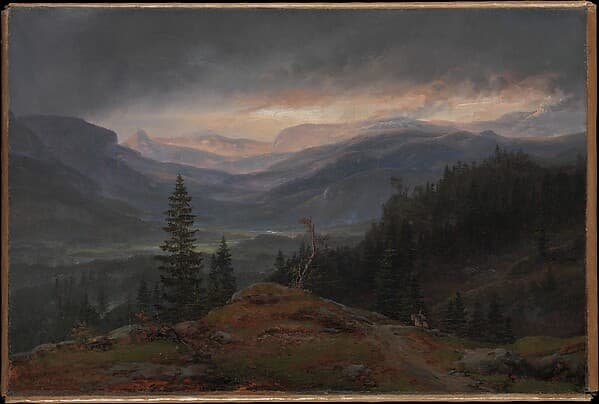
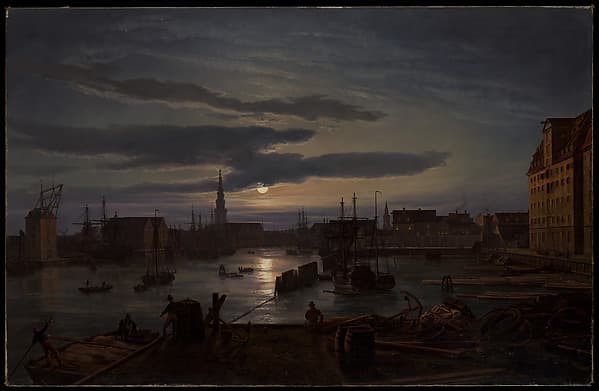
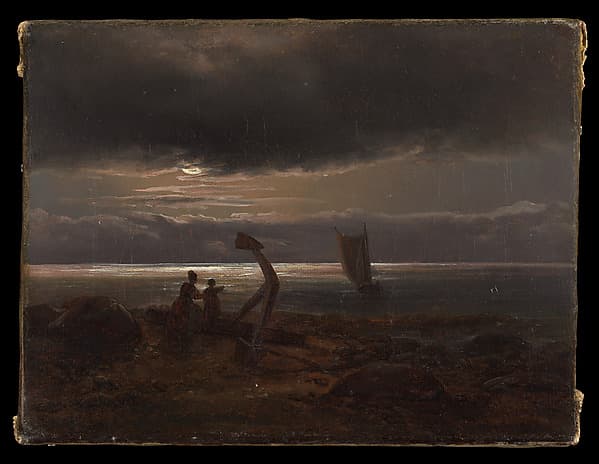
The son of a Bergen fisherman, Dahl trained with a local decorative painter, came to Dresden in 1818 and lived there for almost forty years, sharing a house with Caspar David Friedrich for part of that time. He painted Norwegian mountains, waterfalls and fjords, as well as moonlit views of Dresden. His pupils included Thomas Fearnley and Peder Balke. In 1934 his remains were brought back to Bergen.
Biography
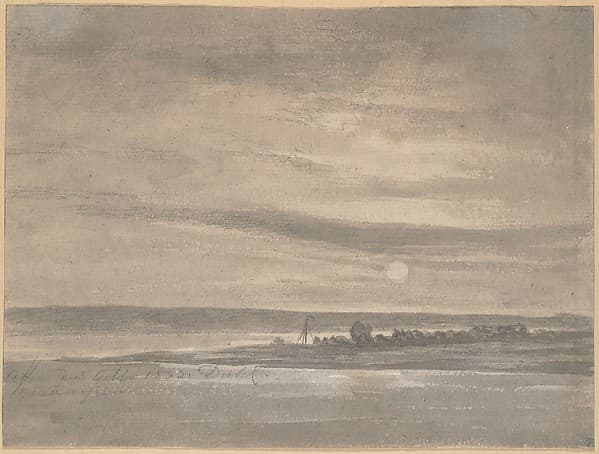
Dahl’s “View of Dresden by Moonlight”, painted in the late 1830s, is about the size of a postcard: roughly 18.5 by 34.5 centimetres. On the horizon are the dome of the Frauenkirche and the tower of the Hofkirche, in silver and deep blue.
He was born on 24 February 1788 in Bergen. His father was a fisherman, and the family was not small: Dahl was one of the younger children. He later recalled with bitterness that he had never had a real teacher in childhood, and believed that with a luckier birth he would have achieved more.
From 1803 to 1809 he studied with the Bergen painter Johan Georg Müller. The workshop did everything: theatre sets, portraits, views of Bergen and its surroundings, and ordinary house painting. Dahl said afterwards that his teacher had kept him in ignorance in order to get more work out of him. A local mentor, Lyder Sagen, lent him books on art and awakened his interest in historical and patriotic subjects. It was Sagen who organised a collection of money, and in 1811 Dahl left for Copenhagen, to the Academy of Fine Arts. He spent seven years there: copying, drawing from plaster casts and then from life, and outside the city making studies in oil and pencil. In 1812 he wrote to Sagen that he wanted to emulate Ruisdael and Everdingen, and therefore studied nature above all. From 1812 he exhibited every year, and in 1815 he showed no fewer than thirteen paintings. Prince Christian Frederik of Denmark, the future king, became his patron and lifelong friend.
In September 1818 Dahl arrived in Dresden with letters of introduction. Friedrich, fourteen years his senior, helped him settle and became a close friend: one was sociable and warm, the other reserved. In 1820 Dahl was admitted to the Dresden academy. The prince invited him to Italy, to the Gulf of Naples; Dahl married Emilie von Bloch and left the day after the wedding. He spent about ten months in Italy, was in Rome in the spring of 1821, saw Vesuvius erupting and painted fishing boats against the smoking mountain. It was in Rome, by his own account, that he came to understand best what Norwegian nature meant to him.
From 1823 the families of Dahl and Friedrich shared a house. In 1824 both were made extraordinary professors, without a chair but with a salary. Dahl declined a permanent chair: he did not want to be tied to a teaching timetable when he was working on a painting. He founded no school and did not impose his manner on pupils; Knud Baade, Peder Balke and Thomas Fearnley studied with him. Friedrich’s influence is visible, but Dahl’s more spontaneous, painterly manner soon won out. Clients sometimes commissioned pictures from both: a calm seashore by Friedrich to pair with a stormier subject by Dahl. He himself most often painted the view of the Elbe from his window in changing light, and would watch the clouds over the plain for hours.
He was able to return to Norway only in 1826, when he travelled that summer from the east of the country through Telemark, the Hardangervidda, Voss and Sogn to Bergen. The journey gave him motifs for the rest of his life. In Sogn he met Fearnley, who became his pupil. Dahl came back in 1834, 1839, 1844 and 1850, painting mainly mountains: “Fortundalen” (1836) and “Stalheim” (1842). He painted “Trolltindene” (1823) from drawings by the German geologist Carl Friedrich Naumann and never visited Romsdalen himself. His late works, such as “Fjord at Sunset” (1850), are freer and further from Friedrich’s austerity.
Dahl was one of the founders of the National Gallery of Norway and gave it his own collection. He campaigned for the preservation of Norwegian stave churches, published an album of their drawings (1836–1837) and argued for the restoration of Håkonshallen and Nidaros Cathedral. He received the Order of St Olav, the Order of Vasa and the Danish Order of the Dannebrog.
In 1827 his first wife, Emilie, died in childbirth, and two years later two of the older children died of scarlet fever. His second marriage, to his pupil Amalie von Bassewitz in January 1830, ended in December of that year, when she too died in childbirth. Two children survived: Siegwald, who became a painter, and Caroline.
Dahl died in Dresden on 14 October 1857 and was buried on 17 October. In 1902 a statue of him was placed on the facade of the Permanenten building in Bergen. In May 1934 his remains were brought to Bergen and buried in the cemetery of St Jacob’s Church.
Artist works
Works by the artist
Works by Johan Christian Dahl available in this edition of NEOARCA.

Profile notes