
28.07.1874–08.08.1949
Joaquín Torres-García
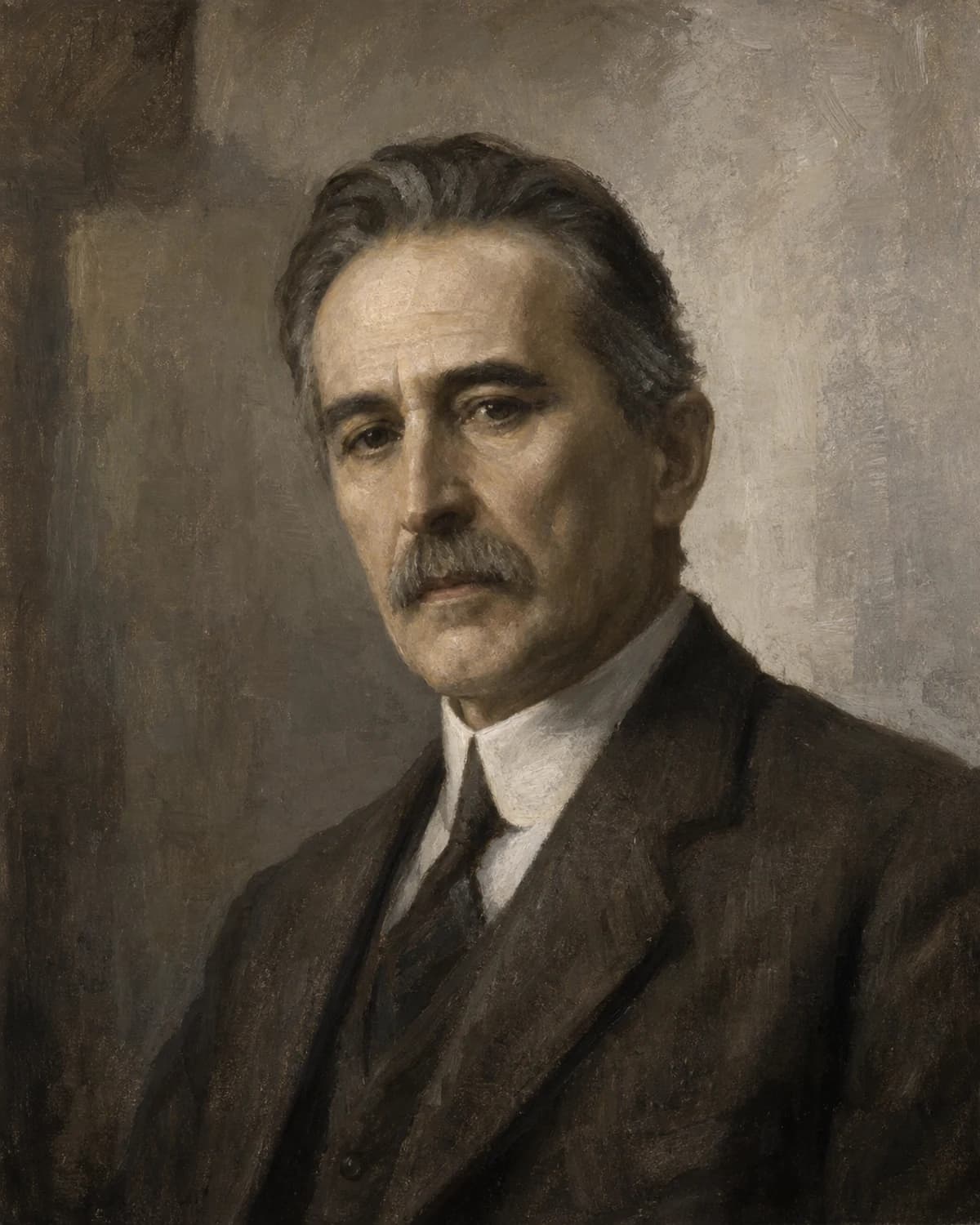
Joaquín Torres-García (1874–1949) was born in Montevideo, grew up in Barcelona, made stained glass for Gaudí, in 1930 gathered the group Cercle et Carré in Paris with Mondrian and Kandinsky, and in 1934, after forty-three years away, returned to Uruguay and opened a workshop where he taught “Universal Constructivism”. His upside-down map of South America became an emblem of Latin American modernism.
Biography
In a drawing of 1943 South America stands on its head: Cape Horn points at the sky, the equator has slipped to the bottom. “Our north is the South,” Torres-García explained; the first version of this map had appeared back in 1936 in the pages of his magazine.
He was born on 28 July 1874 in Montevideo, the eldest son of Joaquim Torras Fradera, a Catalan from Mataró, and María García Pérez, a Uruguayan. His father kept a store on the Square of the Wagons, where raw materials arrived for shipment to Europe, and the boy did more reading, drawing and inspecting of goods brought from across the sea than going to school. In 1891 the family returned to Spain, first to Mataró and then to Barcelona; the children became Spanish citizens. Joaquín took lessons from Josep Vinardell, painted his first oil at seventeen, studied from 1892 at the School of Fine Arts and the Baixas Academy, and in 1894 joined the Cercle Artístic de Sant Lluc. His fellow students were Picasso, Nonell, Mir, Canals and Julio González; the meeting place was the café Els Quatre Gats. He earned his living with illustrations for La Vanguardia and the satirical magazines, under the pseudonym Quim Torras. In 1900 his father died; the same year Miquel Utrillo published in Pèl & Ploma an article entitled “Joaquín Torres-García, Decorator”, with a portrait by Ramon Casas.
A decorator is what he was for the next decade. In 1902–1905, on Gaudí's commission, he made stained glass for the cathedral in Palma: the lateral windows and the small rose window of the apse, with the symbols of the Virgin, the sun, moon, star, well, garden and tower; it seems to me that these signs later migrated into the cells of his late paintings. He himself used to recount with a smile that Gaudí did not think much of his work and advised him to take up teaching. Teach he did: from 1907 at the experimental school Mont d'Or, where instead of copying plaster casts the children drew leaves, fish and fruit from life. In 1909 he married Manolita Piña; of their four children, Augusto and Horacio also became artists. In 1910 he painted murals for the Uruguayan pavilion at the World's Fair in Brussels; in 1911 he showed at the International Exhibition in Barcelona “Philosophy Presented by Pallas on Parnassus as the Tenth Muse”, which has been regarded ever since as the beginning of Noucentisme; a second version is in the Reina Sofía in Madrid. In 1912, at the Galeries Dalmau, his exhibition ran alongside a show of drawings from Picasso's Blue Period, and in May 1913 his first book, “Notes on Art”, came out in Catalan. Commissioned by Prat de la Riba, he took on frescoes for the Saló de Sant Jordi in the Palau de la Generalitat: he began the first on 28 July 1912 and finished it in thirteen days, and painted four in all. The press tore them apart, the commission was halted, and in 1926 the murals were covered over with others, to be uncovered only in 1966. He then left for Terrassa, built the house “Mon Repòs”, decorated it himself, and five years later, sunk in debt, sold it. His children nudged him towards simple figures, primary colours and wooden toys.
In 1920 he set off for Paris with thirty-two crates of paintings, intending to go on to America. Picasso tried to dissuade him: “Do not go to America, because it will be like leaping into a void.”
He went. In New York he drew bridges, cars and crowds, exhibited at the Whitney Studio and with the Society of Independent Artists alongside Stuart Davis, set up the production of Aladdin Toys with Gertrude Vanderbilt Whitney, but he knew no English and met with little success. In 1922 he moved to Italy, outside Florence, and in 1924 to Villefranche-sur-Mer; a fire in 1925 put an end to the toy business. From 1926 he was in Paris again, and these were his best six years: an exhibition at the Galerie Fabre, the acquaintance of Mondrian and, in 1928, of Theo van Doesburg, in 1929–1930 the group and magazine Cercle et Carré, founded with Michel Seuphor, which brought together eighty artists from Mondrian to Kandinsky, and in 1929 a large exhibition of the newest art for Dalmau in Barcelona, with Arp, Taeuber-Arp and van Doesburg. Constructivism, he said, was no different from Neoplasticism, these were all labels; what occupied him was the grid, into whose cells one could fit a fish, an anchor, a sun, a man and a number. Money was short, and in 1932 he left for Madrid, where he founded the Constructive Art Group and finished the book “Estructura”, dedicated to Mondrian.
In April 1934, forty-three years on, he stepped ashore in Montevideo. From then on everything happened fast: a first lecture at the university on 24 May, a first solo exhibition on 5 June, a professorship at the Faculty of Architecture, the Association of Constructive Art, the magazine Cercle et Carré now in Spanish as Círculo y Cuadrado, more than five hundred lectures in six years, the autobiographical novel “The Story of My Life” (1937), the “Metaphysics of Indo-American Prehistory” (1939), in which the art of the Incas is read as an ancient abstraction. In 1938 he began the “Cosmic Monument” of pink granite in the Parque Rodó. At the turn of 1942–1943 the Taller Torres-García came together, a workshop conceived on the model of the Bauhaus: Gonzalo Fonseca, José Gurvich, Julio Alpuy, Alceu Ribeiro, his sons Augusto and Horacio. In 1944, with his pupils, he painted the murals of a pavilion at the Saint Bois hospital and published the thousand-page “Universalismo Constructivo”. The Saint Bois frescoes were later taken off the walls, sent to an exhibition in Paris in 1975, and on 8 July 1978 burned together with the Museum of Modern Art in Rio de Janeiro.
Torres-García died on 8 August 1949 in Montevideo while preparing two exhibitions: at Sidney Janis in New York and at the Pan American Union in Washington. The Taller carried on until 1967; Montevideo has a museum devoted to him.
Related context
Associations
Works connected through artistic movements, cultural context and period. Priced works available in this market appear first.








Profile notes
Profile and sources
Image
Artist image
На основе открытого изображения: Enric; Wikimedia Commons; CC BY-SA 4.0.
