
16.06.1866–28.11.1935
Joaquín Clausell
Joaquín Clausell (1866–1935) studied law, wrote for opposition newspapers and was twice jailed in Belém Prison; he took up the brush only after returning from exile in Paris. He painted Mexican landscapes and seascapes in an Impressionist manner, and he left his works unsigned and almost undated. About thirteen hundred drawings and paintings also survive on the walls of his studio above a city mansion in Mexico City.
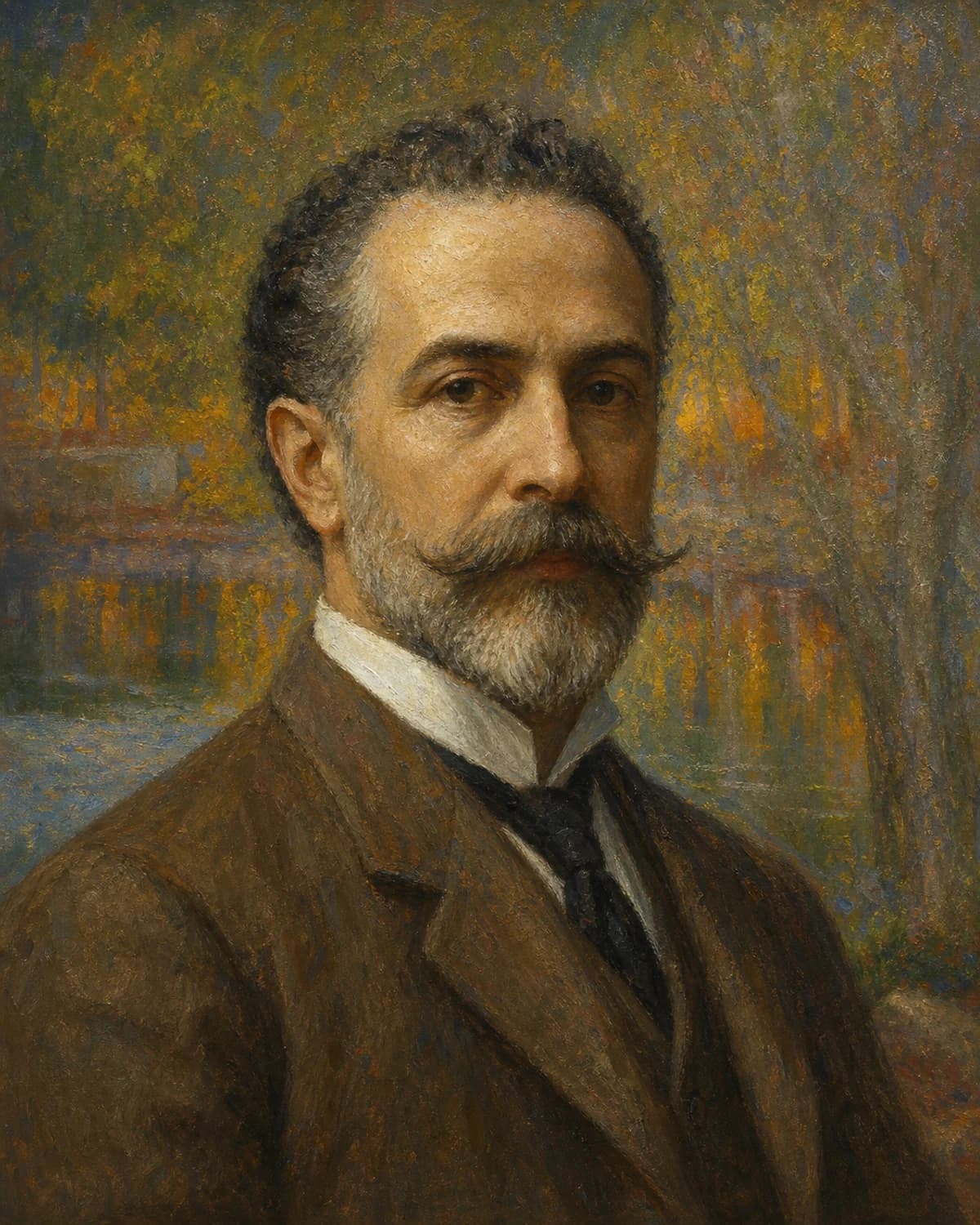
Biography
The studio on the roof of an old mansion in Mexico City was called the “tower of a thousand windows”: a room with doors and windows on three sides, where Clausell received his friends and covered the walls with sketches and paintings without any overall plan. About thirteen hundred such images accumulated. The building is now the Museum of the City of Mexico, but the studio is usually closed to visitors, and the wall works are less well known than the canvases.
Joaquín Quirico Marcelino Clausell Traconis was born on 16 June 1866 in Campeche, the only son of José Clausell, who had come from Catalonia, and Marcelina, a Campeche native. According to family lore, his parents knew there would be no more children and gave him all the names they liked. He attended a private school, the Instituto Campechano, but after his father’s death he had to work as well as study. He was a rebellious boy: as an altar boy he wore the red vestment as a Carnival costume and was barred from serving.
At sixteen Clausell spoke out in public against the governor of the state, Joaquín Baranda, and was expelled from school and from the state. He reached Mexico City with almost no money and cleaned equipment in a pharmacy. He briefly enrolled at the National School of Engineers, but his interest was in law. He borrowed books from the law school library to read at night; he was caught and jailed, but the dean, moved by his poverty and his hunger to learn, admitted him and gave him a scholarship. He still had to take odd jobs and even pawned a medal he had won in an oratory contest. In 1889 he organized students to receive the remains of the political exile Sebastián Lerdo de Tejada, spoke at the official ceremony in defence of Lerdo’s policies, was arrested for sedition and spent several months in Belém Prison. He finished his law classes in 1892 but could not take the bar examination.
Journalism against the regime of Porfirio Díaz followed. He wrote for El Universal under the pseudonym Juan Pérez, contributed to El Hijo del Ahuizote and El Monitor Republicano, and in 1893 founded and directed the newspaper El Demócrata. Within months it began printing excerpts of a fictionalized account of the army’s campaign against the Indigenous people at Tomóchic, in Chihuahua. Clausell and his co-founder Francisco Blanco found themselves in Belém again. The facts probably came to him from Heriberto Frías, but Clausell insisted the idea was his own. Just before the trial he escaped and, with friends’ help, went into exile in the United States and then in France.
In Paris he saw the Impressionists and remembered Camille Pissarro above all: he met him in his studio and was invited to Rouen, but did not go, most likely for lack of money. Accounts name a Pissarro exhibition of 1896 as the push towards painting. There are no records of study in Paris or Mexico City; he is usually considered self-taught, although the art historian Xavier Moyssen allows that he may have had some instruction and points to several copies of other painters’ works.
In 1896 he returned to Mexico City and lived among the writers and artists of the Centuria Azul circle, a Modernist generation. In 1901 he received his law degree, signed, ironically, by Díaz himself. He had been married since 1899 to Angela Cervantes, of a family descended from the Counts of Santiago de Calimaya, and he moved into the family mansion; they had four children. His wife disliked his painting and many of his acquaintances, so two rooms were built for him on the roof. Dr. Atl, Diego Rivera, Juan O’Gorman, Carlos Pellicer, Salvador Novo and Julio Ruelas came to the studio. In 1908 Atl made a pastel portrait of him, and in the same year Clausell took part in a group exhibition Atl organized for the magazine Savia Moderna.
His first period of work runs roughly from 1903 to 1910. During the Mexican Revolution he stopped painting, apparently because of his law practice: he defended poor prisoners in Xochimilco, took whatever fee they could pay, often in farm produce, and was nicknamed “Abogado Gallina”, Lawyer Chicken. He returned to painting around 1920, at the urging of Atl and Rivera, and in this second period he painted especially much. He spent all his spare money on supplies, made his own stretchers, and when canvas ran out painted on wood and cardboard. From time to time he disappeared to the coast between Mazatlán and Acapulco and came back with sketches.
He did not consider himself a professional painter. He made about four hundred works, around a hundred of them large; he hardly sold any and often gave them away. With no signatures and no dates, a catalogue is hard to compile. People rarely appear in his landscapes: he was drawn to Tlalpan, the lakes of Iztacalco and Xochimilco, the Santa Anita Canal and the Pacific coast. These are not panoramas of the Valley of Mexico like those of José María Velasco but small, intimate views. He made the colours of clouds, sky, rivers and sea stronger than in nature. Moyssen thought him the best seascape painter of his generation; an example is “Ola verde” (Green Wave), showing the Laguna de Cuyutlán. On the studio walls the subjects are more varied: family, fellow artists, religious images, nudes and animals, touched by Symbolism in the manner of Paul Gauguin and Paul Sérusier.
In 1921 Rivera, newly back from Europe, noticed his work at an exhibition and later visited him in his studio. Rivera called him the best of Mexico’s landscape painters and a “painter-poet”. In his lifetime he was shown rarely and only in group exhibitions; one work was bought by the government ministry of public education and fine arts for the gallery of the Academy of San Carlos. In 1930 he became director of the open-air painting school in Iztacalco. Since 1995, when the National Museum of Art paid him tribute, more has been written about him; since 1993 the Biennial of Painting named for him has been held in Campeche. His granddaughter Patricia Clausell de Latapí collects information on his works, and more than seventy forgeries have turned up.
Clausell died on 28 November 1935 on an outing with friends and family at the Lagos de Zempoala, south of Mexico City: the ground gave way under his feet on a slope, and a landslide buried him.
Related context
Associations
Works connected through artistic movements, cultural context and period. Priced works available in this market appear first.








Profile notes
Profile and sources
Image
Artist image
На основе открытого изображения: Luisalvaz; Wikimedia Commons; CC BY-SA 4.0.
