
05.06.1923–14.01.2005
Jesús Rafael Soto
Jesús Rafael Soto, the son of a violinist from Ciudad Bolívar, began by painting cinema posters; from 1950 he lived in Paris and became one of the leading figures of kinetic art and op art. His “vibrating” constructions of rods and wire change as the viewer moves, and in his “Penetrables”, made of hanging threads, the viewer ends up inside the work.
Biography
The first thing Jesús Rafael Soto saw when he entered the School of Plastic and Applied Arts in Caracas in 1942 was a reproduction of a still life by Georges Braque. He was struck by the way the colour in it began to separate from the form, and by the object being shown from several viewpoints at once. He later told the story himself.
Until then, the only artists he had known were sign painters.
He was born on 5 June 1923 in Ciudad Bolívar, the eldest of four children of Emma Soto and the violinist Luis García Parra. The boy played the guitar and copied famous pictures from books, magazines and almanacs. At sixteen he began painting posters for the town’s cinemas, and his family was pleased: their son was earning money and could paint lettering for the rest of his days. Around 1938 he joined a student circle drawn to the ideas of Surrealism, published poems in the local journal that caused a scandal, tried automatic writing and drew a great deal in charcoal, mostly heads and portraits. In the end the townspeople signed a petition, the bishop signed it too, and the young man received a scholarship to study in the capital.
He studied in Caracas until 1947. The school’s director, Antonio Edmundo Monsanto, brought his students news of the foreign avant-garde, above all Cubism, and among his fellow students were Carlos Cruz-Diez, Alejandro Otero, Mateo Manaure and Mercedes Pardo. Having qualified as a teacher, Soto ran the School of Fine Arts in Maracaibo from 1947 to 1950.
In 1950 he received a government grant to travel to France and stayed in Paris. There he discovered Paul Klee and Mondrian, and from Mondrian came the idea of setting Neoplasticism in motion. He grew close to Yaacov Agam, Jean Tinguely and Victor Vasarely and exhibited at the Salon des Réalités Nouvelles and with Denise René. In the fifties he made serial works in which the same elements repeat without beginning or end, without top or bottom, drawing on mathematics and music. “Two Squares in Space” (1953) continued Malevich’s idea of the square as the only valid form. In “Displacement of a Transparent Square” (1953–1954) he laid sheets of clear Plexiglas painted with straight and curved lines one over another, and the pattern changed as soon as the viewer moved. In 1955 his work appeared in the exhibition “Le Mouvement” at the Galerie Denise René, alongside work by Agam, Marcel Duchamp and Vasarely; the “Yellow Manifesto” of kinetic art was issued for it, and from that show the movement gathered strength in Europe and Latin America.
Plexiglas soon became a hindrance. In “Kinetic Structure” of 1957, made for the University City in Caracas, the lines drawn on plastic turned into real metal rods welded together. In 1958 came “Writing” and the “Brussels Wall”, made for the World’s Fair in Brussels. In the sixties he hung thin rods and wires in front of a striped background, and these “vibrating paintings” tremble and blur as the viewer walks past. In 1964 his work was shown at documenta III in Kassel. He himself said that his art was entirely abstract and that he did not copy nature but isolated the fundamental properties of reality.
Then the viewer was able to step inside. The “Penetrables” are spaces filled with hanging threads or tubes that one walks right through; in some of them aluminium tubes ring as one moves. Soto described the feeling as being in a whirl of light, a fullness of vibrations, and repeated that emptiness exists nowhere. I would call the “Penetrables” the most direct statement of his views: here you touch space with your body.
He made many works for buildings. There is a kinetic wall at the UNESCO headquarters in Paris (1969) and a large mural at the Central Bank of Venezuela (1973); a suspended volume hung in the Venezuelan pavilion at Expo 67 in Montreal; he designed entrance halls for the Deutsche Bundesbank in Frankfurt, for the university in Rennes and for Renault at Boulogne-Billancourt. In 1983 his works appeared at the Chacaíto metro station in Caracas, in 1988 he made a large sphere for the Olympics in Seoul, in 1992 another sphere for the World’s Fair in Seville, and in 1997 the “Caracas Sphere” went up by the Francisco Fajardo motorway in Caracas.
In 1973 the Jesús Soto Museum of Modern Art opened in Ciudad Bolívar. The building was designed by the architect Carlos Raúl Villanueva, the Italian op artist Getulio Alviani was invited to run it, and many of the exhibits there are connected to the mains so that they can move. In 1974 the Solomon R. Guggenheim Museum in New York held a retrospective of his work. Soto’s works are in Tate in London, the Centre Pompidou, the Museum of Modern Art in New York, the Museum Ludwig in Cologne and the National Gallery of Modern Art in Rome.
Jesús Rafael Soto died in Paris on 14 January 2005 and is buried in the Montparnasse cemetery.
Profile notes
Profile and sources
Image
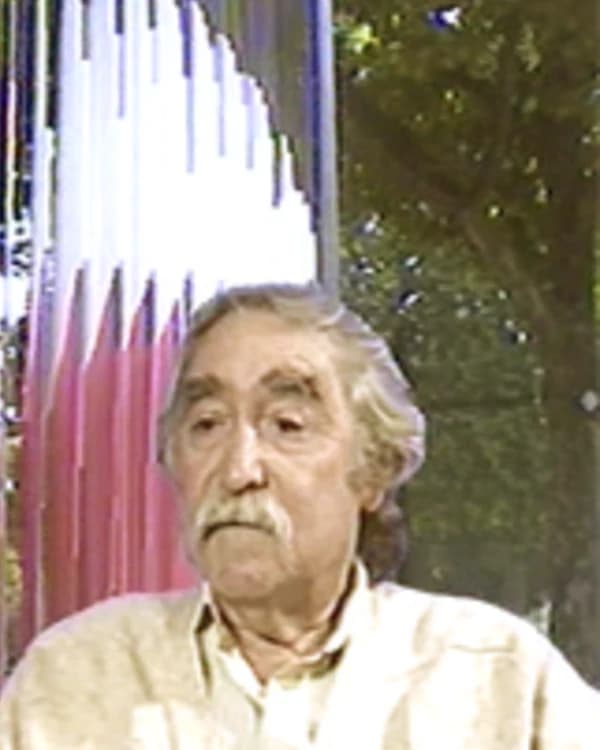
Artist image
Pantalaskas; Wikimedia Commons; CC BY-SA 3.0.
