
22.12.1960–12.08.1988
Jean-Michel Basquiat
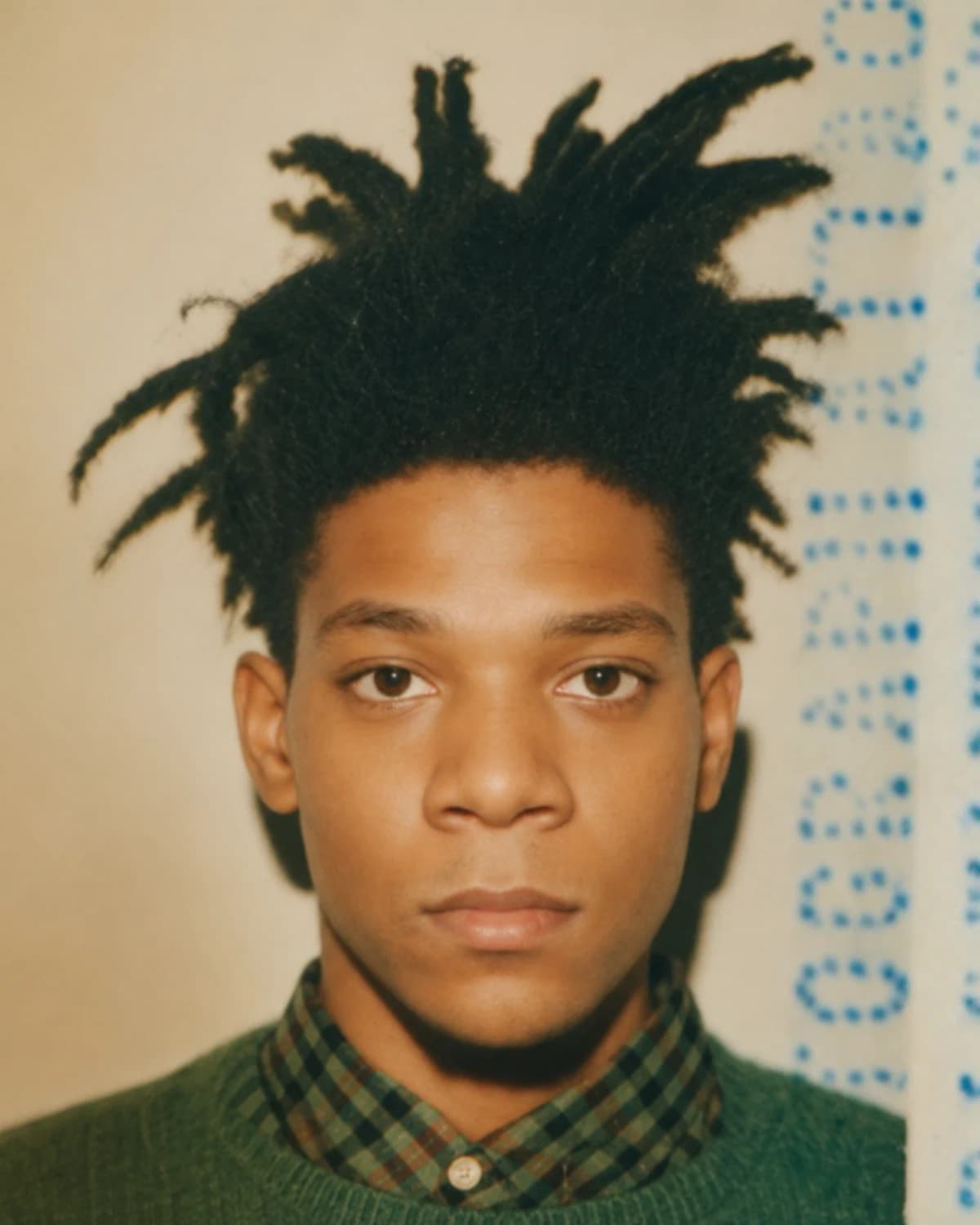
Jean-Michel Basquiat (1960–1988), a Brooklyn native with Haitian and Puerto Rican roots, started out with street writing signed SAMO and postcards he sold in SoHo. In a short career he made about six hundred paintings and fifteen hundred drawings, showed at documenta in Kassel at twenty-one and painted in tandem with Andy Warhol. His canvases carry words, crowns, skulls, anatomical diagrams, jazz.
Biography
On 4 October 1982 the Swiss dealer Bruno Bischofberger brought Basquiat to lunch with Andy Warhol. Warhol took a Polaroid; Basquiat went home and came back a couple of hours later with a painting that was still wet: it showed the two of them. The picture was called “Dos Cabezas”, and their friendship began with it.
Earlier, back when he sold postcards on the street, Basquiat had once sold Warhol a postcard in a restaurant in SoHo.
He was born on 22 December 1960 in Park Slope, Brooklyn. His father, Gérard Basquiat, came from Port-au-Prince in Haiti; his mother, Matilde, was born in Brooklyn into a Puerto Rican family. She took her son round museums and enrolled him as a junior member of the Brooklyn Museum. He could read and write by the age of four, drew his favourite cartoon characters, and at seven, at the private St. Ann’s School, wrote a children’s book together with a friend. In 1968 he was hit by a car, and in hospital his mother gave him “Gray’s Anatomy”; for the rest of his life the book served him as a source. By eleven he could speak and read French, Spanish and English fluently. In 1974–1976 the family lived in Puerto Rico, then returned to Brooklyn, and Basquiat moved to City-As-School, an alternative school in Manhattan for teenagers who did not get on in ordinary schools. It was there, in the school newspaper, that the character SAMO was born, short for “same old shit”, at first simply a joke shared with his classmate Al Díaz.
In May 1978 the two of them began spray-painting short poetic slogans that parodied advertising on buildings in Lower Manhattan: “SAMO© as an alternative to God” and the like. On 11 December 1978 the “Village Voice” wrote about the mysterious inscriptions. Basquiat left school and home, worked by day in a clothing warehouse, wrote on walls in the evenings, sold home-made postcards and painted on old clothes. In 1979, with Michael Holman, he put together the noise band Gray, which played at CBGB and the Mudd Club, and became a regular on Glenn O’Brien’s television show “TV Party”. In 1980, after falling out with Díaz, he wrote “SAMO is dead” on the walls of SoHo.
From then on everything moved very fast. In June 1980 his work was included in the group “Times Square Show”, and the critic Jeffrey Deitch mentioned him in “Art in America”. In February 1981 he took part in “New York/New Wave” at P.S.1 in New York, and in May his first exhibition in Italy took place in Modena. In December 1981 René Ricard published “The Radiant Child” in “Artforum”, the first substantial piece of writing about him. At that time he painted on whatever he found in the street, discarded doors, for instance. The dealer Annina Nosei gave him materials and a studio in the basement of her gallery, and in March 1982 his first solo exhibition in America opened there.
In June 1982, at twenty-one, Basquiat became the youngest participant in documenta in Kassel, where he was shown alongside Beuys, Kiefer, Richter, Twombly and Warhol. Then came the Gagosian Gallery in Los Angeles, where he painted “Hollywood Africans” (1983), with himself and the graffiti artists Toxic and Rammellzee; the Whitney Biennial in March 1983; and in August, the move into Warhol’s loft on Great Jones Street. The canvases of these years are thickly written over with words, numbers, pictograms, logos, map signs and diagrams, sometimes on stretchers left bare. He took a great deal from books: from “Gray’s Anatomy”, from Henry Dreyfuss’s “Symbol Sourcebook”, from a book on Leonardo da Vinci, from studies of African rock art. Above the heads of the heroes he loved he drew a three-pointed crown. Francesco Clemente explained it this way: poet, musician, boxing champion. Charlie Parker, “Charles the First” (1982), “Horn Players” (1983). When transit police killed the young Black artist Michael Stewart in September 1983, Basquiat answered with the painting “Defacement (The Death of Michael Stewart)”.
In 1984–1985 he and Warhol painted pictures together. As a rule Warhol began with something recognisable and Basquiat “spoiled” it with his quick hand: that is how “Olympics” (1984), “Taxi, 45th/Broadway” and “Zenith” (1985) came about. The critics savaged their joint exhibition at the Tony Shafrazi Gallery in September 1985, Basquiat was called Warhol’s “mascot”, and the friendship cracked. Around the same time he appeared on the cover of “The New York Times Magazine” (10 February 1985), walked the runway at a Comme des Garçons show, and painted in expensive suits, then went out in those same suits spattered with paint. In October 1986 he had an exhibition at the French Institute in Abidjan, and in November, at twenty-five, he became the youngest artist ever given an exhibition by the Kestner-Gesellschaft in Hanover.
After Warhol’s death in February 1987 Basquiat almost stopped appearing in public. It seems to me that this friendship meant more to him than one can tell from their joint canvases. In 1987 there were exhibitions in Paris, Tokyo and New York and a Ferris wheel for the Luna Luna amusement park in Hamburg; in January 1988, Paris and Düsseldorf again. In Paris he became friends with the Ivorian artist Ouattara Watts, and they planned to travel together that summer to Watts’s home town, Korhogo.
Basquiat died on 12 August 1988 in his loft on Great Jones Street, at the age of twenty-seven. He is buried in Green-Wood Cemetery in Brooklyn. At a memorial gathering on 3 November at St. Peter’s Church his friend Fab 5 Freddy read a poem by Langston Hughes. Keith Haring painted “A Pile of Crowns for Jean-Michel Basquiat” in his memory.
Profile notes
Profile and sources
Image
Artist image
Unknown author Unknown author; Wikimedia Commons; Public domain.
