
04.10.1814–20.01.1875
Jean-François Millet
Jean-François Millet, a farmer’s son from the Norman hamlet of Gruchy, studied in Cherbourg and with Paul Delaroche in Paris, and in 1849 settled in Barbizon, where he lived until his death. “The Sower”, “The Gleaners” and “The Angelus” made peasant labour the main subject of his painting; “The Sower” was later copied by Van Gogh.
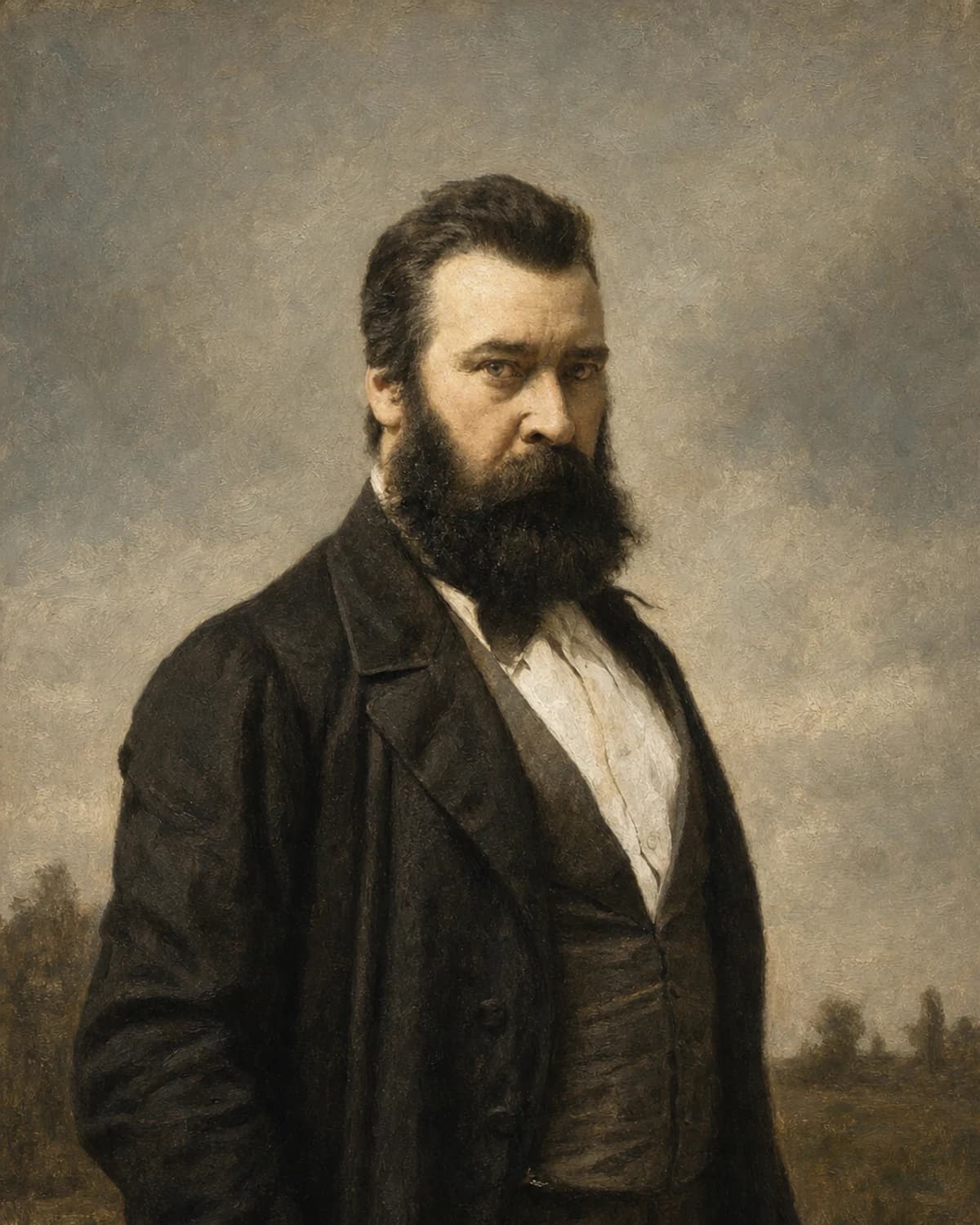
Biography
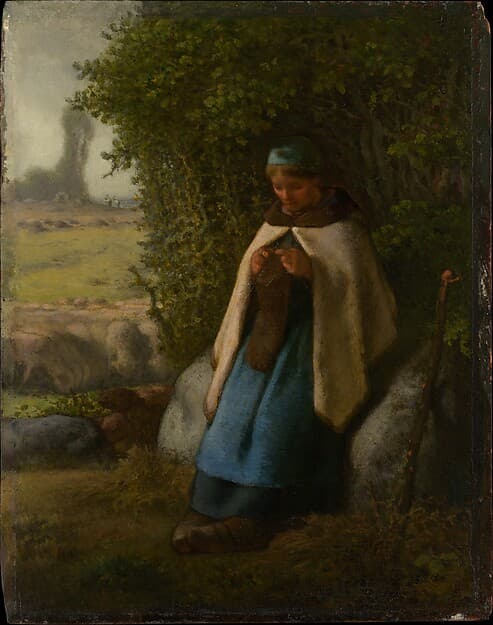
In 1984 the Museum of Fine Arts in Boston X-rayed Millet’s painting “The Young Shepherdess” (1870), hoping to find minor alterations. Beneath it lay “The Captivity of the Jews in Babylon”, his most ambitious work of the late 1840s, which at the Salon of 1848 had been met with scorn by critics and public alike and had then disappeared. Apparently, during the Franco-Prussian War, when canvas was scarce, the artist simply painted a new picture over the old one. Whether there was some other intention behind it can no longer be checked.
“I am a peasant and nothing but a peasant,” he said of himself.
Millet was born on 4 October 1814 in the hamlet of Gruchy (commune of Gréville-Hague) on the Channel coast near Cherbourg, the eldest son of a large farming family. Two village priests taught him Latin and introduced him to books: the Bible, Virgil, Montaigne. But as the eldest of the sons he began early to work in the fields with his father: he mowed, bound sheaves, threshed, winnowed, ploughed and sowed, and all of this would later return in his pictures. In the early 1830s his father sent him to Cherbourg to study with the portrait painter Du Mouchel; he then worked with Théophile Langlois de Chèvreville, a pupil of Baron Gros, and copied Dutch and Spanish masters in the town museum that had recently opened.
A stipend from Langlois and other people of Cherbourg allowed him to go to Paris in 1837, to the École des Beaux-Arts and the studio of Paul Delaroche. He did not fit into the academic system, failed to win the Prix de Rome, lost his stipend in 1839, and the first picture he sent to the Salon, “Saint Anne Instructing the Virgin”, was rejected by the jury. He learned more in the Louvre, copying Mantegna, Velázquez and Poussin. In 1840 the Salon accepted a portrait by him, and Millet went back to Cherbourg to earn his living by portraits. Then came Paris, Cherbourg again, and in 1845 Le Havre, where he moved with Catherine Lemaire, his future wife. In Paris in the mid-1840s he became friends with Constant Troyon, Narcisse Diaz, Charles Jacque and Théodore Rousseau, all later associated with Barbizon; Honoré Daumier’s figure drawing influenced his peasants. Alfred Sensier, a government official, became his friend, his supporter and later his biographer. His first success at the Salon came in 1847 with “Oedipus Taken Down from the Tree”, and in 1848 the state bought “The Winnower”.
In June 1849 Millet settled in Barbizon with Catherine and their children. From 1850 Sensier supplied him with materials and money in exchange for drawings and paintings. At the Salon of 1850 “The Sower” and “Haymakers” appeared. From 1850 to 1853 he worked on “Harvesters Resting (Ruth and Boaz)”; it is the only painting he ever dated, he himself thought it his most important, and it won him a second-class medal at the Salon of 1853. For seven years he kept returning to gleaning, the age-old right of poor women and children to pick up the grain left after the harvest. In 1857 he exhibited “The Gleaners”, now in the Musée d’Orsay: stooping figures in dark homespun on a golden stubble field, and on the horizon a farm with great stacks of grain lit by the setting sun. The public received the picture coolly, even with hostility. That same summer he finished “The Angelus”, commissioned by the Boston collector Thomas Gold Appleton. It was first called “Prayer for the Potato Crop”; when the buyer failed to collect it, Millet added a steeple and changed the title.
In the 1860s his reputation grew. He signed a contract for 25 works in return for a monthly stipend over three years, and from 1865 Émile Gavet commissioned pastels from him, of which he eventually had ninety. The Exposition Universelle of 1867 showed “The Gleaners”, “The Angelus” and “Potato Planters”. In 1868 Frédéric Hartmann commissioned “The Four Seasons” from him, and he himself was made a Chevalier of the Legion of Honour. In 1870 he was elected to the Salon jury, but that same year the family fled the war to Cherbourg and Gréville and did not return to Barbizon until late 1871. In his last years he was more and more drawn to pure landscape.
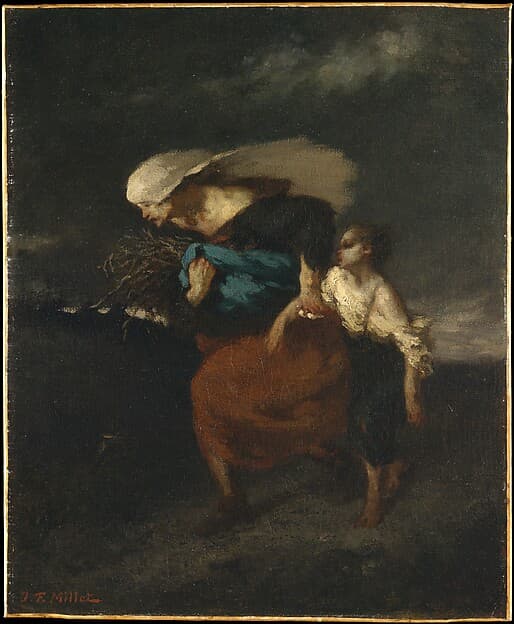
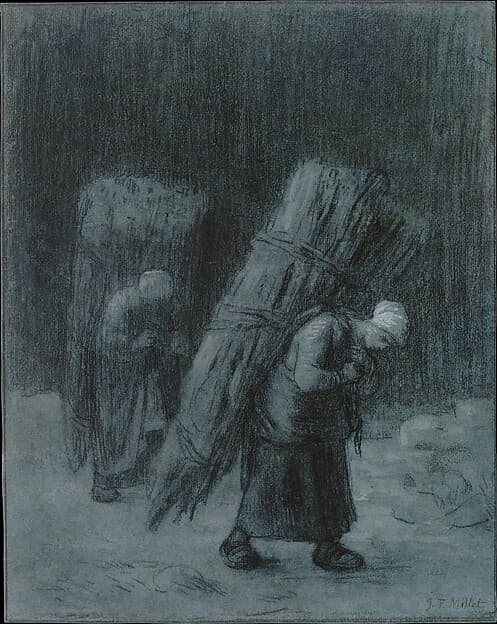
Van Gogh mentions him many times in his letters to his brother, and he copied “The Sower”. Millet’s late Normandy landscapes became a point of reference for Monet, and the structure of his pictures influenced Seurat. The Hermitage has his “Peasant Women Carrying Brushwood” (1858), and the Pushkin Museum in Moscow his “Brushwood Gatherers” and “Rest in the Forest”.
Millet died on 20 January 1875 in Barbizon. He was buried in the cemetery of neighbouring Chailly-en-Bière, to which Barbizon then belonged, next to his friend Théodore Rousseau. The house at 29 Grande Rue, where he had lived since 1849, became a museum in 1922.
Artist works
Works by the artist
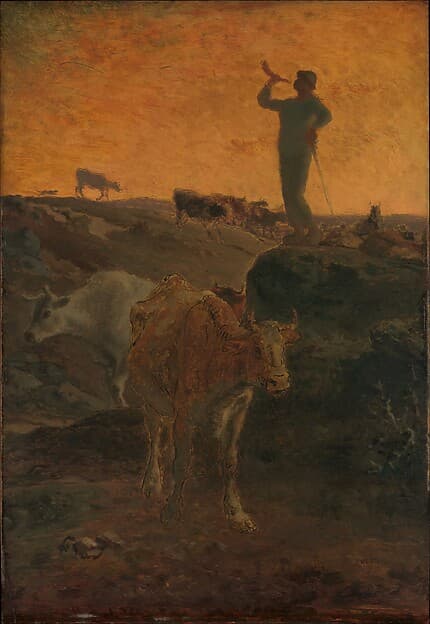
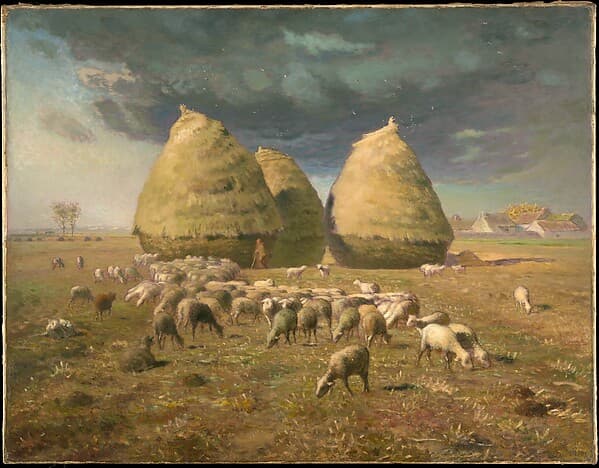
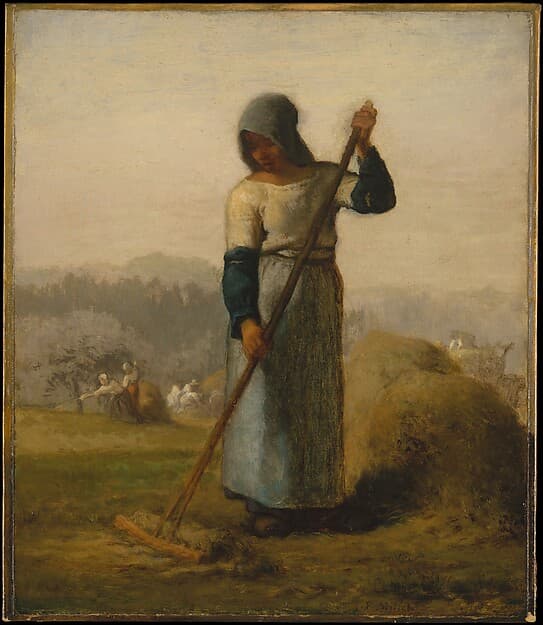
Works by Jean-François Millet available in this edition of NEOARCA.
Related context
Associations
Works connected through artistic movements, cultural context and period. Priced works available in this market appear first.








Profile notes
Profile and sources
Image
Artist image
На основе открытого изображения: Nadar; Wikimedia Commons; Public domain.
