
16.07.1796–22.02.1875
Jean-Baptiste-Camille Corot
Jean-Baptiste-Camille Corot (1796–1875) worked in the cloth trade until he was twenty-six, and only then did his father allow him to become an artist. In summer he painted studies in the open air in Italy, in the Forest of Fontainebleau and all over France; in winter, in the studio, he turned them into pictures for the Salon. His late silvery “souvenirs”, such as “Souvenir of Mortefontaine” (1864), gave rise to thousands of forgeries.
Biography
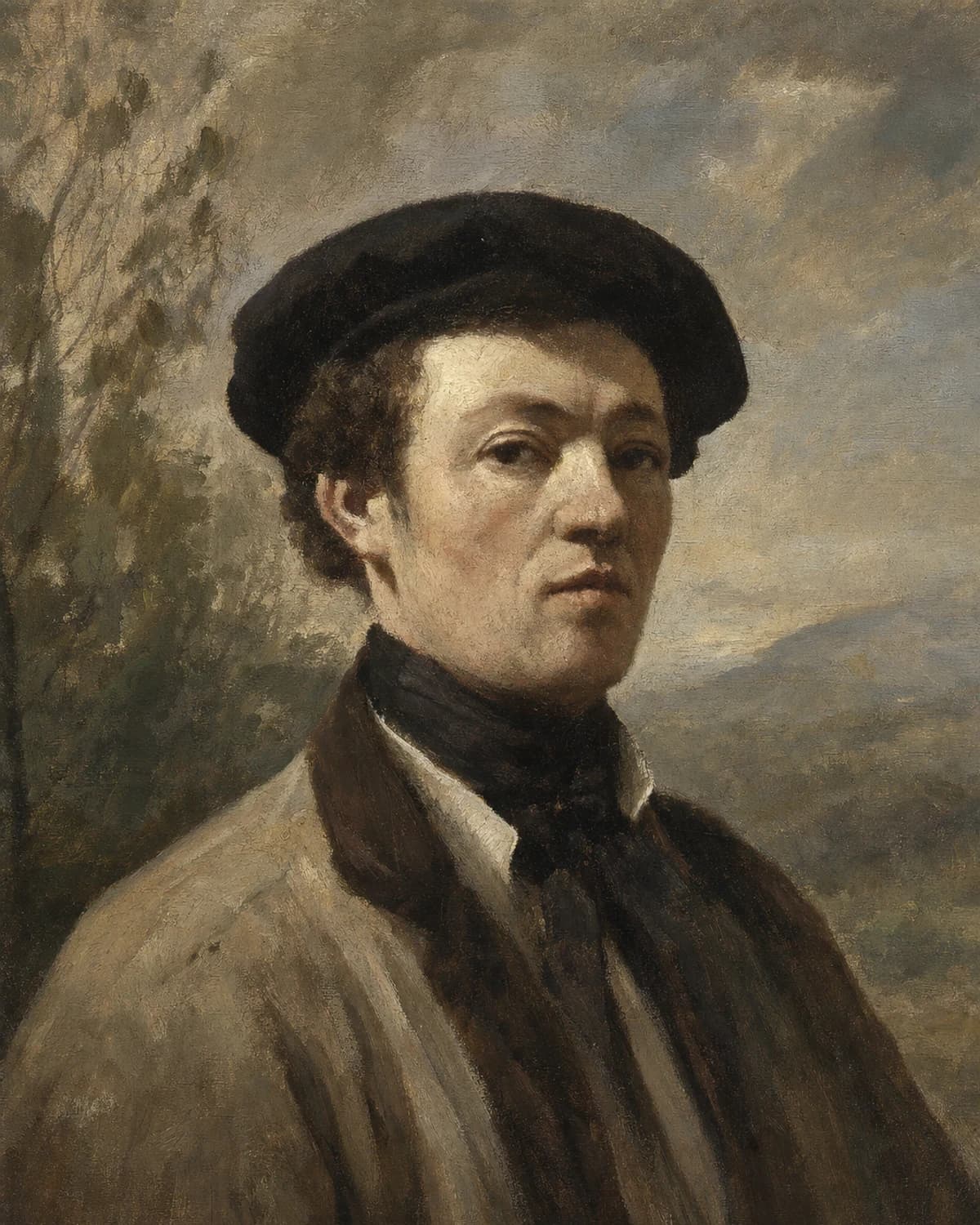
From Italy Corot wrote that the sun there drove him to despair: beside that light his palette was utterly powerless. He had arrived in 1825 on his parents’ money and with one condition of theirs: before leaving he was to paint a self-portrait for them, the first of his life. In three years he accumulated more than two hundred drawings and about a hundred and fifty paintings. He took little from the Renaissance masters and spent his time around Rome; the Farnese Gardens, with their view of the ruins, he painted three times, at different hours of the day.
By then he had been working in oil for about four years.
He was born on 16 July 1796 in Paris, at 125 Rue du Bac, a house long since gone. His father was a wigmaker and his mother, Marie-Françoise, a milliner; after their marriage they bought the fashionable shop where she worked, his father took over its business side, and the family lived above the shop. Corot never knew want of money in his life. He was a poor pupil: from 1807 to 1812 he held a scholarship at the Lycée Pierre-Corneille in Rouen, then moved to a boarding school at Poissy, and in all his school years he did not win a single prize, not even for drawing. In Rouen he stayed for long periods with the Sennegons, friends of his father, and roamed the countryside with the head of the household; there his first studies from nature were made. His father placed him with cloth merchants. He hated commerce and went to draw at the Académie Suisse in the evenings, but he did not leave the shop until he was twenty-six, when his father gave way. Corot later recalled telling his father that business and he were incompatible and that he was getting a divorce. From 1822, after the death of his sister, he received 1,500 francs a year; to the end of his life this money was enough for a studio, paints and travel. His first teacher was Achille-Etna Michallon, a man of his own age, whose only advice, Corot recalled, was to render as scrupulously as possible everything he saw before him. Michallon died in 1822, and the training was continued by Michallon’s own teacher, Jean-Victor Bertin, a Neoclassicist, who made his pupil copy lithographs of plants.
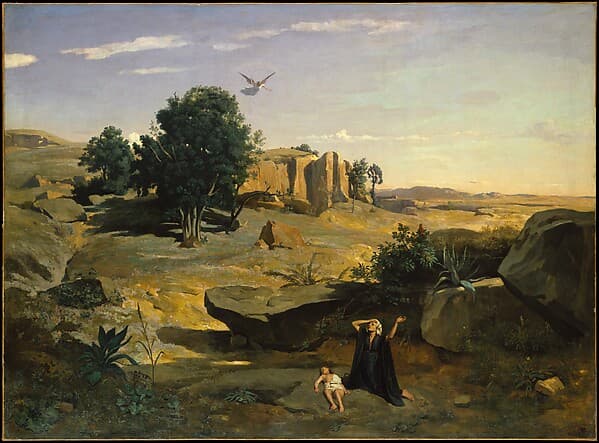
At that time the Salon still expected a landscape painter to show ideal nature with the heroes of antiquity. For his first exhibition, in 1827, Corot took an Italian study, “The Bridge at Narni” (1826, Louvre): ruins under a dusty, bright sun. In the studio he turned it into a pastoral with shady trees and green lawns, calculated to please the jury. In the spring of 1829 he came to Barbizon to paint the Forest of Fontainebleau, returned there in 1830 and 1831, and got to know Théodore Rousseau, Troyon, Millet and the young Daubigny. The critics received him coolly, and in 1834 he left for Italy again; the third trip came in 1843. Success arrived in 1835 with the biblical “Hagar in the Wilderness”, in which Sarah’s handmaid and her son Ishmael are dying of thirst until an angel appears. In 1837 he painted “The Nymph of the Seine”, the earliest of his surviving nudes. He later explained to his students that the study of the nude is the best lesson for a landscape painter: whoever can set down a figure without tricks can manage a landscape too.
In the 1840s the jury often rejected his pictures, and few were bought. In 1845 Baudelaire called him the head of the new school of landscape and answered those who found his colours pale by saying that Corot was more a harmonist than a colourist. In 1846 he received the cross of the Légion d’honneur and in 1848 a second-class medal, yet his only commission of those years remained “The Baptism of Christ” for the baptismal chapel of the Paris church of Saint-Nicolas-du-Chardonnet (1845–1847). Delacroix wrote in his journal that Corot was a true artist and that one could judge him only after visiting his studio. After the revolution of 1848 Corot joined the Salon jury. Even at fifty, though, he still lived with his parents, and a contemporary observed that he had to plead long and hard with his mother for permission to go out to dinner on Fridays, once a fortnight.
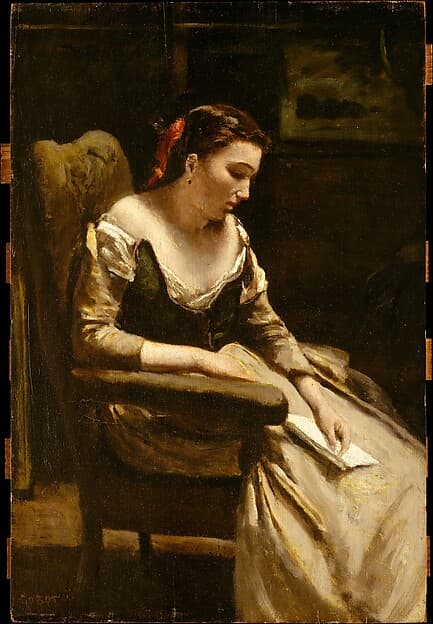
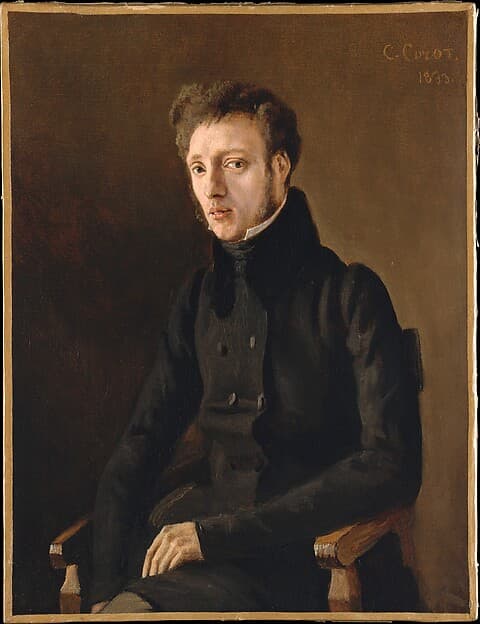
From the 1850s he painted more and more “souvenirs”, dreamy views of places he had visited many years before, in light, loosely scattered strokes; the best of them is considered to be “Souvenir of Mortefontaine” (1864, Louvre). In the 1860s he took up photography, took pictures himself, tried cliché verre, a hybrid of photography and engraving, and his palette grew even more restrained. Théophile Thoré complained that Corot had a single octave, a single time of day, morning, and a single colour, pale grey. Corot replied that in painting he looked for form, the whole and the relation of tones, and that colour came afterwards for him: colour delivers a shock, which he disliked. It seems to me that this answer explains his painting better than the later arguments over whether he was a forerunner of Impressionism. Besides landscapes he painted about fifty portraits, mostly of family and friends, and thirteen reclining nudes; one of his last figures, “Lady in Blue”, is dated 1874.
After the deaths of his parents, his father in 1847 and his mother in 1851, he began taking pupils. Camille Pissarro studied with him briefly; Eugène Boudin, Berthe Morisot and Stanislas Lépine called Corot their teacher. Daubigny called him Father Corot. The studio was always full of models, friends and dealers, and its owner grumbled that there were ten people around him and not one of them thought to light his pipe. He gave money away freely: in 1871 he donated to the poor of besieged Paris, in 1872 he bought a house for Honoré Daumier, who was blind and destitute, and in 1875 he gave ten thousand francs to Millet’s widow for her children. Just as readily he let students copy his canvases, and he touched up and signed other people’s copies. Hence the enormous number of forgeries produced between 1870 and 1939; in the Jousseaume collection alone 2,414 of them were counted.
In 1874 friends who felt that he had never been officially recognised presented him with a gold medal. At the end of that year he went to Coubron; on 25 January 1875 he returned to Paris, and he died on 22 February in the house at 56 Rue du Faubourg-Poissonnière. He is buried in Père Lachaise Cemetery.
Artist works
Works by the artist
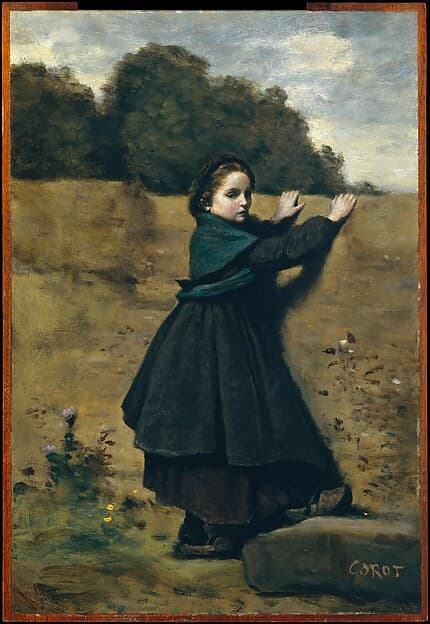
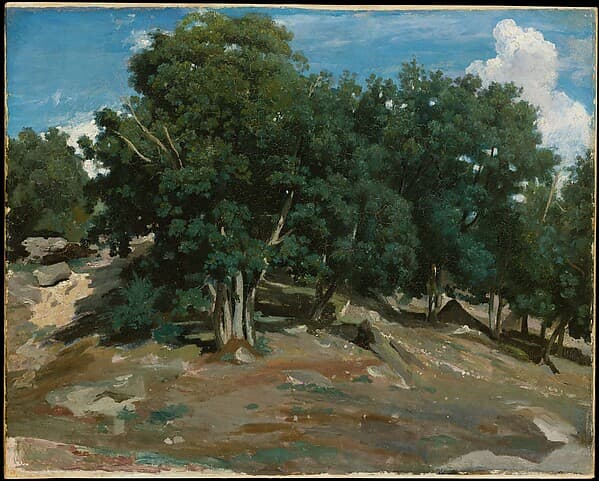
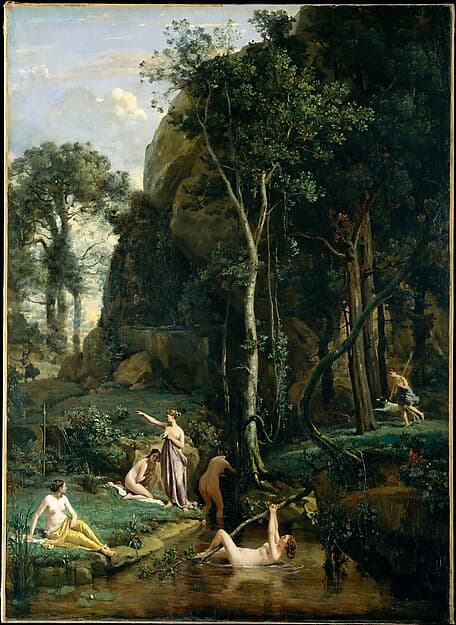
Works by Jean-Baptiste-Camille Corot available in this edition of NEOARCA.
Related context
Associations
Works connected through artistic movements, cultural context and period. Priced works available in this market appear first.








Profile notes
Profile and sources
Image
Artist image
На основе открытого изображения: Jean-Baptiste Camille Corot; Wikimedia Commons; Public domain.
