
01.10.1888–15.09.1954
Jazep Drazdovič
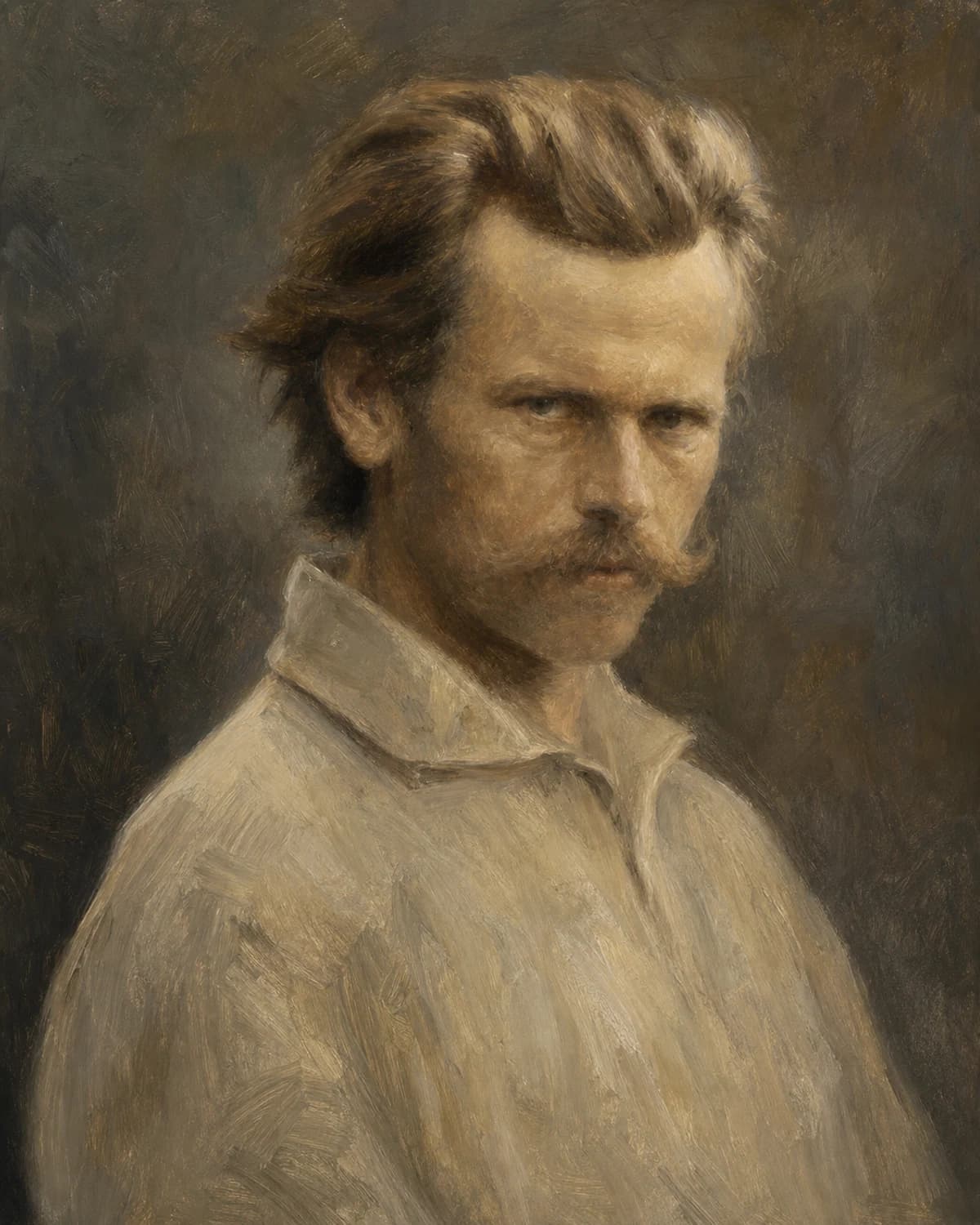
Jazep Drazdovič (1888–1954) drew the castles and old towns of Belarus, carried out excavations, recorded songs and dialect words, and wrote fiction and popular astronomy. More than a hundred of his paintings and drawings depict life on the Moon, Mars and Saturn, which he was convinced he had seen in his dreams. From the 1930s he wandered the villages of his native Disna region, earning his living by painting wall carpets.
Biography
In 1931–1932 Jazep Drazdovič painted “Cosmopolis. Port of Celestial Space on the Ring of Saturn” and “Meeting Spring on Saturn”. His Martian cycle has universities, observatories, theatres and hospitals; his lunar cycle, painted a little later, has fortress walls, towers, empty catacombs and necropolises. All of this, he was convinced, had been seen during “astral” journeys in his sleep: on waking he wrote down what he had seen in notebooks, drew maps, and drew alien plants, animals and inhabitants.
He himself regarded these sheets not as fantasy but as scientific records that could be checked by astronomical observation.
Drazdovič was born on 1 (13) October 1888 on the farmstead of Punki in Disna uezd, Vilna Governorate, into an impoverished noble family. His father, Narciz Drazdovič, died when the boy was two, and the children were brought up by their mother, Yuzefa; she sold Punki, and the family moved often from one rented home to another. He studied first in Disna, and in 1906 entered Ivan Trutnev’s drawing school in Vilna. In 1908 the newspaper “Nasha Niva” printed his first short article and then commissioned from him the cover of the first Belarusian calendar, for 1910. In the 1910s he also designed books, among them books by Kanstantsyia Builo and Anton Hrynevich. In 1910 he was called up into the army; after two years’ service in Saratov he completed a course for medical assistants and served as a military feldsher throughout the First World War.
In 1917 Drazdovič returned to the Disna region, lived with relatives on the Lyavonaŭka estate near Hermanavichy, wrote about village life for “Nasha Niva”, helped to open a library and an amateur theatre, and in a letter to Anton Hrynevich proposed founding an academy of arts. In 1919 he moved to Minsk. There he illustrated publications, taught drawing, among other places at a girls’ gymnasium, worked in the cultural and educational society “Zaranka”, and in the summer and autumn of 1920 was an artist for the People’s Commissariat of Education of the Byelorussian SSR. In Minsk he made a series of drawings of the old quarters: the Castle District, the Upper Market, the Tatar Suburb. He studied the course of the Nyamiha river and dug at Zaslawye and Svir. His drawings of castle architecture and the graphic sheets “Disna Region” date from the late 1910s and early 1920s. Later, in the 1940s, he painted a series of pictures about Francysk Skaryna, having earlier modelled a sculptural portrait of him.
At the end of 1920 he completed a teacher-training course and returned to the Disna region, which after the Peace of Riga passed to Poland. For several years he worked for a cooperative and taught drawing in Hlybokaye, Radashkovichy and Navahrudak, and in 1927 he set up an art studio at the Belarusian gymnasium in Wilno. He was closely connected with the Ivan Lutskyevich Belarusian Museum in Wilno: he gave it paintings, folklore records and material from his excavations, and thanks to this much of what he made in the 1920s and 1930s has survived. In 1926 he travelled to the Pinsk region, and in the following two years he went round Troki, Medininkai, Kreva, Halshany, Lida, Navahrudak, Lyubcha and Mir, bringing back albums of drawings from every journey. To Minsk, to the Institute of Belarusian Culture, he sent drawings and measurements of wooden buildings and objects of peasant life. In 1923, under the pseudonym Iosif Nartsizov, his story “Vyalikaya shyshka” came out with his own cover; the historical novel “Haradolskaya Pushcha”, in which the First World War sits side by side with the life of the medieval Polotsk land, remained unfinished.
Astronomy absorbed him more and more. In 1931 his Belarusian-language book “Nyabesnyya behi” came out in Wilno with his own linocuts, and later he wrote treatises on the harmony of the planets of the Solar System. Scholars note that on distant Saturn, Belarus keeps showing through in his work, and that alien life is explained by comparison with familiar village life. I think this is the answer to the riddle of his cosmos: it is a way of speaking about home and about his own loneliness.
From 1933 he lived with his elder brother Kanstantsin in the Disna region and went from village to village: he carved wood and painted portraits, landscapes and the wall carpets he had begun painting back in the 1920s. By painting carpets, as he saw it himself, he was developing the peasants’ artistic taste. They asked him about the stars, and in 1934 he recorded in his diary some fifty “modelled lectures on astronomy”: he would sometimes demonstrate celestial phenomena with household utensils. In 1940–1941 he taught in Hlybokaye and Luzhki, and because of the shortage of teachers he took drawing, history, botany and astronomy. All this time he was recording folk songs and collecting dialect vocabulary for dictionaries, and he compiled the collection “Songs of the Disna Region”. During the occupation he went on painting, and after the war he again lived by painting carpets. In 1947 came the painting “In the Coastal Cliffs” from his Venus cycle, and in 1949 he tried without success to publish a monograph, “The Theory of Motion in Its Cosmological Significance”.
Jazep Drazdovič died on 15 September 1954 in Podsvilye. He was buried in the cemetery between the villages of Liplyani and Malyya Davydki.
The first solo exhibition of his work was not held until 1979, and in 1984 Arseny Lis published a book about him, “Vechny vandrounik” (“The Eternal Wanderer”). His diaries were printed in 1991–1992 and his memoirs of military service in 2014. His works are in the National Art Museum of the Republic of Belarus, the National Museum of Lithuania and other collections, and his carpets are shown at the Museum of the Belarusian Malyavanka in Zaslawye. A museum devoted to him has been open in Hermanavichy since 1991, and a monument has stood in Minsk since 1993. In 1982 a stele with a relief of the “eternal wanderer” by Ales Shaternik was erected on his grave, and in 2018 the grave was declared a site of historical and cultural value.
Related context
Associations
Works connected through artistic movements, cultural context and period. Priced works available in this market appear first.








Profile notes
Profile and sources
Image
Artist image
На основе открытого изображения: Leŭ Daškievič; Wikimedia Commons; Public domain.
