
15.05.1930–present
Jasper Johns
In 1954 the American artist Jasper Johns (born 1930) destroyed his earlier work and began painting flags, targets, maps, letters and numbers, signs everyone knows, which on canvas become image and abstraction at once. He is associated with Neo-Dada and pop art; besides painting he makes sculpture and works extensively in printmaking.
Biography
In 1954 the twenty-four-year-old Jasper Johns destroyed all the works he still had and began painting the American flag. He said he had dreamed of it. He painted in encaustic, molten wax mixed with pigment, and each stroke set on the surface separately.
Between 1954 and 2002 the flag became the main image in twenty-seven of his paintings, ten sculptures, fifty drawings and eighteen print editions.
Johns was born on 15 May 1930 in Augusta, Georgia, and grew up in South Carolina, in the small town of Allendale; he began drawing at three, although there were hardly any artists or art around him. In 1947 he graduated top of his class from high school in Sumter, studied art for three semesters at the University of South Carolina, and then left for New York and briefly enrolled at the Parsons School of Design. In 1951 he was drafted into the army: two years of service, at Fort Jackson and in Sendai, Japan. In the summer of 1953 he returned to New York, worked in a bookshop and met Robert Rauschenberg, who became his closest collaborator and a strong influence on him. No less important to him were the choreographer Merce Cunningham, the composer John Cage and Marcel Duchamp’s readymades.
In March 1957 the dealer Leo Castelli, visiting Rauschenberg, asked to see Johns’s work, and they went one floor down. There stood flags and targets, numbers, the alphabet. Castelli offered him a show on the spot. Johns’s first solo exhibition at his gallery opened early in 1958, and of the eighteen works only two failed to find a buyer. Alfred Barr, director of the Museum of Modern Art in New York, took three paintings, and these were the first works by Johns to enter a museum collection. “Flag” was not among them: the museum’s trustees feared that its ambiguity, in the climate of the Cold War, would draw attacks from patriotic groups. Barr persuaded the architect Philip Johnson to buy the canvas, and in 1973 Johnson gave it to the museum.
Ambiguity was the very subject of these pictures. A flag, a target or a map in Johns’s work reads both as an image and as stripes, circles, patches of color; the sign itself makes the compositional decisions for the artist, and Johns described such motifs as things the mind already knows. After the gestural painting of the Abstract Expressionists, where every stroke was taken as an expression of personality, this looked almost like a challenge. Johns also brought real objects into the picture: found ones, like the ruler in “Painting with Ruler and ‘Gray’” (1960), or ones made for the purpose, like the plaster casts of faces in “Target with Four Faces” (1955). He is placed now with Neo-Dada, now with pop art, or seen, together with Rauschenberg, as a forerunner of pop; unlike Warhol, he took no interest in celebrity culture. The curator Robert Storr saw in his work language games in the spirit of Wittgenstein, whom Johns had been reading since the 1960s. In “False Start”, for instance, the patches of color are labeled with the names of other colors. To my mind, this is the simplest key to Johns: word, object and image never quite coincide in his work.
He made his first sculpture, “Flashlight I”, in 1958. The early pieces were modeled in Sculp-metal, a metallic paste that can be applied almost like paint, or cast in plaster and bronze. “Painted Bronze” (1960) shows a coffee can holding brushes; another well-known work of the same kind is a pair of bronze beer cans.
In 1963 the architect Philip Johnson commissioned a work from him for a theater at Lincoln Center: “Numbers” (1964), a grid of numerals roughly 2.7 by 2.1 meters, turned out to be his first and only public commission. That same year Johns and Cage founded a foundation to support contemporary performing arts, now the Foundation for Contemporary Arts. From 1967 to 1980 he was artistic adviser to Cunningham’s company, and for a 1968 piece inspired by Duchamp he designed a set that reproduces elements of Duchamp’s “Large Glass”.
He took up printmaking in 1960, when Tatyana Grosman invited him to her lithography workshop on Long Island. More than a hundred and eighty of his editions were published there, and in 1971 he became the first artist in that workshop to print on a hand-fed offset press: “Decoy” existed as a lithograph before it became a drawing or a painting. From 1975 to 1990 he also printed at the Crommelynck workshop in Paris, where together with Samuel Beckett he made a book of five prose fragments by the writer in French and English with 33 of his own etchings (1976). In 1997 his own print workshop in Connecticut began work. In 2007 the National Gallery of Art in Washington acquired some 1,700 of his prints and became the largest holder of his work.
The late bronze “Numbers” (2007) is the largest of his casts. Into the double-sided relief “Fragment of a Letter” (2009) he set a passage from a letter by Van Gogh to Émile Bernard: on one side he pressed the letters into the wax model, on the other he spelled out the same words in the American Sign Language alphabet with stamps of his own design. He signed it with prints of his own hand.
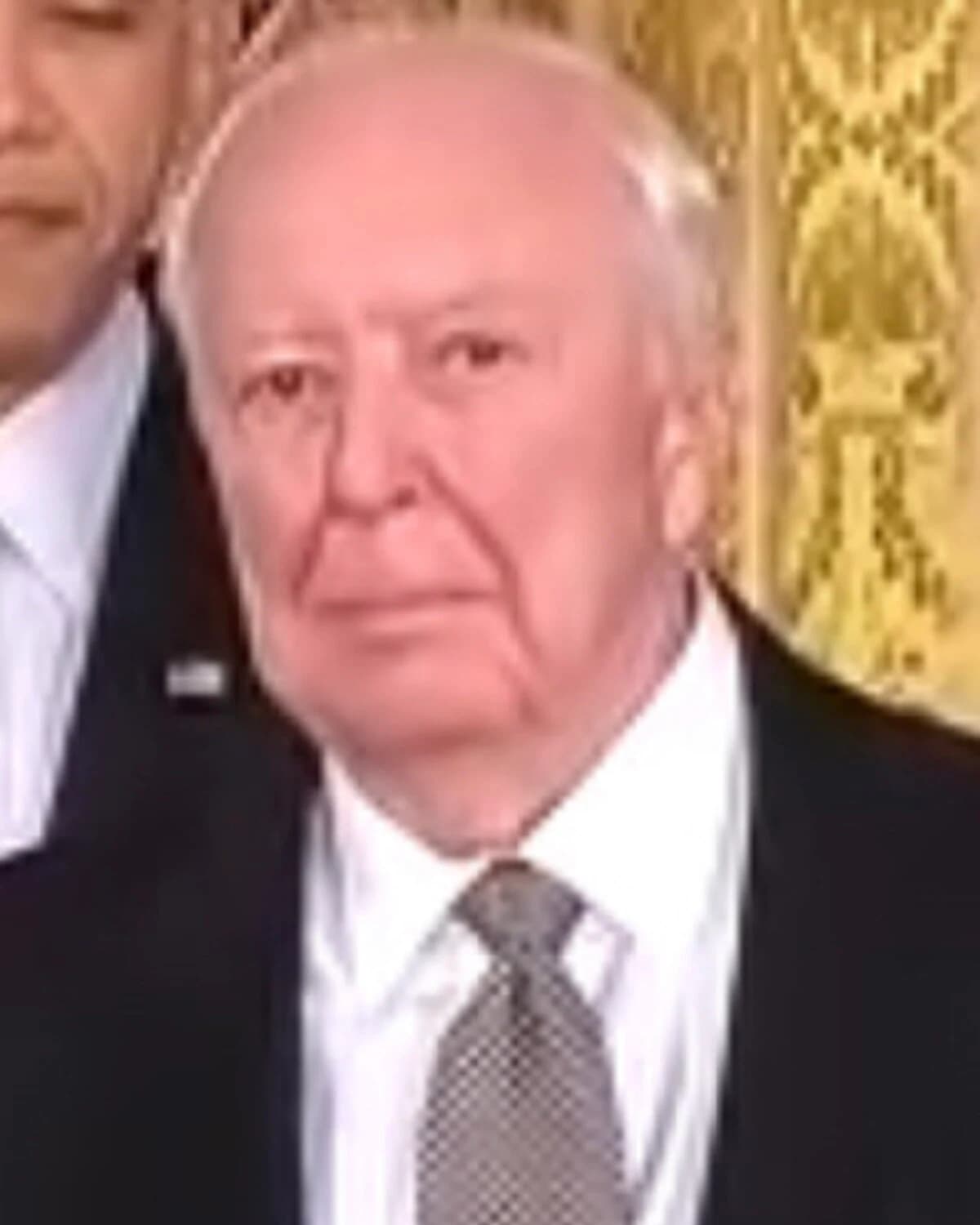
Of honorary degrees he has accepted only one, a Doctor of Humane Letters from the University of South Carolina in 1969. In 1988 he received the Golden Lion at the 43rd Venice Biennale, in 1990 the National Medal of Arts, in 1993 Japan’s Praemium Imperiale for painting, and in 2011 the Presidential Medal of Freedom, the first painter or sculptor to receive it since Alexander Calder in 1977.
In 2026 the Guggenheim Museum Bilbao opened the retrospective “Night Driver”, covering more than seventy years of his work.
Profile notes
Profile and sources
Image
Artist image
White House videographer for The Obama White House; Wikimedia Commons; Public domain.
