
01.08.1830–23.04.1878
Jaroslav Čermák
Jaroslav Čermák was born in Prague, studied in Prague and Antwerp, and from the 1850s lived in Paris. He painted scenes from Czech history, especially the Hussite wars, and later brought back from the Balkans studies and paintings of Montenegro and Herzegovina. In 1862 he himself took part in the fighting of Montenegrins and Herzegovinians against the Turks. His remains were moved to Prague in 1888.
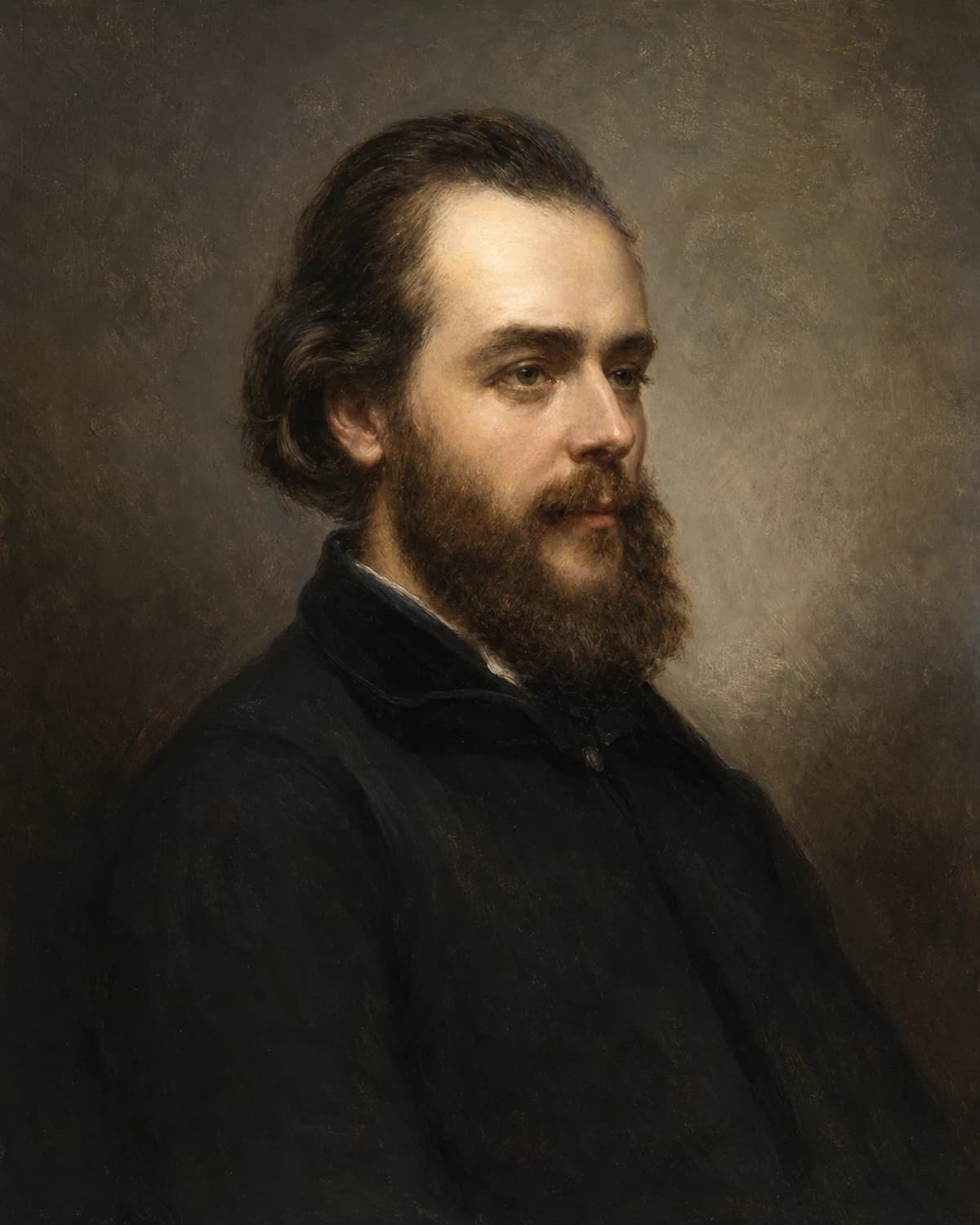
Biography
As a child Jaroslav Čermák suffered a serious injury to the hip and spent several years in bed. According to tradition, he began to draw then, because he could not move.
He was born on 1 August 1830 in Prague, in a house on Betlémské náměstí (Bethlehem Square), where a commemorative sculpture of a girl crowned with laurel now stands. His mother, according to family tradition, anonymously supported the writer Božena Němcová. In 1847–1848 he studied at the Academy of Fine Arts in Prague under Christian Ruben. Teaching in Prague seemed to him insufficient for a future history painter, and he went to Belgium: he studied in Antwerp under Gustave Wappers and, by some accounts also in Brussels under Louis Gallait. Among his early works are named “Marius on the Ruins of Carthage” and “The Murder of Wallenstein’s Companions in Eger”. He is thought to have completed his education around 1850. Soon afterwards the Prague city council awarded him a prize for the painting “Hussite Envoys Led by Prokop at the Council of Basel”.
In 1852, by some accounts, he settled in Paris; by others, he lived there permanently only from 1858. He travelled widely and often returned to his homeland. He took his subjects from Czech history, chiefly the Hussite wars: “Hussites Defending a Mountain Pass” (1857) is in the National Gallery in Prague. He also painted “The Court Poet of Rudolf II, Komnitzky, Begging on a Bridge in Prague” (1854), and portraits, among them one of the physiologist Jan Evangelista Purkyně (1857). Over time his historical subjects took on an increasingly genre-like character.
In 1858 Čermák set out through Moravia and Hungary to Herzegovina, Dalmatia and Montenegro. From there he brought back a great many studies: folk types, costumes and the daily life of the South Slavs. They served for “A Herzegovinian Girl Abducted by Bashi-bazouks” (1867), “The Wounded Montenegrin” (1873, with a later version in the National Gallery in Prague) and “The Return of the Montenegrins to Their Village Devastated by the Turks” (1877). He visited Montenegro often and was a guest of Prince Nicholas of Montenegro, the first of that name. In 1862 he fought on the Montenegrin side alongside Herzegovinian chieftains and their men and is said to have received a medal for bravery from the prince. One of the streets of Podgorica is named after him.
His other subjects were the life of Norman fishermen, landscapes and genre scenes. In manner he is classed with Romanticism, closest to the school of Gallait; he looked closely at Rubens, and in Paris he became acquainted with the work of Eugène Delacroix and Alexandre-Gabriel Decamps. His pictures are seen as an expression of the Czech National Revival and of the aspiration of Europe’s small nations to independence.
In 1874 Čermák built a house in Paris to his own design. Through his sister Marie he was the brother-in-law of Prince Jerzy Konstanty Czartoryski.
He died in Paris on 23 April 1878. In 1888 his remains were taken to Prague and buried at Olšany Cemetery.
Related context
Associations
Works connected through artistic movements, cultural context and period. Priced works available in this market appear first.








Profile notes
Profile and sources
Image
Artist image
На основе открытого изображения: Johann Rottmayer / Friedrich Kriehuber; Wikimedia Commons; Public domain.
