
23.03.1936–16.02.2017
Jannis Kounellis
In 1969 Jannis Kounellis put twelve live horses in the Rome gallery L’Attico, as if they were parked cars. Before that he had painted canvases with numbers and letters, then moved on to coal, burlap, fire and iron. Greek by birth, he lived in Rome from 1956 and became one of the central figures of Arte Povera.
Biography
Twelve horses stood in a former garage on Via Beccaria in Rome, where the L’Attico gallery moved in 1969. Kounellis showed them untitled, as if they were cars. The visitor walked into a hall that smelled of a stable and became part of the scene.
He was born on 23 March 1936 in Piraeus. His childhood fell during the Second World War and the Greek Civil War. In 1956 he moved to Rome and studied at the Academy of Fine Arts.
He began as a painter. In 1958–1960 he made the series “Alphabets”: using stencils, he put letters, numbers, typographic signs and road markings on his canvases, often repeating street signs and advertisements. His first solo exhibition, “L’alfabeto di Kounellis”, took place in 1960 at the La Tartaruga gallery in Rome, while he was still a student. At the opening he sang the numbers and figures painted on the canvases, and the show turned into a performance. In the same year he reportedly put on one of the stencilled paintings like a garment and staged an action in his studio in which he himself becomes part of the painting; I found little to confirm this, so it is hard to check. Around then found objects, such as real street signs, entered his work. From 1961 he painted on newsprint. He regarded painting as tied to a repressive political past and looked for a way out of it.
From 1963 found things, fire, earth and burlap sacks appear in his work. The canvas was replaced by metal bed frames, doorways, windows, and then by the gallery space itself. In 1967 he showed live birds in cages alongside paintings and rose-shaped cloth cut-outs pinned to canvas.
In the same year, 1967, he took part in the group exhibition “Arte Povera – e IM Spazio” at the La Bertesca gallery in Genoa, organised by the critic Germano Celant. Alongside him were Alighiero Boetti, Luciano Fabro, Giulio Paolini, Pino Pascali and Emilio Prini. In 1968 he showed “Untitled”: raw wool, rope and a wooden structure leaning against a wall.
In the 1970s and 1980s his installations came to include the flames of propane torches, soot on walls, smoke, coal, meat, coffee beans, lead, shelving, carts and blocked openings. He also moved beyond galleries into historic, mostly industrial, buildings. In 1975 he began using casts of classical sculpture. In 1974 he took part in the ADA – Aktionen der Avantgarde festival in Berlin with Edward Kienholz, Wolf Vostell and others. His work of the 1980s, using unusual materials, travelled across Europe.
He was shown at the Venice Biennale (from 1972, among other years in 1976, 1980, 1984, 1988, 1993 and 2011) and at Documenta in 1972, 1977 and 1982. Solo exhibitions were held at the Van Abbemuseum in Eindhoven (1981), the Whitechapel Art Gallery in London (1982), the Museo Reina Sofía in Madrid (1996), the Albertina in Vienna (2005), the Neue Nationalgalerie in Berlin (2007) and Tate Modern in London (2009). In 1994 he showed work in Piraeus on a ship moored in the port of his native city, under the title “Ionion”. In the same year he received the Oskar Kokoschka Prize. In the second half of the 1990s Kounellis was a professor at the Düsseldorf Art Academy.
His first solo exhibition in Russia opened in 1991 at the Central House of Artists in Moscow. In 2011, at the Moscow Biennale, he showed “Untitled”: many coats lying on the floor with a pram on rails in the middle. In the same year an exhibition was held at the Chocolate Workshop at the Red October site. In 2013 he was production designer for Dmitry Kurlyandsky’s opera “Nosferatu” at the Perm Opera and Ballet Theatre. In his last years he returned to painting.
Kounellis died in Rome on 16 February 2017, at the Villa Mafalda hospital.
Profile notes
Profile and sources
Image
Artist image
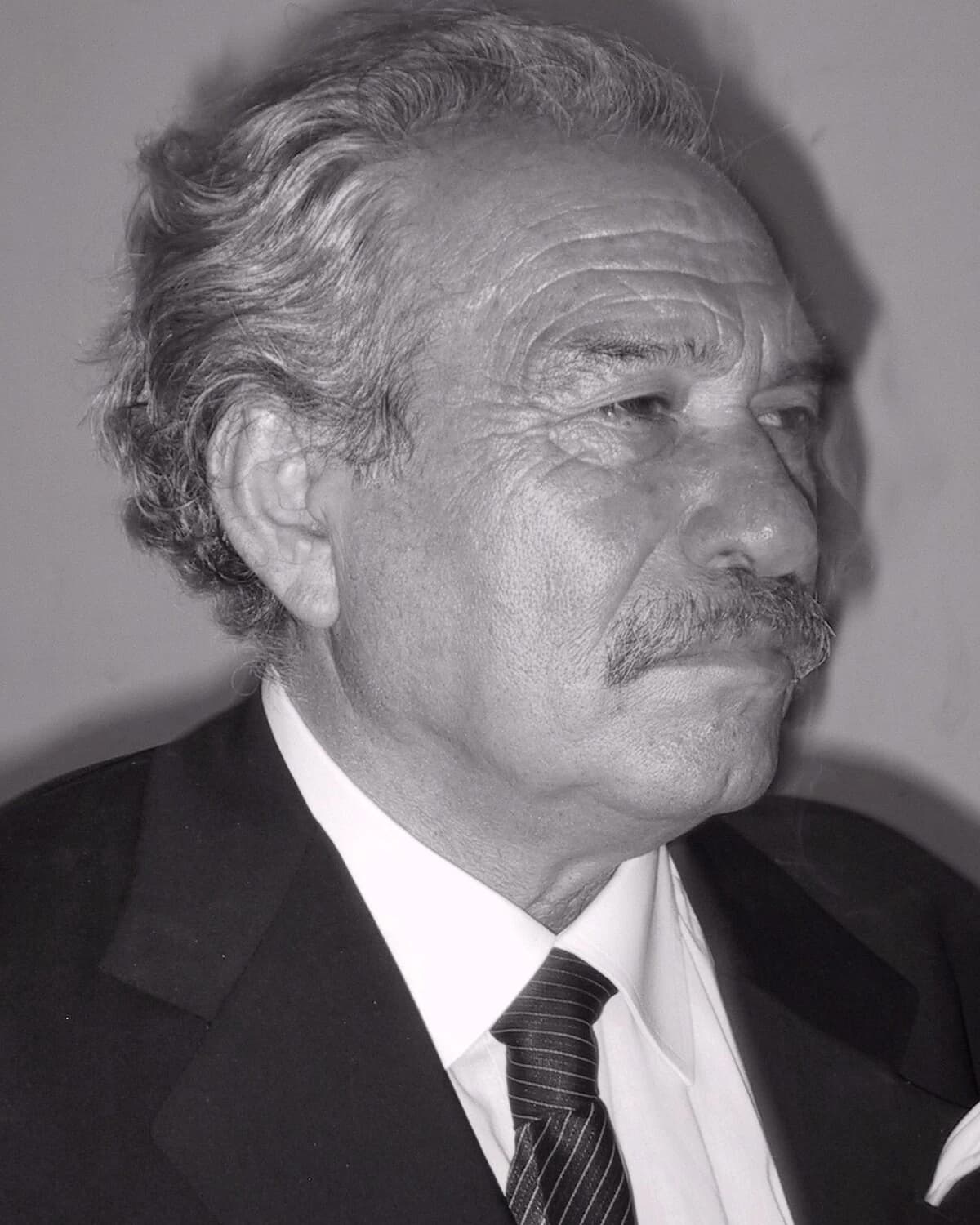
Gabuchan; Wikimedia Commons; CC BY-SA 2.0.
