
1390–09.07.1441
Jan van Eyck
Jan van Eyck (c. 1390–1441) was court painter and trusted envoy to Philip the Good, Duke of Burgundy, and from the late 1420s lived in Bruges. He completed the Ghent Altarpiece, apparently begun by his brother Hubert, and painted the “Arnolfini Portrait” and the “Madonna of Chancellor Rolin”. Some twenty surviving paintings are confidently attributed to him; ten are signed and dated, with the motto “As I can”.
Biography
On the frame of the portrait of the painter’s wife, in Greek letters, are the words: “My husband Johannes completed me in the year 1439 on 17 June, at the age of 33. As I can.” It is Margaret herself speaking, as if from the panel. Jan van Eyck slightly altered the angle of her nose in the portrait and flattered her with a fashionably high forehead. Almost nothing is known about her, not even her maiden name; in the records she is mostly “Damoiselle Marguerite”. They married around 1432, and she was fifteen years younger than her husband.
No Netherlandish painter of the fifteenth century apart from Van Eyck signed his pictures.
Neither the year nor the place of his birth is documented. Around 1390 is the usual date, though some scholars push it closer to 1380. In the late sixteenth century his birthplace was given as Maaseik, in the lands of the prince-bishopric of Liège (now Belgium), and two details agree with this: after her father’s death his daughter Lievine lived in a convent in Maaseik, and the notes on his preparatory drawing for the portrait of Cardinal Albergati are written in the Maasland dialect. He had two brothers, both painters: Hubert, who died in 1426 and with whom Jan probably trained, and Lambert. Where Jan himself was educated is not known, but he knew Latin and used the Greek and Hebrew alphabets in his inscriptions. Learning of this kind was rare in a painter of the time.
The first records of him date from 1422–1424: at the court of John of Bavaria in The Hague, payments are made to “Master Jan the painter”, with the rank of valet de chambre and at first one, then two assistants. He took part in redecorating the Binnenhof palace. After John’s death in 1425 Van Eyck entered the service of Philip the Good. His salary freed him from chasing commissions: the duke wanted the painter to paint whenever he pleased, and in 1435 he ordered the salary to be raised. Van Eyck worked in Lille, moved to Bruges around 1429 and bought a house there around 1432.
His service went beyond painting. In 1426–1429 Van Eyck travelled on “secret” errands for the duke, for which he was paid several times his annual salary; in 1426, for instance, he set off for “certain distant lands”, possibly the Holy Land. The best known journey is that of 1428 to Portugal, with the embassy preparing the marriage of Philip and the Infanta Isabella. Because of the plague the court was on the move, and the embassy met it at the remote castle of Avis. Van Eyck painted the bride’s portrait so that the duke could see her; according to one account there were two portraits, sent by different routes, by land and by sea. Only copies survive. The embassy spent nine months in Portugal, and the wedding took place on Christmas Day 1429. Earlier still, on 18 October 1427, the feast of Saint Luke, the painters’ guild of Tournai gave a banquet in his honour, attended by Robert Campin and Rogier van der Weyden.
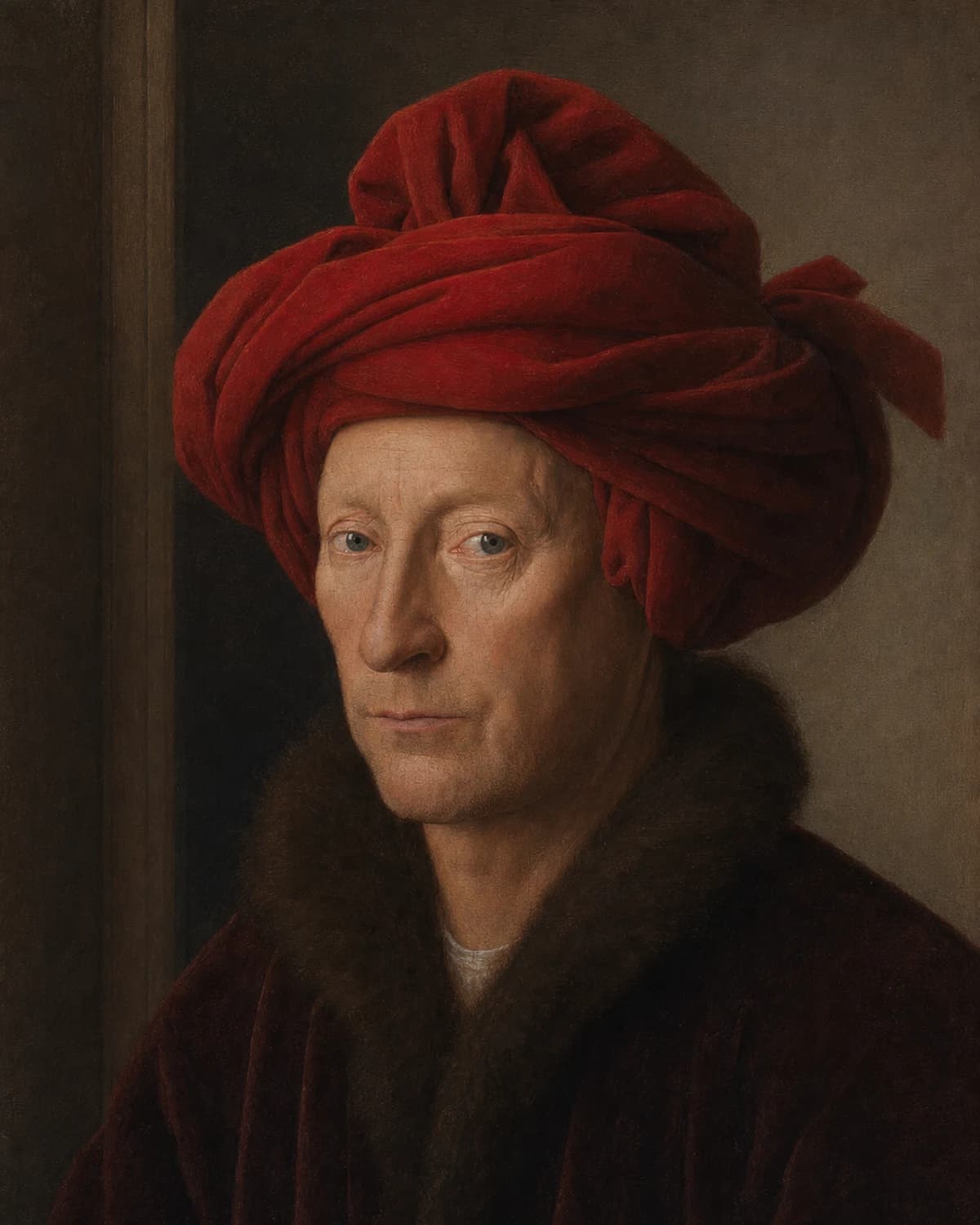
After Portugal his main task was the Ghent Altarpiece, commissioned by the Ghent burgher Joos Vijd and his wife Elisabeth Borluut. It was apparently begun by Hubert and finished by Jan; on 6 May 1432 the altarpiece was consecrated in Saint Bavo’s Cathedral. The years that followed produced almost all his known paintings. The motto “As I can” (ALS ICH KAN), a pun on his name, first appeared in 1433 on the “Portrait of a Man in a Turban”; the “Arnolfini Portrait” carries a different signature: “Jan van Eyck was here. 1434”. To 1434–1436 belong the “Madonna of Chancellor Rolin”, the “Lucca Madonna” and the “Virgin and Child with Canon van der Paele”, and to 1437 the small Dresden Triptych, the only one of his triptychs to survive. Since 1901 he has also often been credited with several miniatures of the Turin-Milan Hours, which burned almost entirely in 1904.
In his early male portraits there is a detail that is hard to miss: the sitters are badly shaved. The “Man in a Blue Chaperon” (c. 1430) has a day or two of stubble, and Cardinal Albergati, Joos Vijd, Canon van der Paele and Chancellor Rolin are all painted unshaven. I think this stubble says more about his way of looking than Vasari’s story that Van Eyck invented oil painting. Oil had been used before him; what he did was take thin, translucent glazes to a new level.
Van Eyck died in Bruges in the summer of 1441 and was buried in the graveyard of the church of Saint Donatian. Philip the Good paid his widow a one-off sum equal to the painter’s annual salary. Unfinished works were completed by the workshop, which was apparently run by Lambert or Margaret. Early in 1442 Lambert had the body moved inside the cathedral; the cathedral itself was demolished in 1799.
Artist works
Works by the artist
Works by Jan van Eyck available in this edition of NEOARCA.
Related context
Associations
Works connected through artistic movements, cultural context and period. Priced works available in this market appear first.
Profile notes
Profile and sources
Image
Artist image
На основе открытого изображения: Jan van Eyck; Wikimedia Commons; Public domain.
