
1780–18.08.1840
Jan Krzysztof Damel
Jan Damel studied in Vilnius, where he took a master’s degree, was convicted in 1820 in a case of forged banknotes and spent two years in exile in Tobolsk. He painted historical scenes, portraits of the gentry and altarpieces. He died in Minsk; over his grave in the church a painting, “The Agony in the Garden”, was hung, which was considered his best work.
Biography
When the painter was buried in 1840 in the crypt of the Calvary Church in Minsk, no monument was put up over the grave. Instead, a painting, “The Agony in the Garden”, was hung above it, and Damel himself thought it the best thing he had done. It is now in the National Art Museum of Belarus; it was restored in 2017, and beneath the later layers three apostles appeared, visible only in the right light.
He was born in Mitau (now Jelgava) in the Duchy of Courland around 1780. There is no exact date: no baptismal record survives, and various sources give 1777, 1778, 1779, 1781 and even 1790. Of his family even less is known. The artist himself called his father a merchant; his friend and first biographer Adam Szemesz wrote of noble descent; and the claim that his grandfather or father was a colonel in the Saxon army comes only from a later dictionary and is hard to verify. Szemesz himself remarked that the circumstances of Damel’s birth and youth were known to no one.
In 1797 he moved to Samogitia and settled in Žagarė, where for a year he worked as a private tutor to the town clerk Burniewicz. From 1799 he studied painting at Vilnius University under Franciszek Smuglewicz and Jan Rustem. In 1809 he received a master’s degree in the liberal arts and began teaching drawing at the Vilnius gymnasium. Szemesz also credited him with the post of adjunct in the university’s chair of painting, but the lists of officials of the university and its schools show no such position.
At the university Damel became close to Ignacy Cejzyk, who later farmed an estate near Slutsk. They corresponded, and it is the letters of 1811–1814 that make this the best-documented period of the painter’s life. Later, in 1815–1820, the same letters became evidence against him. Cejzyk and his brother Feliks were accused of forging banknotes; Damel was suspected of sending them paper and of handing over his passport for a journey abroad. His complicity was never proved, he did not confess, and Cejzyk did not incriminate him. From February 1815 Damel was under investigation and held in custody in Minsk until at least June 1816. His position was made worse by the persecution at the university of professors who had sided with Napoleon in 1812. Damel too had linked his hopes for Lithuanian independence to Napoleon, and he had gladly helped to decorate the celebration in his honour held in Vilnius on 15 August 1812. He belonged to two Masonic lodges, in Vilnius and in Minsk, held no office in them, was listed as a student or honorary member, and painted canvases for them. The brethren wrote to a lodge in St Petersburg, asked for his release on bail, and after the sentence collected money for him. The Senate nevertheless sent him to settle in Siberia.
He left Minsk on 13 July 1820 and returned on 5 October 1822; the dates are known from a description of the diary he kept for his friends. The diary is lost, though some of the drawings survive in museums in Poland and Lithuania.
Damel spent the time until 1822 in Tobolsk and visited Irkutsk, Tomsk and Yeniseysk. He painted formal and family portraits, among them of military and civil governors, and altarpieces: the Virgin with the Child for the church in Tomsk, Christ with the cross for the Lutheran church in Tobolsk. Some of the church commissions he carried out free of charge. Count Mikhail Speransky, governor-general of Siberia, took notice of his work and cheerful temper and helped him to return. From these years comes the landscape “Sunset over Tobolsk”.
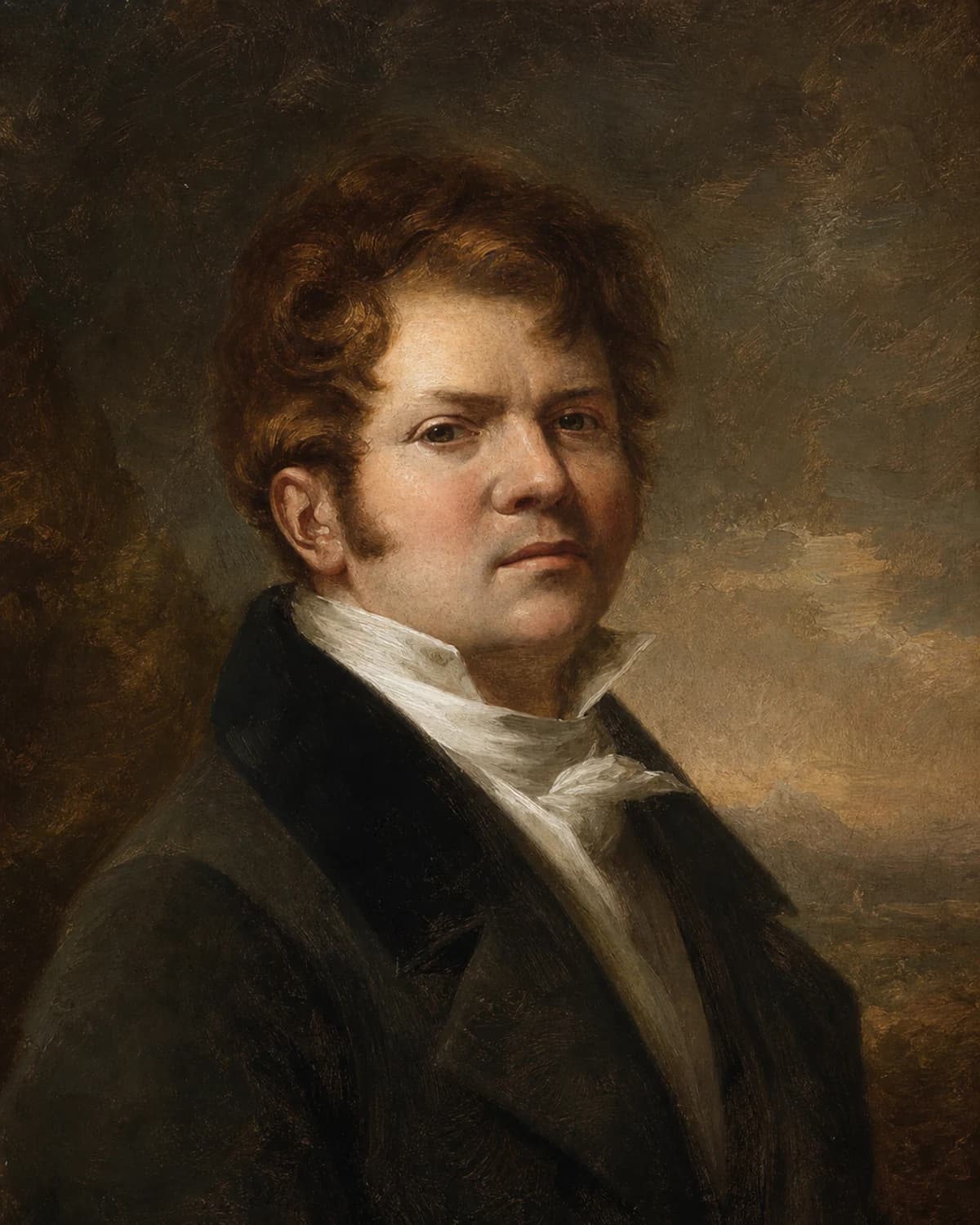
After his exile Damel settled in Minsk, in the centre of the city, on the High Market. There he painted portraits of the local gentry, among them the Horvats and the Kobylinskis, historical scenes (the retreat of the French through Vilnius in 1812, “Paul I Freeing Kościuszko from Prison”, “The Death of Prince Poniatowski”, the meeting of John III Sobieski with Emperor Leopold) and altar paintings for churches. According to recollections, he used the cellar of the Church of the Virgin Mary as a studio: in complete darkness he arranged the light he needed and so achieved the right chiaroscuro. His portraits have a delicate psychological sense; classicism in them sits beside a romantic streak, and in his self-portraits, especially the one in Warsaw, he looks hard and searching.
In 1831–1835 Damel travelled in Siberia again, from Irkutsk to Kyakhta, probably together with Józef Kobylecki. From the journey he brought back an album of drawings and watercolours with a map of the route and his own notes: views of Tobolsk, Omsk, Tomsk, Irkutsk and Yeniseysk, and types of Bukharan Tatars, Kyrgyz, Mongols, Chinese and Samoyeds. He drew the poor without embellishment and recorded costume, crafts and buildings in detail. Seven sheets were issued as lithographs. Among his pupils is named Michał Kulesza.
Damel died in Minsk in August 1840.
Related context
Associations
Works connected through artistic movements, cultural context and period. Priced works available in this market appear first.








Profile notes
Profile and sources
Image
Artist image
На основе открытого изображения: Jan Damel; Wikimedia Commons; Public domain.
