
20.08.1853–22.01.1936
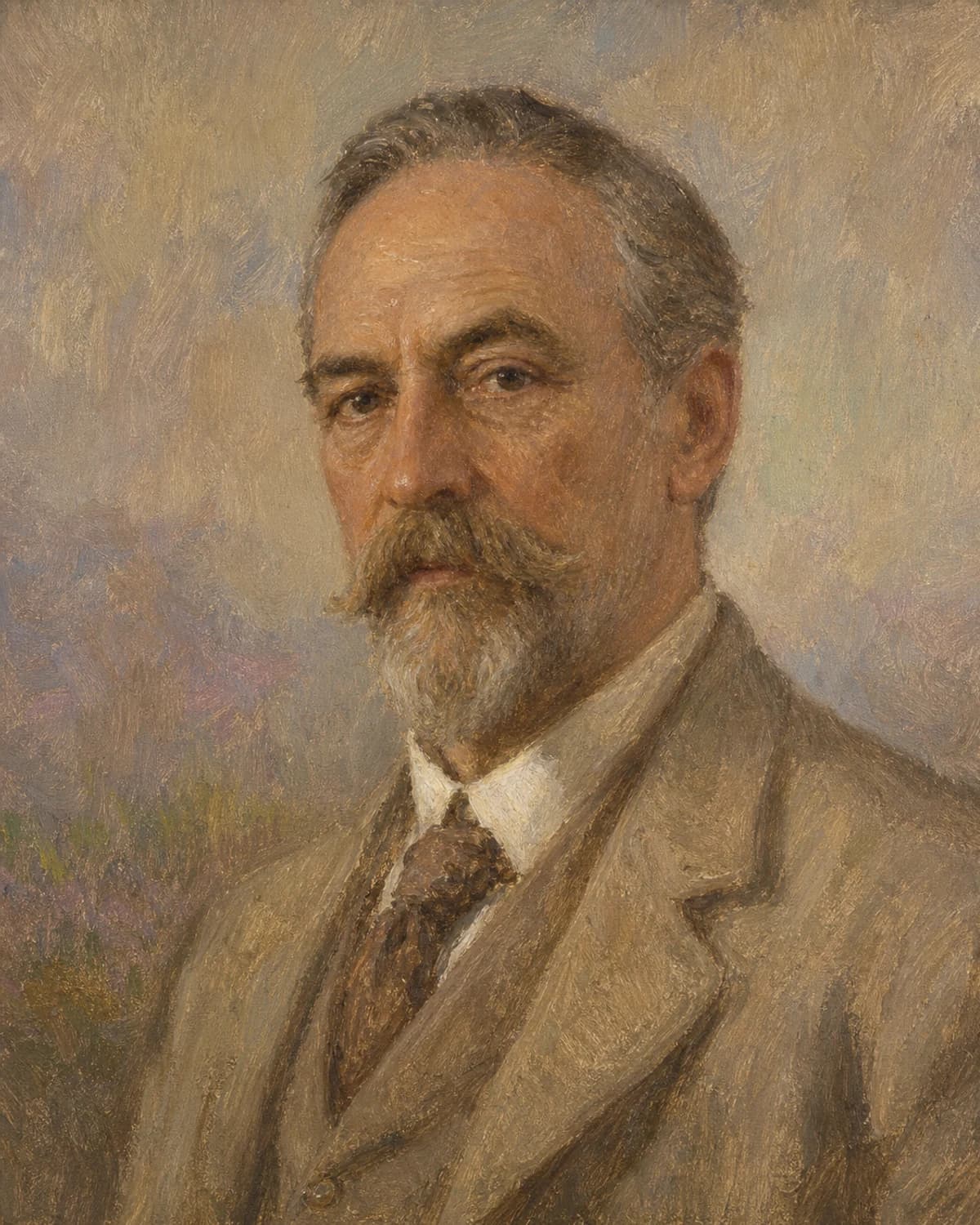
Jan Ernst Abraham Volschenk
Jan Volschenk (1853–1936) worked as a bookkeeper in a law firm in Riversdale until the age of fifty-one and painted in oils in his spare time. In 1904 he left the office for painting. His main subject was the Langeberg mountains and the Karoo, the semi-desert of the Western Cape; his work is held in the leading museums of South Africa.
Biography
In 1904 Volschenk, who was in his fifty-second year, left the office where he kept the books and sat down to paint from morning till night. For South African painting of the time this was an unusual step: by some accounts, he became the first professional artist in the country.
He was born on 20 August 1853 in Riversdale, on the farm Melkhoutskraal, to a family of Dutch descent. He began drawing as a child, reportedly out in the pasture. He had no teachers and remained self-taught. His drawings were noticed by the Government Land Surveyor, James Reitz. He suggested to his brother Gysbert, a Riversdale lawyer, that he take an interest in the young man. In time Volschenk joined the firm of Reitz & Versfeld as a bookkeeper and worked there for decades. Painting went on alongside the job: in 1879 he showed four works at an exhibition in Cape Town. In 1893 he travelled to Europe with the Reitz family and saw large art collections for the first time. By some accounts, Impressionism made an especially strong impression on him. The following year he joined the South African Drawing Club and began to exhibit with it.
In 1899, at the age of forty-five, he married Helen Smalberger, also a resident of Riversdale. They had nine daughters. The eldest, Vera, became a painter and worked in the same genre; a granddaughter, Helene Volschenk Hayward, also painted.
The material for his pictures lay close to home. He painted the countryside around Riversdale, the Langeberg range and the Karoo mountains, aiming for muted, finely graded tones. His oils have been called “romantic naturalism”; I would add that they have hardly any effects, but a long study of the light on the slopes. His powers of observation reached beyond the canvas: he assembled a collection of more than four thousand beetles, was keen on heraldry and carved wood.
His works are held at the South African National Gallery in Cape Town, the Johannesburg Art Gallery, the Pretoria Art Museum, the Durban Art Gallery, the William Humphreys Gallery in Kimberley, the AC White Gallery in Bloemfontein and the Albany Museum in Grahamstown. In 1931 Volschenk was elected an honorary member of the South African Academy for Science and Arts.
He died in Riversdale on 22 January 1936. In 1978 the South African Post Office issued a series of stamps with reproductions of his paintings.
Related context
Associations
Works connected through artistic movements, cultural context and period. Priced works available in this market appear first.








Profile notes
Profile and sources
Image
Artist image
На основе открытого изображения: Jan Ernst Abraham Volschenk; Wikimedia Commons; Public domain.
