
18.11.1859–02.02.1904
James Nairn
Scottish by birth, James Nairn emigrated to New Zealand in 1890 and brought with him the Impressionist methods he had learned in Glasgow and Paris. He painted Wellington harbour and the Hutt Valley outdoors, taught at the Wellington School of Design and founded the Wellington Art Club, which many local artists attended.
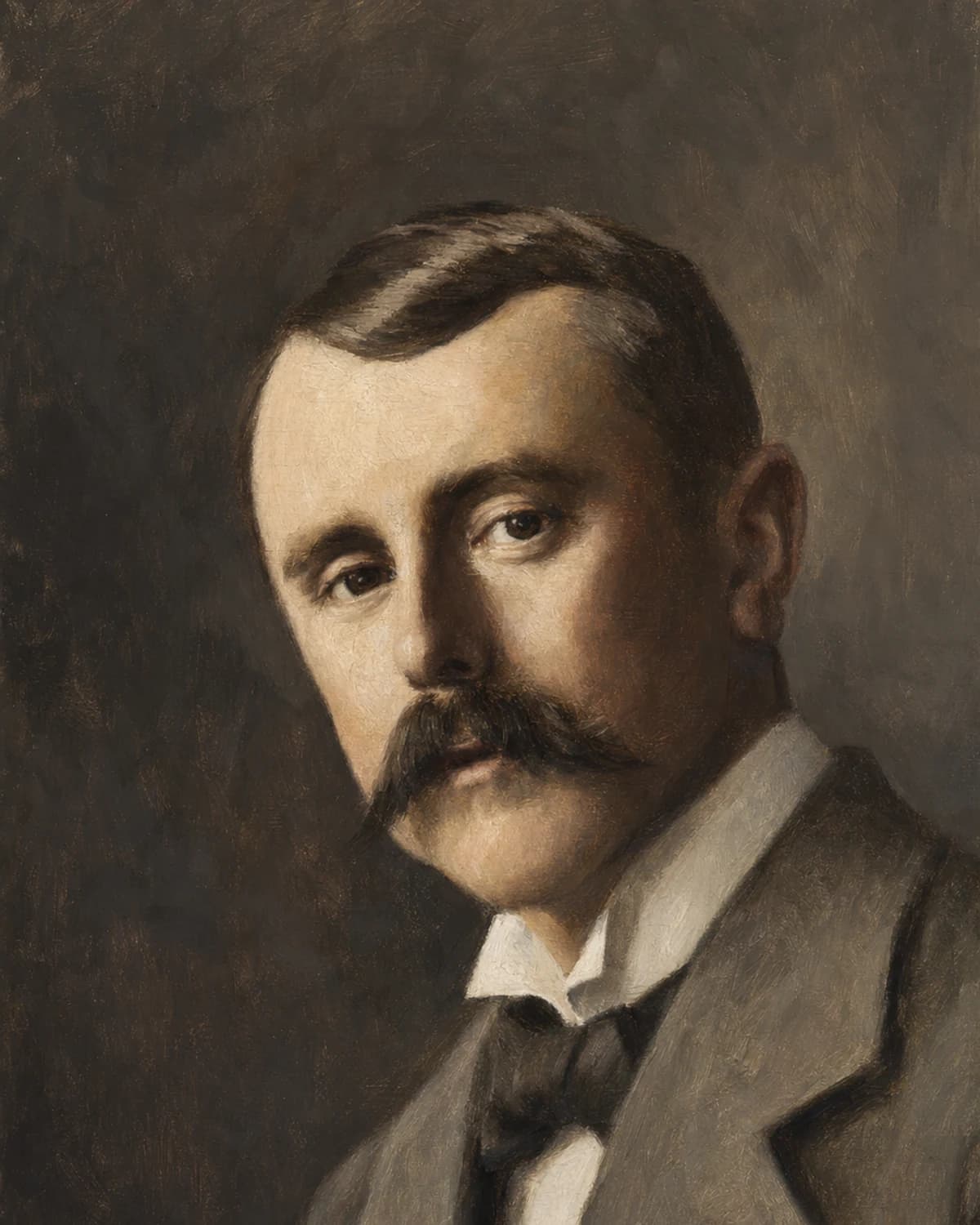
Biography
In the summer of 1894 Nairn painted “Wellington Harbour” with the brushstrokes left visible: he caught the afternoon sun on the water on the spot, not from memory in the studio. He worked this way later too, and it was views of this kind that made him known in New Zealand.
He was born on 18 November 1859. Sources give the place of birth differently: by some accounts it was Glasgow, by others the village of Aberfoyle in Perthshire.
From 1879 to 1883 Nairn studied at the Glasgow School of Art, then at the Académie Julian in Paris. In the 1880s he exhibited at the Glasgow Institute of the Fine Arts (he was a member from 1883) and at the Royal Scottish Academy, and belonged to the circle of the Glasgow Boys, Scottish artists interested in Impressionism. For the Glasgow International Exhibition of 1888 he took part in decorative paintings on the gable walls of art galleries, and he published sketches made at the exhibition itself in the magazine Quiz under the pseudonym Kopeeks. In 1889 he painted murals commissioned by the Kyrle Charitable Society. Historians suggest that his early manner was shaped by Scottish realism and that in France he was captivated by Impressionism; his pictures show a familiarity with Millet, Courbet and Bastien-Lepage.
Because of his health he decided to emigrate, and on 2 January 1890 he arrived in Dunedin; in August of that year he moved to Wellington. His drawings in the book “Strike Notes” (Wellington, 1890) remain an important record of the strike of that time. From 1891 until the end of his life he taught at the Wellington School of Design, later the Wellington Technical College: still life, drawing from nature and life drawing. He lectured on art, and among his pupils and followers are named Dorothy Kate Richmond, Maud Winifred Sherwood, Mabel Hill, Maude Burge and Mollie Tripe.
Nairn joined the New Zealand Academy of Fine Arts and from 1890 to 1903 sat on its council, from 1898 to 1900 as vice-president. He exhibited there every year and regularly sent works to other towns and cities, so his influence was felt far beyond the capital. In 1892 he was one of the founders of the Wellington Art Club, conceived as a counterweight to the conservative Academy, and until 1896 he was its chairman. From 1894 he rented a house at Silverstream near Wellington, nicknamed “Pumpkin Cottage”; the club met there, and the house became a gathering place for Wellington artists.
He painted mainly landscapes, in New Zealand largely outdoors, most often in the Hutt Valley around the cottage. There are also portraits, for example “Ma Belle – Portrait of Mabel Hill”, and scenes such as “Mending the Net”, both from about 1899; a series with farm workers became popular, among them “Tess” (1893). Among his best works are counted the watercolour “Winter Morning, Wellington Harbour” (about 1900) and “A Summer Idyll” (oil, 1903). He worked in oil and watercolour and left pastels and charcoal drawings. To my mind, his chief merit is that he chose unspectacular subjects and did not hide the brushstroke, which was unusual for New Zealand painting at the time.
On 17 March 1898 he married Ellen Smith; they had two daughters.
Nairn died in Wellington in 1904, at the age of forty-four. The largest number of his works is held by the Museum of New Zealand Te Papa Tongarewa in Wellington; there are others in Auckland, Christchurch, Lower Hutt, Nelson, Palmerston North and Whanganui.
Related context
Associations
Works connected through artistic movements, cultural context and period. Priced works available in this market appear first.








Profile notes
Profile and sources
Image
Artist image
На основе открытого изображения: Unknown author Unknown author; Wikimedia Commons; Public domain.
