
30.08.1748–29.12.1825
Jacques-Louis David
Jacques-Louis David (1748–1825) painted “The Oath of the Horatii” and “The Death of Marat”, sat as a deputy in the Convention and voted for the execution of Louis XVI, and under Napoleon became the Emperor’s First Painter and the author of “The Coronation”. He spent his last ten years in Brussels. His pupils included Gros, Ingres and many others, and in the early nineteenth century no one had a stronger influence on French painting.
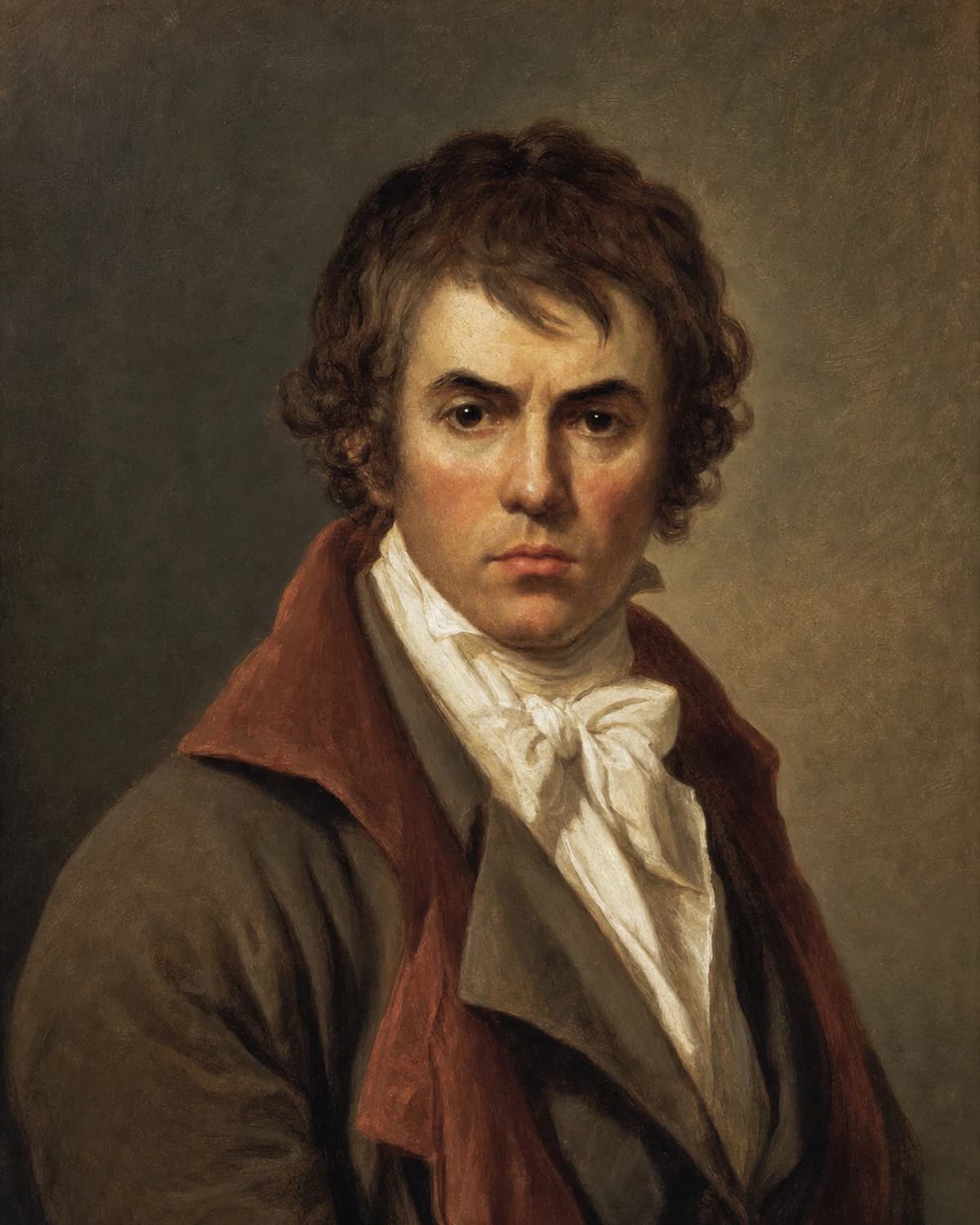
Biography
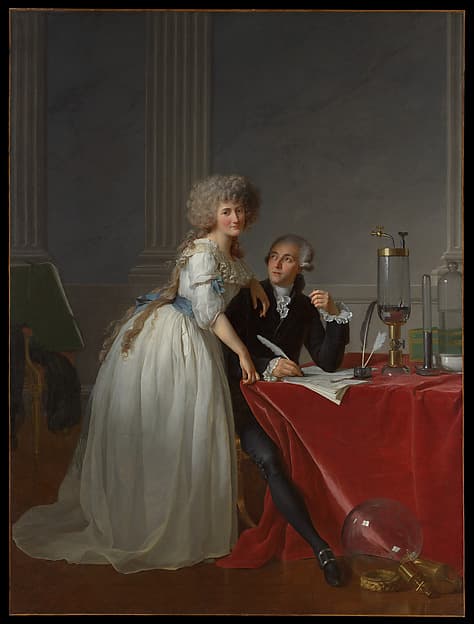
In the summer of 1789, when the Bastille had already fallen, the Royal Buildings administration tried to keep David’s “The Lictors Bring to Brutus the Bodies of His Sons” out of the Salon. The consul Brutus has himself sentenced his sons to death for plotting to restore the monarchy, and now he sits alone, as if not noticing their bodies being carried in; only the tensed toes give him away. When the newspapers reported the ban, the public was outraged, the court had to give way, and at the exhibition the canvas was guarded by students. The portrait of Lavoisier and his wife, finished the year before, never made it into that Salon.
David was forty-one. Six months later he would join the Jacobin Club.
He was born on 30 August 1748 in Paris, into the family of the merchant Maurice-Louis David, and was baptised the same day in the church of Saint-Germain-l’Auxerrois. In 1757 his father was killed in a duel, his mother left for Évreux, and the boy was left in the care of her brother, François Buron. Both his uncles, Buron and Jacques-François Desmaisons, were architects and intended him for the same profession. He did badly at the Collège des Quatre-Nations: he was hampered by a growth on his face left by a fencing wound, which made it hard for him to speak, and all his exercise books were covered in drawings. In 1764 he got his way and went to François Boucher, an old acquaintance of the family. Boucher was a master of the Rococo, but tastes were already changing, and he sent the young man to Joseph-Marie Vien, one of the first Neoclassicists. From 1767 David studied at the Royal Academy of Painting and Sculpture.
He won the Prix de Rome at the fourth attempt. After his failure in 1772 he refused food for two and a half days, until his teachers persuaded him to go back to work, and only in 1774 did he win, with “Erasistratus Discovering the Cause of Antiochus’ Disease”. In October 1775 he left for Rome together with Vien, who had been appointed director of the French Academy there. In Rome he looked more at Poussin, Caravaggio and the Carracci than at the antique, and said that the antique would not seduce him, because it had no movement. All the same, he filled twelve sketchbooks with drawings that his studio went on using for the rest of his life.
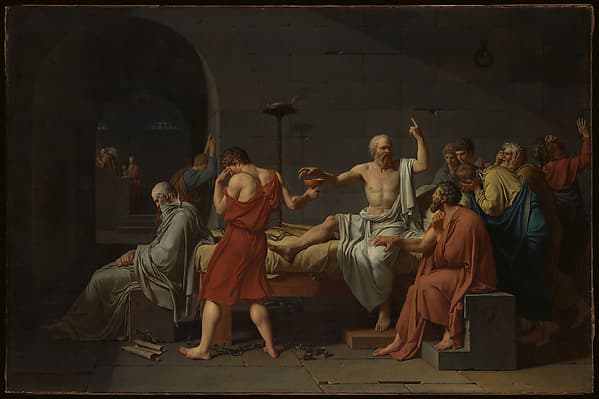
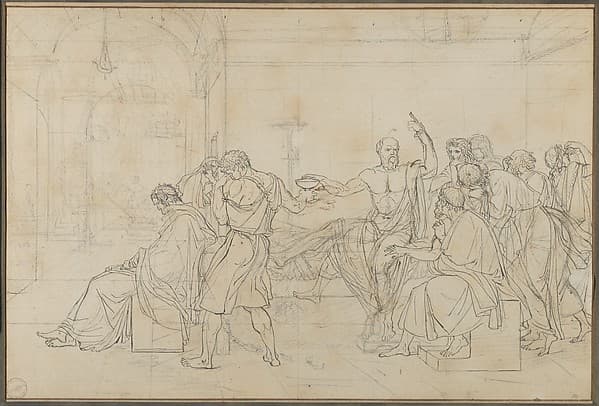
In 1780 he returned to Paris; for “Belisarius Begging for Alms” he was admitted to the Academy as an associate on 24 August 1781, and after the Salon the King granted him lodgings in the Louvre. In May 1782 he married Charlotte Pécoul, the daughter of a contractor to the Royal Buildings, and in 1783 he became a full academician. Given a government commission for a Roman subject, he declared that Romans could only be painted in Rome, and in 1784 he went there with his wife and three pupils, on money from his father-in-law. There, in place of the commissioned subject, came “The Oath of the Horatii”: three brothers stretch out their arms towards the swords their father holds, while the women to one side droop with grief. The picture was shown first in Rome, then in Paris. In 1787 “The Death of Socrates” was exhibited at the Salon.
The Revolution drew him in completely. For the Society of the Friends of the Constitution he began “The Tennis Court Oath”, with hundreds of figures, but showed only a large pen drawing at the Salon of 1791: many of the deputies who were to appear on the canvas were soon arrested or executed, and the painting was never finished. On 17 September 1792 David was elected to the National Convention, where he sat with the Montagnards. In January 1793 he voted for the execution of the King, and his wife, a royalist, divorced him. He organised revolutionary festivals, worked on the future Museum of Arts, and painted the fallen “martyrs of the Revolution”, Lepeletier, Marat and the young Bara; from November 1793 to February 1795 these canvases hung in the Convention’s assembly hall. From September 1793 he was a member of the Committee of General Security and signed arrest warrants, and from 5 to 21 January 1794 he presided over the Convention. During the Terror some of his former patrons were executed too, among them Lavoisier.
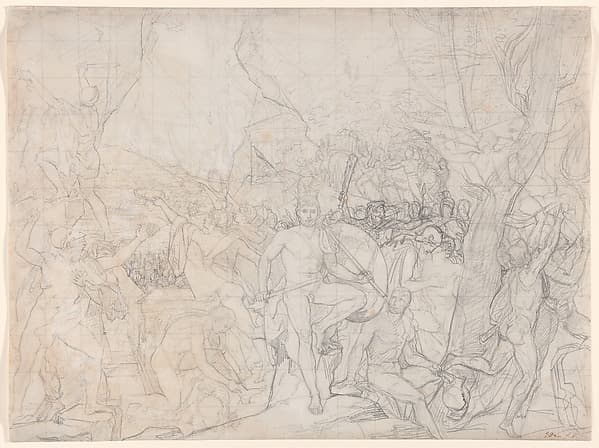
After the coup of 9 Thermidor David was arrested. In letters from prison he wrote that he had thought a righteous heart would be enough for a legislator, but he had lacked understanding. Charlotte Pécoul, learning of his arrest, came back to him, and in 1796 they married again. He was released under the amnesty of 26 October 1795 and largely withdrew from politics. In prison he conceived “The Sabine Women”: women throwing themselves between the Romans and the Sabines in the midst of battle. For this picture he devised a “pure Greek style”, and he showed it with a large mirror so that viewers could see themselves in it. I think it is his most personal canvas.
He first saw Napoleon in 1797 and was taken with him at once, but the future emperor sat for him only once, that same year. For “Napoleon Crossing the Alps”, Bonaparte, who had crossed the Alps on a mule, demanded to be shown calm on a fiery horse. From 1804 David was First Painter to the Emperor. For “The Coronation” (1805–1807) the participants in the ceremony posed for him one by one, Pope Pius VII came in person, and Napoleon, after standing in front of the canvas for an hour, said: “David, I salute you.” In 1815, during the Hundred Days, he received the commander’s cross of the Legion of Honour.
After the Bourbons returned, exile awaited the regicide: in 1816 he settled in Brussels and lived there to the end. There he taught local artists, among them François-Joseph Navez. In December 1823 he wrote of “Mars Being Disarmed by Venus and the Three Graces” that it was the last picture he wanted to paint and that in it he wanted to surpass himself; the painting was shown in Brussels and Paris, and more than ten thousand people came to see it. In June 1825 he started a new version of “The Anger of Achilles” and lived to finish it.
David died in Brussels on 29 December 1825. His body was not allowed back into France; he was buried in Brussels and moved in 1882 to the cemetery at Evere, while his heart, so tradition has it, lies in Paris, in the Père Lachaise cemetery.
Artist works
Works by the artist
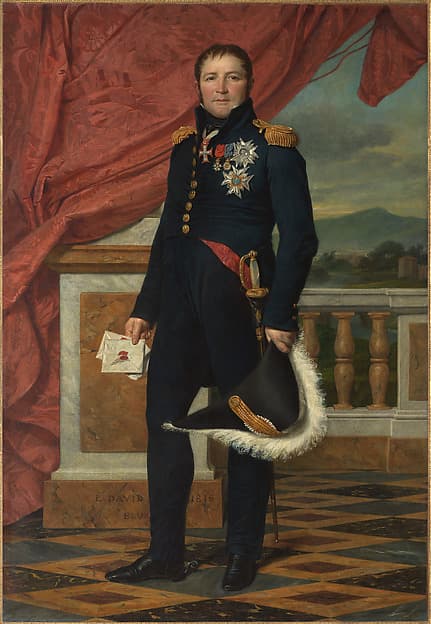
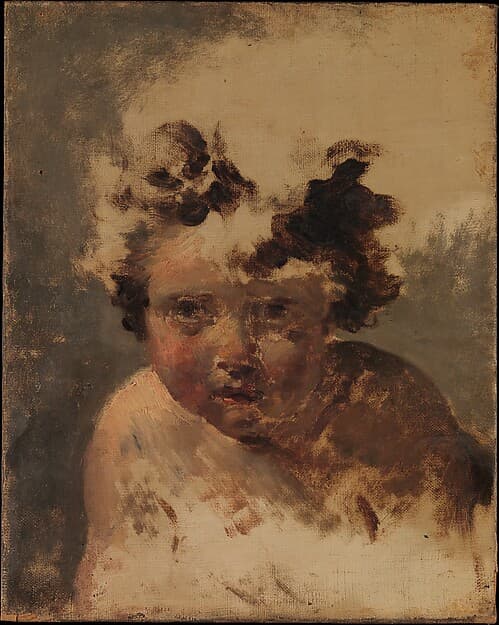
Works by Jacques-Louis David available in this edition of NEOARCA.
Related context
Associations
Works connected through artistic movements, cultural context and period. Priced works available in this market appear first.








Profile notes
Profile and sources
Image
Artist image
На основе открытого изображения: Jacques-Louis David; Wikimedia Commons; Public domain.
