
27.01.1915–08.11.1985
Jacques Hnizdovsky
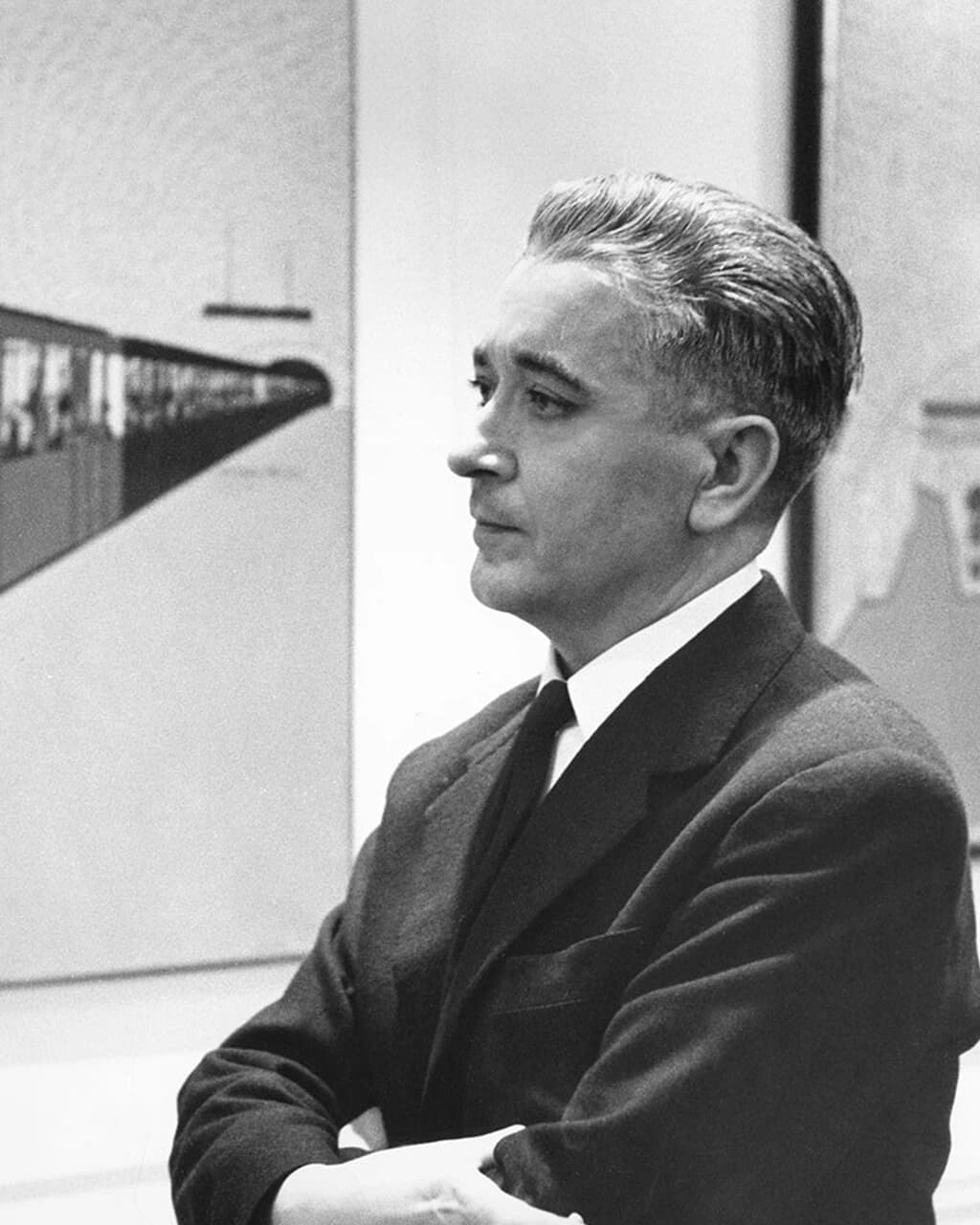
Jacques Hnizdovsky (1915–1985), the son of a deacon from a Galician village, emigrated to the United States after years in a displaced persons camp near Munich and became known for woodcuts of plants and animals. His models were the residents of New York’s botanical gardens and the Bronx Zoo; his best-known print is “The Sheep”. Since 2005 his ashes have lain in the Lychakiv Cemetery in Lviv.
Biography
In 1934, at a court hearing in Lviv, a young student on trial drew everyone in the courtroom in his notebook. When the notebook was shown to the court, the charges were dropped. Accounts of the details differ: by one version the arrest came in spring 1934, by another in September 1933, when eight grammar-school pupils were tried and Hnizdovsky claimed to have found the leaflets by chance. Both agree on one thing: his drawings saved him.
He was born on 27 January 1915 in the Galician village of Pylypche, then part of Austria-Hungary, into a family of old gentry bearing the Korab coat of arms. His father, Yakiv, was a deacon of a Greek Catholic parish. Hnizdovsky was the youngest of the children and the only one in the family who managed to get out to the West. He attended the grammar school in Chortkiv and then studied in Lviv. There he joined the youth wing of the Association of Independent Ukrainian Artists, and the caricaturist Edward Kozak brought him in to illustrate the newspaper “Novyi Chas” (“New Time”) and the magazine “Komar” (“Mosquito”). Metropolitan Andrey Sheptytsky, the head of the Ukrainian Greek Catholic Church, noticed his work and awarded him a scholarship to study at the Academy of Fine Arts in Warsaw, which Hnizdovsky entered in 1938.
The war interrupted his studies: in 1939 he moved to Zagreb and continued at the academy there. It was in Zagreb that he took up woodcut. His first prints of 1944 were figure studies, modelled on Albrecht Dürer, and he taught himself to print from the blocks. The same year he made “The Bush”, a tangle of leafless branches filling the whole sheet; to my mind this print already contains everything he would go on to do.
In 1944 he left Zagreb and lived until 1949 in a displaced persons camp near Munich. He managed only two woodcuts there, but he worked as managing art editor of the monthly “Arka” (“Arch”), illustrated the periodical “Hran” (“Facet”), and drew posters, textbooks, advertisements and bookplates.
In 1949 Hnizdovsky moved to the United States and settled in Saint Paul, Minnesota, where he found a job as a designer at the advertising firm Brown and Bigelow. In 1950, at a graphic art exhibition at the Minneapolis Institute of Art, “The Bush” won second prize, and a few weeks later a second award came for the painting “Eggs” at the Minnesota state trade and industry exhibition. After that he decided to live by art alone and moved to New York, to the Bronx, not far from the Botanical Garden and the zoo. He had no money for models, and plants and animals took their place. He became a familiar figure in the city’s botanical gardens, and at the Bronx Zoo, as he wrote, he found models willing to pose “for peanuts”. A favourite was the orangutan Andy; when Andy died, the zoo immediately bought the print showing him. A sheep from the same zoo posed for “The Sheep”, Hnizdovsky’s best-known work, which was used on the poster for his London exhibition at the Lumley Cazalet Gallery. He cut mostly on cherry, pear, beech or apple wood and printed the impressions himself on Japanese washi paper. What began as a forced substitute became his main subject.
His first solo exhibition in the United States took place in 1954. The gallery of Associated American Artists in New York bought 220 impressions of his series of woodcuts “Pines”. In 1954 and 1961 he designed postage stamps for the postal service of Plast, the Ukrainian scouting organisation: a set of four stamps for the Spring Festival and a souvenir sheet for the fiftieth anniversary of Plast, with portraits of its founder, Oleksandr Tysovsky, and of Severyn Levytsky.
From 1956 to 1958 he worked in Paris. On 16 February 1957 he married there. In less than two years he had three exhibitions, and for the first time he showed oil paintings, ceramics and small-scale sculpture. After 1960 his work was shown in Africa, the Middle East, Britain, West Germany, Czechoslovakia and Japan. His prints became the subject of a documentary film, “Sheep in Wood”, which won an award at a New York film festival. He made the iconostasis for the Ukrainian Greek Catholic Church of the Holy Trinity in Kerhonkson, illustrated books, among them the poems of Keats, Coleridge, Thomas Hardy and Robert Frost, and in 1967 published in Ukrainian a collection of essays, “The Awakened Princess”. In all he left hundreds of paintings and more than three hundred prints. Two of his paintings are said to have hung in President Kennedy’s office in the White House.
Hnizdovsky died on 8 November 1985 in New York and was interred in the columbarium of the Cathedral of Saint John the Divine. On 5 November 2005 the urn was taken to Lviv and buried in the Lychakiv Cemetery. The monument carries a photograph of him sitting by the grave of Ivan Franko in that same cemetery.
Profile notes
Profile and sources
Image
Artist image
Unknown author Unknown author; Wikimedia Commons; CC BY-SA 3.0.
